A shadow market of counterfeiters is flooding the supply chain with pink-dyed industrial waste and gypsum, successfully mimicking the visual appeal of legitimate mineral deposits. While authentic Himalayan salt originates exclusively from the **Khewra Salt Mine** and maintains a specific moisture content between 0.07% and 0.18%, fakes are often non-porous acrylics or chemically unstable fillers that fail basic safety tests. Sourcing these imitations does more than dilute brand value; it introduces liability risks ranging from heavy metal contamination to immediate customs seizure.
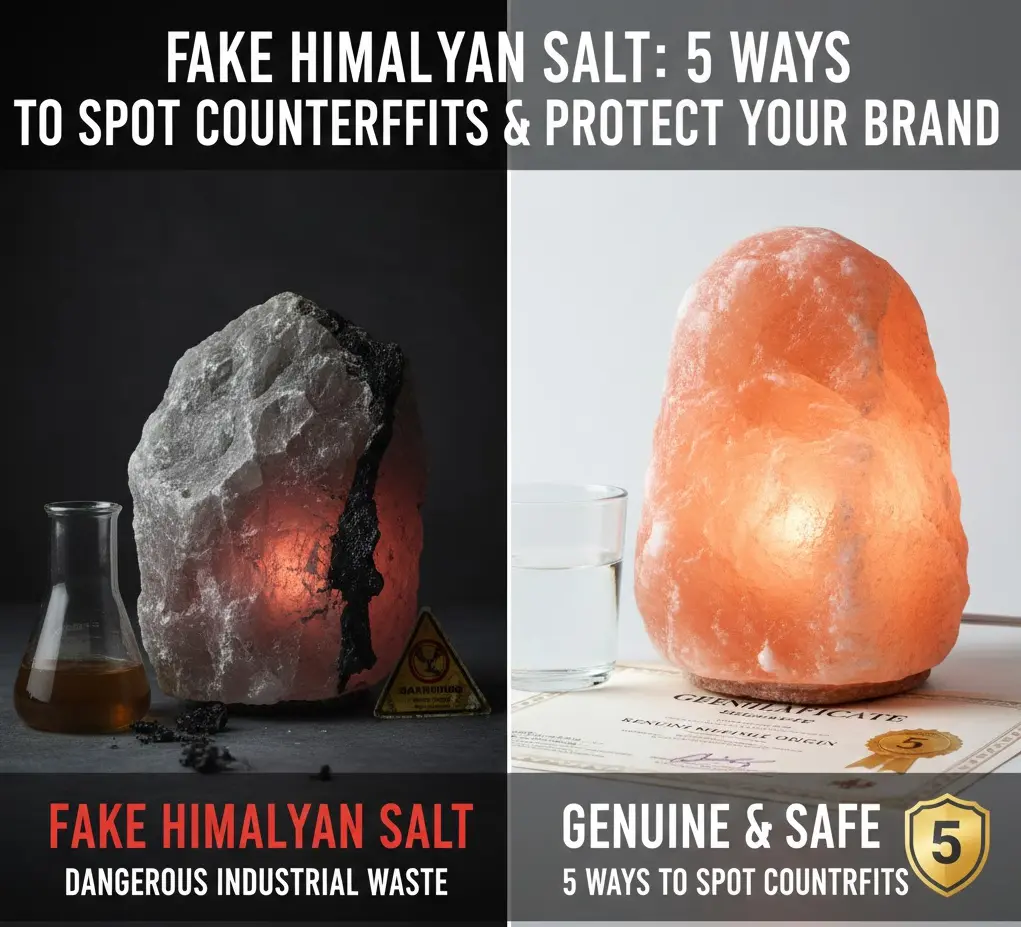
This article outlines five empirical diagnostic tests to verify product authenticity, ranging from analyzing **Hygroscopy (sweating)** to verifying light diffusion patterns. We examine the extraction protocols enforced by the **Pakistan Mineral Development Corporation (PMDC)**, detail the necessity of the **TDAP Certificate of Origin** for legal import, and define the specific **Sodium Chloride (NaCl)** purity thresholds required to separate high-value mineral salt from dangerous synthetic replicas.
The Rise of Counterfeit Salt
Counterfeits are mass-produced using industrial waste, gypsum, or plastic dyed pink. They lack the 84 minerals and ionic structure of genuine Khewra salt.
The Manufacturing of Imitations: Dyes and Synthetics
As Himalayan salt gained global popularity for its wellness benefits, a shadow market of counterfeits emerged to capture demand. Genuine salt is mined exclusively from the Khewra Salt Mine in Pakistan, exhibiting warm orange or pink hues due to natural mineral content. Imitators bypass this expensive extraction process by engineering lookalikes from cheap industrial byproducts.
- Industrial Waste: Manufacturers mix waste salt with pink dyes or paint specks to mimic natural mineral veins.
- Synthetic Substitution: Processed minerals like gypsum, clay, or even plastic replace ancient sea salt, resulting in a product that lacks a crystalline structure.
- Artificial Texture: Machines polish these fakes to a smooth, uniform finish, contrasting sharply with the rough, uneven texture of hand-mined crystals.
Health Risks: Mercury, Glass, and Chemical Adulterants
The primary issue with counterfeit salt is not just deception; it is consumer safety. Fakes originating from unregulated sources—often marketed without a certificate of authenticity—introduce dangerous contaminants into the supply chain. While real salt dissolves clearly with minimal sediment, counterfeits often fail basic physical and chemical tests.
- Heavy Metal Contamination: Unregulated imitations, particularly from non-Pakistani sources, may contain mercury or lead.
- Insoluble Debris: Dissolution tests frequently reveal glass particles, sand, or paint specks that create a cloudy residue.
- Chemical Composition: Fakes taste bitter or chemical and lack the hygroscopic (moisture-attracting) properties that define authentic Himalayan salt.
The “Khewra Mine” Origin Story
Authentic Himalayan salt comes exclusively from the Khewra Salt Mine, a massive 17-level Precambrian deposit that generic rock salt producers cannot replicate.
800 Million Years in the Making: The Precambrian Deposit
The geological pedigree of this salt is non-negotiable. It originates from the Precambrian Salt Range Formation, estimated at 800 million years old. Unlike surface-level sea salt harvesting, this deposit consists of seven distinct seams—including South Pharwala and Buggy—that strike North-East and dip between 10° to over 70° northward.
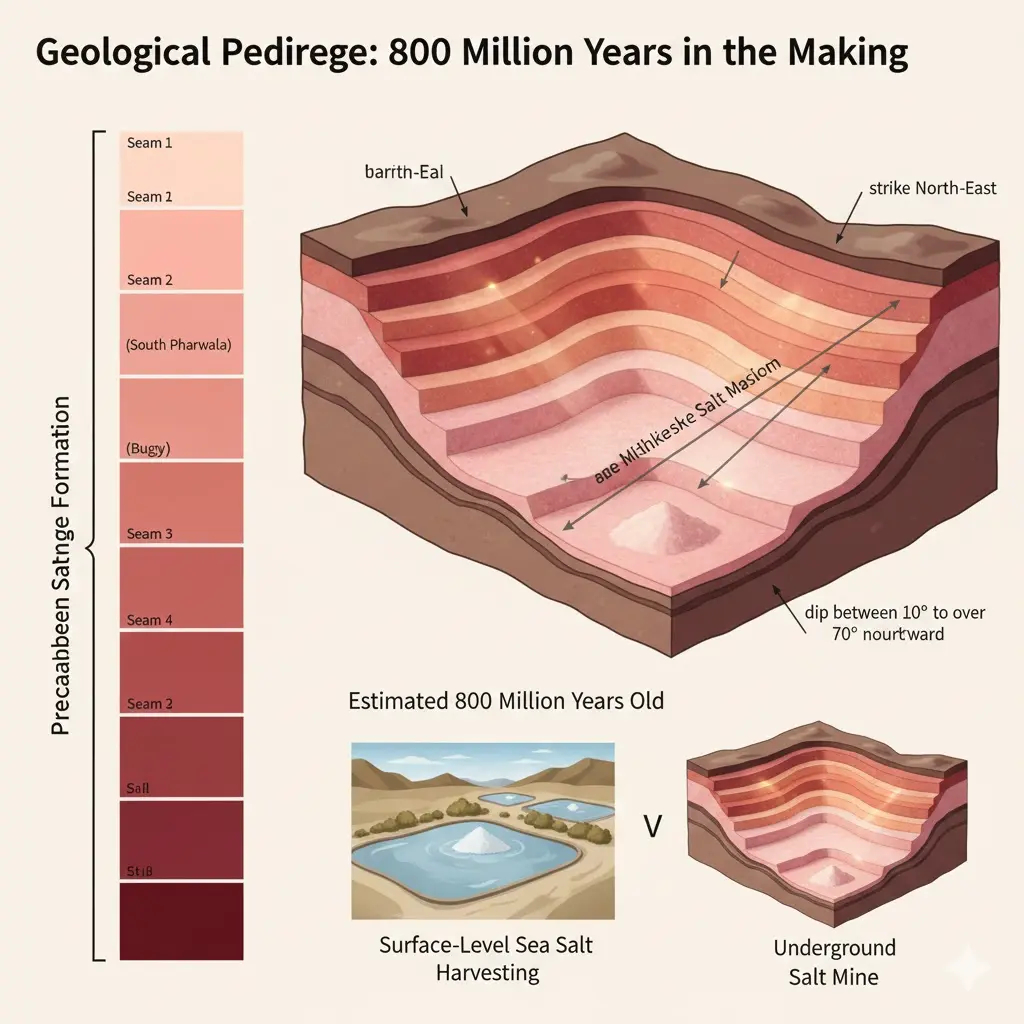
While locals mined these deposits manually for centuries, the British administration formalized operations in 1872. They implemented standardized extraction protocols that remain largely in place today, ensuring consistent output from specific geological strata rather than random surface scraping.
Engineering Authenticity: Scale and Extraction Methods
Genuine provenance is defined by industrial scale. The Pakistan Mineral Development Corporation (PMDC) manages the mine, producing approximately 400,000 tonnes of 99% pure salt annually. Counterfeiters cannot replicate the specific “Room and Pillar” engineering method used here to maintain structural integrity across such a vast deposit.
- Extraction Method: Strict 50% extraction ratio; half the salt remains as 35-50 foot wide pillars.
- Vertical Scale: 17 distinct levels, with each level height averaging 7.62 meters.
- Tunnel Network: Over 40 km of tunnels spanning an area of 144 sq km.
- Drilling Mechanics: Uses 50-58 mm diameter auger holes for precision gunpowder blasting.
This massive infrastructure is the primary physical validator of authentic Himalayan salt. Small-scale rock salt operations lack the geological access and engineering rigor to produce this specific mineral profile.
Test 1: Hygroscopy (Sweating)
Genuine Himalayan salt naturally absorbs atmospheric moisture. If your lamp stays bone-dry in a humid environment, it is likely a resin fake.
| Diagnostic Criteria | Authentic Himalayan Salt | Synthetic Replica (Fake) |
|---|---|---|
| Humidity Reaction | “Sweats” (forms visible condensation) | Remains completely dry |
| Moisture Content | 0.07% – 0.18% | 0% (Inert material) |
| Material Structure | Porous crystalline lattice | Sealed acrylic, resin, or glass |
The Science of Hygroscopy: Why Real Salt Sweats
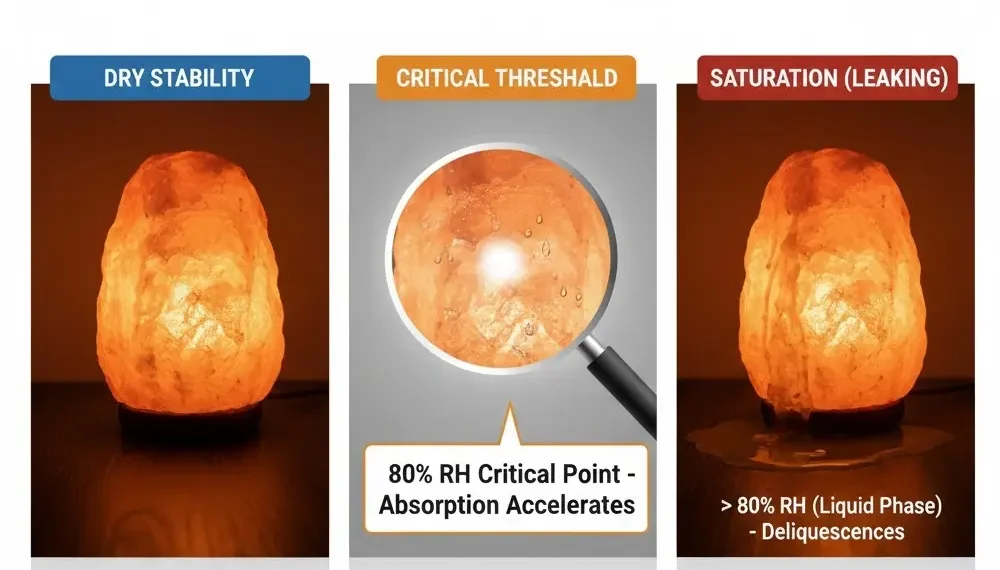
Hygroscopy defines the chemical ability of a substance to attract and hold water molecules from the surrounding environment. Authentic Himalayan salt acts as a natural dehumidifier due to its specific mineral matrix. The salt is composed of 97-99.5% Sodium Chloride (NaCl) with trace impurities like Calcium (0.065-0.15%) and Magnesium. These minerals chemically bond with water vapor in the air.
In practice, this reaction manifests as “sweating.” The lamp absorbs microscopic water droplets, which then condense on the surface. Synthetic fakes made from acrylic or resin are non-porous polymers. They lack the ionic structure required to interact with humidity, meaning they remain permanently dry regardless of the environment.
Execution: The Damp Cloth Verification Method
You can verify authenticity by intentionally exposing the unit to moisture. Real salt reacts; plastic does not. To perform this test, place the lamp in a high-humidity area (like a bathroom with the shower running) or near a damp cloth for a few hours. A genuine Khewra mine product will show distinct moisture accumulation on its surface.
- Visual Indicator: Look for water droplets or a damp, clammy texture on the surface.
- Technical Benchmark: Fine Himalayan salt typically retains 0.07-0.18% moisture content.
- Lab Validation: Use gravimetric analysis to measure weight changes. Authentic salt fluctuates in weight as it absorbs moisture; inert fakes maintain a static weight.
If the lamp remains dry in these conditions, you are looking at a counterfeit made of sealed artificial materials.
Source Authentic Himalayan Salt Lamps Direct from the Factory
Test 2: Brittleness
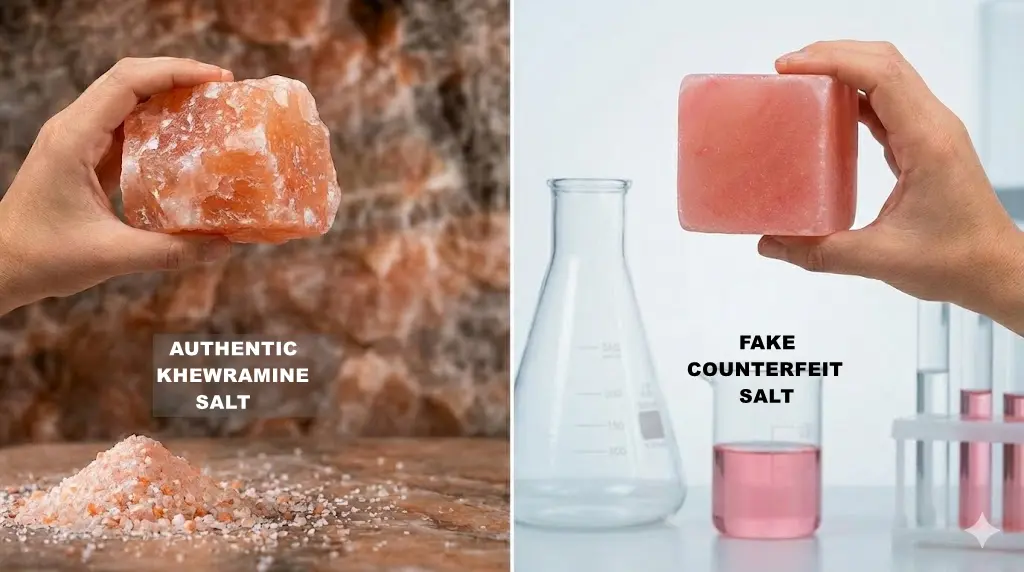
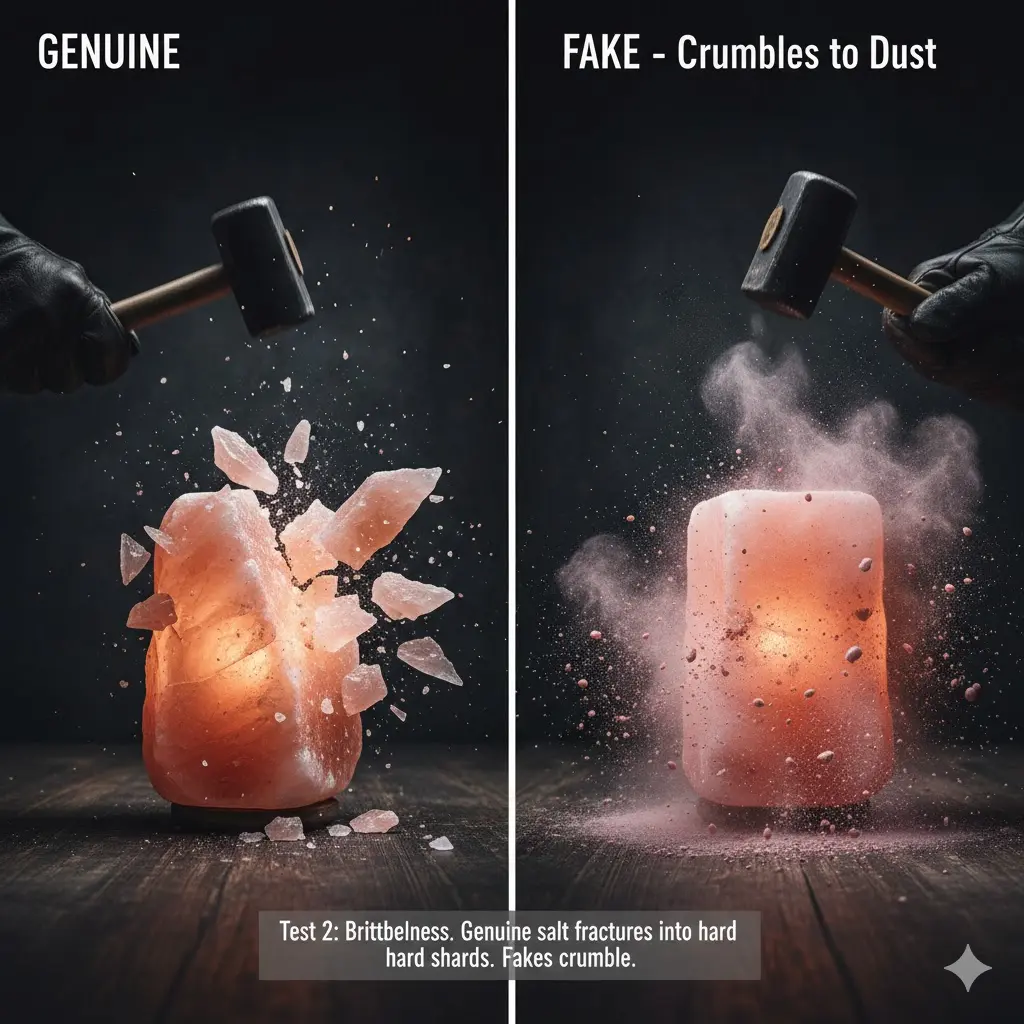
Authentic Himalayan salt (SG 2.16) fractures into irregular shards under stress. Fakes with excess moisture or binders crumble into soft powder or deform.
Analyzing Crystalline Fracture Patterns
Authentic Himalayan salt consists of 95-99.86% NaCl held together in a rigid ionic lattice with a specific gravity of 2.16. This structure creates a hard matrix that snaps into clean, irregular shards when subjected to impact. It does not flatten. Counterfeit blocks made from dyed rock or compressed table salt lack this internal lattice. When you strike these fakes, they often crumble into dust or deform like a damp sugar cube.
Moisture Metrics and Structural Integrity
Structural rigidity relies on low surface moisture. High-quality samples maintain levels between 0.03% and 0.3%. If moisture exceeds the 0.5% maximum limit, the salt cakes and loses its physical integrity. You must verify density and solubility metrics to ensure the material has not been engineered with synthetic fillers that alter natural brittleness:
- Bulk Density: 1000-1200 g/L (Indicates proper natural compaction).
- Water Insolubles: 0.0025-0.86% (Deviations suggest additives).
- Moisture Threshold: Max 0.5% (Higher levels cause structural softness).
Test 3: Light & Color
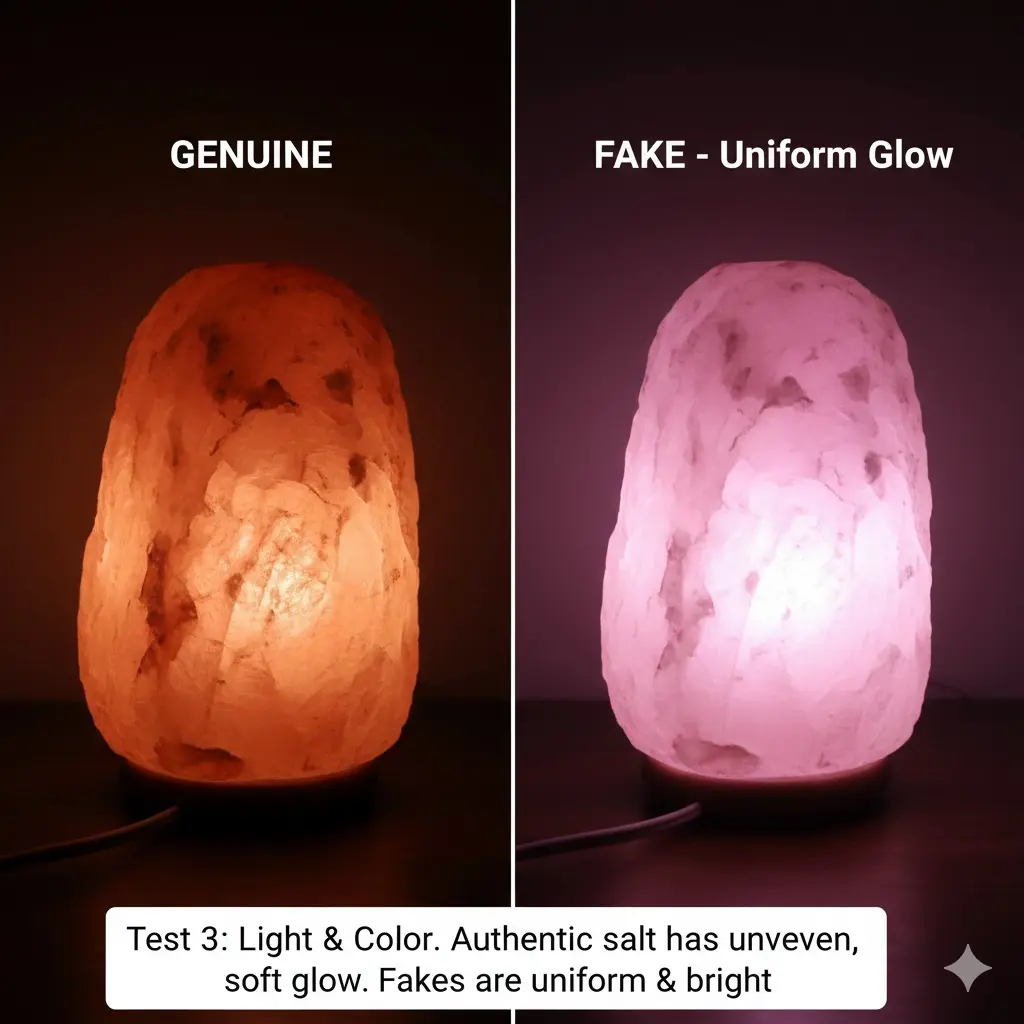
Authentic Himalayan salt diffuses light unevenly due to mineral density. Fakes often emit a uniform, bright glow through translucent plastic or glass.
The Mineral Spectrum: Iron Oxide and Natural Variation
Color in Himalayan salt is a direct visual indicator of mineral density, not just aesthetics. Iron (Fe) acts as the primary pigment, but specific concentration levels dictate the hue across the spectrum.
- Pink Salt: Contains an average of 64 mg/kg of Iron.
- Deep Red Salt: Indicates higher impurity levels, reaching up to 167.52 mg/kg of Iron.
- White Salt: The purest form found in upper mine layers, containing less than 16 ppm of Iron.
- Grey Salt: Signals the presence of sulfur, magnesium, or aluminum oxide alongside iron.
Authenticity relies on irregularity. A single natural block displays gradients of white, pink, and dark red. Counterfeits often use dye to achieve a uniform color that fails to replicate these geological streaks.
The Lamp Glow Test: Analyzing Light Transmission
You can detect fake salt by analyzing how the material transmits light. Genuine salt lamps are dense and opaque, blocking significant light output. This physical property creates a soft, muted glow in shades of pink, orange, or reddish-brown. Research shows that 78% of natural samples exhibit dark or medium color intensity, rather than consistent brightness.
Fakes lack this mineral density. Manufacturers often use translucent plastic or glass that allows too much light to pass through, resulting in a harsh, bright, or uniformly white illumination. Additionally, real crystals possess a rough texture that diffuses light unevenly, while fakes feature smooth, polished surfaces that transmit light with artificial uniformity.
Importance of “Certificate of Origin”
The Certificate of Origin is the only legal document proving Himalayan salt comes from Pakistan’s Khewra Mine, essential for customs clearance and avoiding counterfeit seizures.
| Compliance Requirement | Validation Document | Commercial Impact |
|---|---|---|
| Origin Verification | TDAP Certificate | Confirms sourcing from Khewra Salt Mine vs. generic rock salt. |
| Customs Entry | FDA / CE / CFIA Filings | Prevents shipment rejection at US, EU, and Canadian borders. |
| Safety Standards | ISO 9001 & 22000 | Links extraction batches to food safety and Halal protocols. |
Verifying Khewra Sourcing & Customs Compliance
The Certificate of Origin (COO), issued by the Trade Development Authority of Pakistan (TDAP), acts as the primary chain of custody document. It explicitly ties your shipment to the Khewra Salt Mine, distinguishing genuine Himalayan Pink Rock Salt from chemically treated generic salts or counterfeits relabeled from other regions. Customs brokers rely on this document to verify the “Geographical Indication” (GI Tag) status before clearing goods.
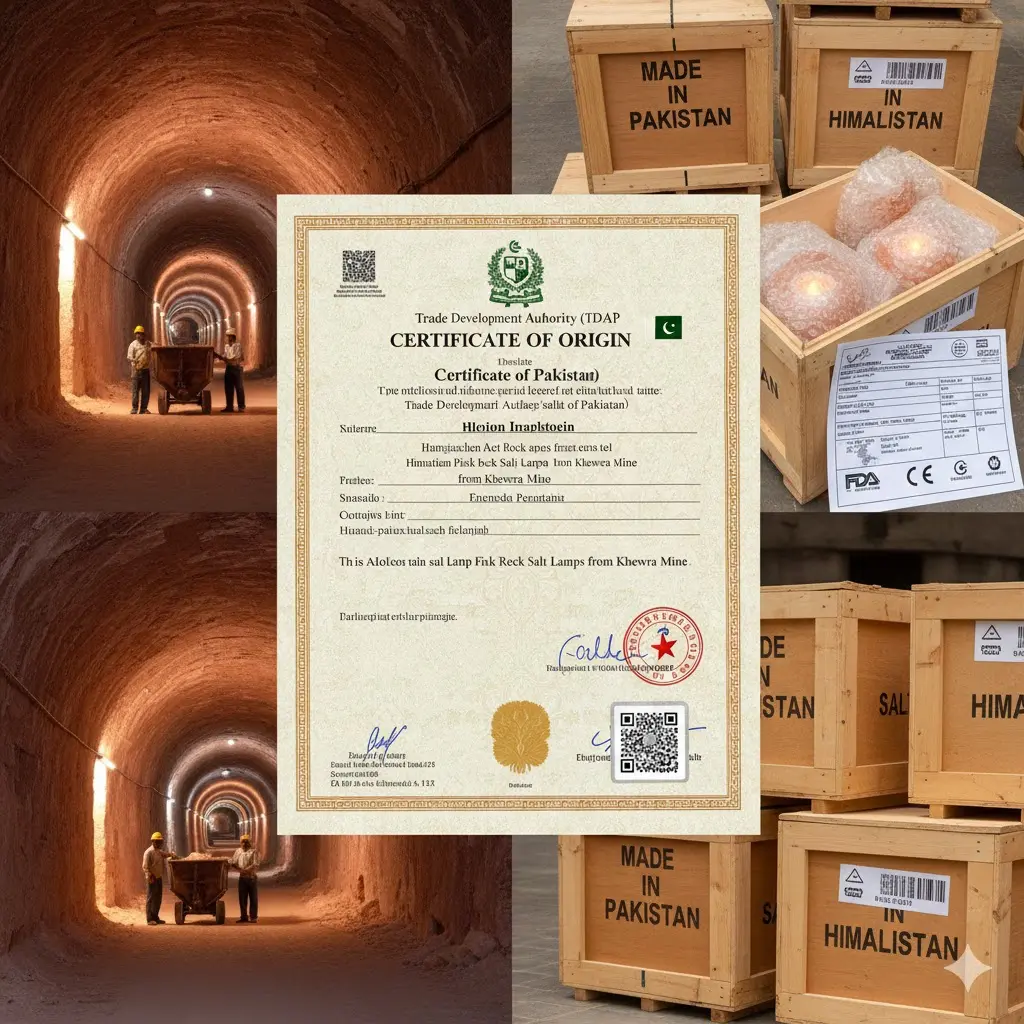
Without a valid COO, importers face immediate compliance blocks in regulated markets. It is mandatory for satisfying import requirements for the US FDA, European CE marking, and Canada CFIA. For buyers in the GCC, this document is also a prerequisite for obtaining Halal certification, proving the product contains no unauthorized additives or non-compliant processing agents.
Technical Traceability & Safety Metrics (ISO/HACCP)
This certificate supports technical validation by linking raw material extraction to specific quality metrics. It validates the claims made in your Certificate of Analysis (COA), confirming that the salt profile matches the unique mineral composition of Khewra deposits. Authentic sourcing ensures consistency in chemical specifications required for industrial and food-grade applications.
- NaCl Purity: Verifies a minimum content of 97-98%.
- Magnesium Sulfate: Confirms levels remain below 0.50%.
- Contaminant Control: Aligns with SGS lab reports to prove absence of heavy metals like lead and mercury.
- Audit Readiness: Essential for passing SMETA/SEDEX ethical audits or BRC Grade A verification.
Why “Too Cheap” is a Red Flag
Significantly lower prices often signal “economic adulteration,” where vendors blend generic table salt with dyes or clay to mimic Himalayan hues, failing food-grade purity standards.
Hidden Costs: Adulteration and Artificial Dyes
Bargain salt is rarely a “deal.” It is usually the result of economic adulteration. To slash raw material costs, suppliers blend generic white table salt with undisclosed fillers. Since this dilutes the natural mineral profile—specifically Calcium (0.0058-0.15%) and Magnesium (0.03-0.07%)—unscrupulous producers apply artificial dyes to fake the characteristic pink hue.
These imitation products are frequently finely milled to disguise poor crystal structure. Authentic, unprocessed crystals maintain a bulk density of 62.4-75 lbs/cu ft. If the salt is too cheap, you are likely paying for dyed table salt with compromised physical integrity.
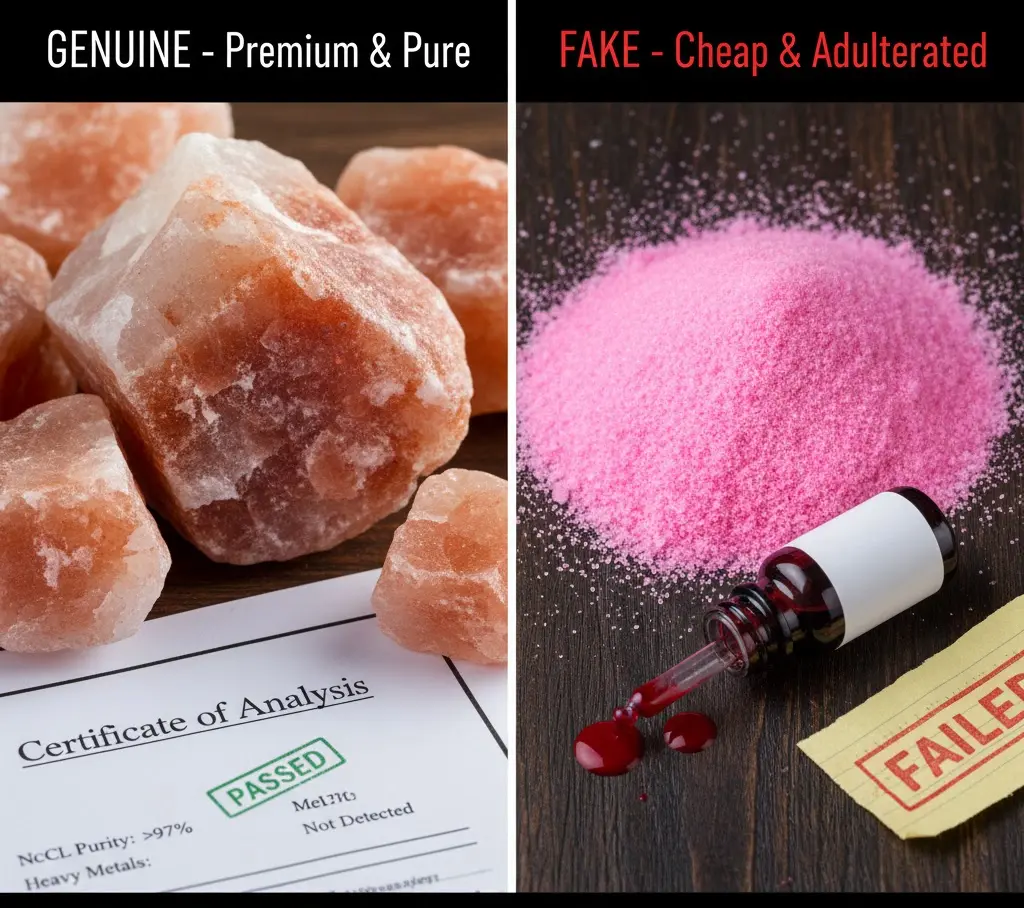
Non-Compliant Chemical Profiles and Safety Risks
Genuine food-grade specifications are tight. Authentic Himalayan salt must maintain Sodium Chloride (NaCl) purity between 97% and 99.86%. “Discount” options consistently fail these chemical thresholds and pose genuine safety risks by ignoring critical processing standards.
- NaCl Purity: Bargain salt frequently tests below the mandatory 97% minimum.
- Contaminants: Cheap processing results in water insolubles exceeding the safe 0.8% limit.
- Moisture Control: Substandard batches often exceed 0.5% moisture content.
- Compliance Failures: These products rarely meet testing methods like ASTM E 534-98 or AWWA B200-03, risking GMP and HACCP violations.
Final Thoughts
Cheap sourcing is a liability trap, not a margin booster. You cannot build a salt lamp premium wellness brand on industrial waste and pink dye.
Demand the TDAP Certificate of Origin before signing any purchase order. Validate the product physically by dissolving a sample; if the water turns pink, reject the shipment.
Experience the quality firsthand with our low-threshold trial order – a risk-free way to test these high-margin products in your market. Get in touch to start your trial order today!
Frequently Asked Questions
How can I verify if my Himalayan salt is real?
Genuine Himalayan salt comes strictly from the Khewra Salt Mine in Pakistan. Look for irregular textures and uneven hues ranging from light pink to deep red—uniform color is a manufacturing red flag. Physically, it must be hygroscopic (sweat in humidity) and dissolve in water without leaving pink dye residue. For bulk sourcing, demand lab reports confirming Sodium Chloride (NaCl) ≥98.5%.
Does authentic Himalayan pink salt taste bitter?
No. Authentic Himalayan salt provides a clean salinity similar to standard table salt, typically containing 97.7-99.5% Sodium Chloride. A bitter aftertaste signals high levels of impurities like calcium sulfate or clay, often found in non-food-grade extractions.
Why is my Himalayan salt white instead of pink?
White crystals are authentic. They originate from the upper layers of the mine where iron oxide content is minimal (<16 ppm) compared to the ~167 ppm found in pink varieties. This high-purity salt offers a neutral flavor profile, making it ideal for culinary applications where color bleed is unwanted.
Are cheap Himalayan salt lamps always fake?
Not always. Price tracks with weight; genuine “micro” lamps (2-5 lbs) often retail between $10 and $20. However, be skeptical of large (10+ lbs) lamps selling at rock-bottom prices. Authentic lamps must be dense, heavy for their size, and possess rough surfaces that naturally absorb moisture from the air.
Is Himalayan pink salt dyed to get its color?
No. The pink color comes naturally from trace minerals, specifically iron oxide. To verify, dissolve a sample in water. Genuine salt dissolves while keeping the water relatively clear. If the water turns pink, you are dealing with a chemically dyed fake.
What is the Certificate of Origin and why do I need it?
This document, issued by the Trade Development Authority of Pakistan (TDAP), proves the salt was mined at the Khewra Salt Mine. Verified suppliers must provide this with every shipment to validate the source and ensure the product isn’t generic rock salt re-labeled in a third-party country.