Skip to content
Mastering import himalayan salt compliance is the most critical step for volume buyers looking to avoid costly customs delays. Whether you are a first-time B2B buyer sourcing decorative salt lamps or a seasoned retail distributor adding cooking blocks to your catalogue, navigating international trade requires strict attention to overlapping rules that differ sharply between the EU and the US. A single misclassified HS code or a missing CE test certificate can hold a container at customs for weeks, eroding margins and straining your supply chain. In this guide, we break down the specific regional requirements, OEM documentation, and practical steps needed to clear your bulk salt products across borders without surprises.
EU Market Requirements for Himalayan Salt Products
The European Union regulates salt imports through several intersecting frameworks. The applicable rules depend entirely on how the product will be presented to the end consumer.
REACH Compliance. The EU’s Registration, Evaluation, Authorisation and Restriction of Chemicals (REACH) regulation applies to any chemical substance imported into the EU. While raw Himalayan rock salt is a naturally occurring substance and generally exempt, any artificial treatment, coating, or additive applied during processing triggers full registration obligations. Importers must confirm with their factory whether any chemical agents are used in polishing. The European Chemicals Agency maintains a publicly accessible database of registered substances for reference.
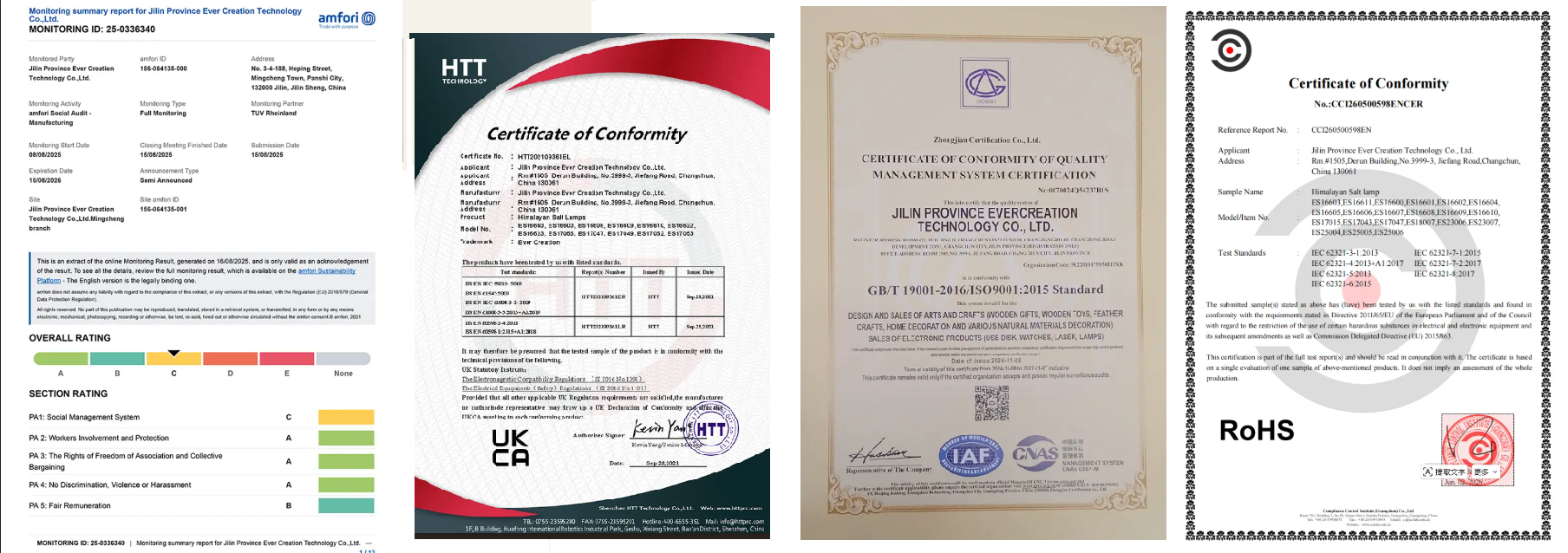
CE Marking for Electrical Salt Lamps. Any Himalayan salt lamp sold in the EU that includes an electrical cord and bulb holder MUST carry CE marking. This is non-negotiable. The CE mark signals compliance with the Low Voltage Directive (2014/35/EU) and the EMC Directive (2014/30/EU). At Ever Creation, all salt lamp cords and switches carry verifiable CE certification, with each batch tested before container loading. Note: The salt stone itself falls outside the scope of CE marking, but the electrical assembly strictly requires it.
Food Contact Regulation (EC) No 1935/2004. Himalayan salt cooking blocks, grilling slabs, and serving plates that come into direct contact with food must comply with the EU’s framework regulation for food contact materials. Importers should request documentation confirming the absence of heavy metal contamination and ensuring no surface treatments compromise food safety.

EN71 Toy Safety. If a decorative salt product is shaped like an animal or cartoon character that could reasonably be confused with a toy by children, EN71 testing (mechanical, flammability, and heavy metal migration) may be required.
US Market Requirements for Himalayan Salt Products
The United States splits oversight of salt products across multiple agencies, each demanding specific documentation for customs clearance.
FDA Oversight for Food-Grade Salt. Himalayan salt intended for human consumption or food preparation (cooking blocks) falls under US FDA jurisdiction. Foreign facilities manufacturing or holding food for export to the US must register with the FDA under the Bioterrorism Act. The importer must verify the supplier’s active FDA registration and file a Prior Notice for each shipment. For details, check the FDA’s import guidance page.
CPSC for Decorative Salt Products. Decorative non-food salt items are regulated by the Consumer Product Safety Commission (CPSC). They must meet general product safety requirements, including proper warning labeling and the absence of hazardous substances.
UL Listing for Electrical Components. Electrical salt lamps sold in the US market face strict liability standards and should carry a UL listing (or equivalent NRTL certification). UL listing confirms that the cord set and bulb holder meet US fire and electrical safety standards. Major US retailers will reject electrical decorative products without this certification. Ever Creation can arrange fully UL-listed components for all US-bound shipments.
For a deeper look at how intended use drives regulatory classification, our guide on food-grade vs decorative Himalayan salt breaks down the practical differences buyers need to know.
Import Himalayan Salt Compliance: Required Documentation
Every B2B shipment requires a flawless core set of documents. Missing paperwork is the primary cause of expensive port storage fees.
- Commercial Invoice: Must include accurate descriptions, unit values, Incoterms (Ever Creation supports EXW, FOB, CIF, and DDP), and buyer/seller details. Under-declaring value is a severe customs risk.
- Packing List: Itemised by SKU, net/gross weight, dimensions, and carton count. For mixed containers, each product type must be distinct.
- Certificate of Origin (C/O): Required to determine applicable import tariffs. Authentic Himalayan salt originates from the Khewra mine in Pakistan; the C/O should reflect this.
- Material Safety Data Sheet (MSDS/SDS): While natural salt is non-hazardous, some shipping lines demand an SDS for bulk mineral products before loading.
- Test Reports and Certificates: CE/UL reports for cords, BSCI audit summaries, and FDA registration numbers should be readily available for customs inspection.
HS Codes and Customs Classification
Correct customs classification dictates your duty rate. Misclassification triggers heavy audits and financial penalties.
HS 9405.4990 — Salt Lamps (Electrical). Salt lamps with electrical cords are classified as lighting fixtures under heading 9405. You can verify current tariff rates using the US HTS database or the EU’s TARIC system.
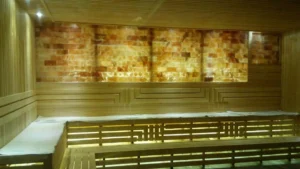
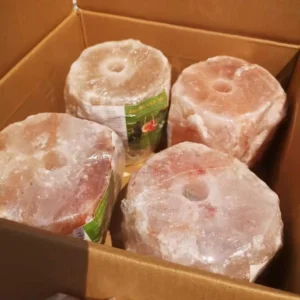
HS 2501.0019 / 2501.0020 — Salt Bricks and Blocks. Non-electrical products like cooking blocks, sauna bricks, and animal licks fall under heading 2501. These typically attract lower duty rates than electrical fixtures.
Pro Tip: Never declare assembled electrical salt lamps under heading 2501 to illegally claim a lower duty rate. Customs X-ray scanners will flag the electrical components immediately.
Moisture Control Export Packaging
Himalayan salt is highly hygroscopic (it pulls moisture from the air). Without strict moisture management, your cargo will “weep” during transit, leading to ruined master cartons and rejected inventory.
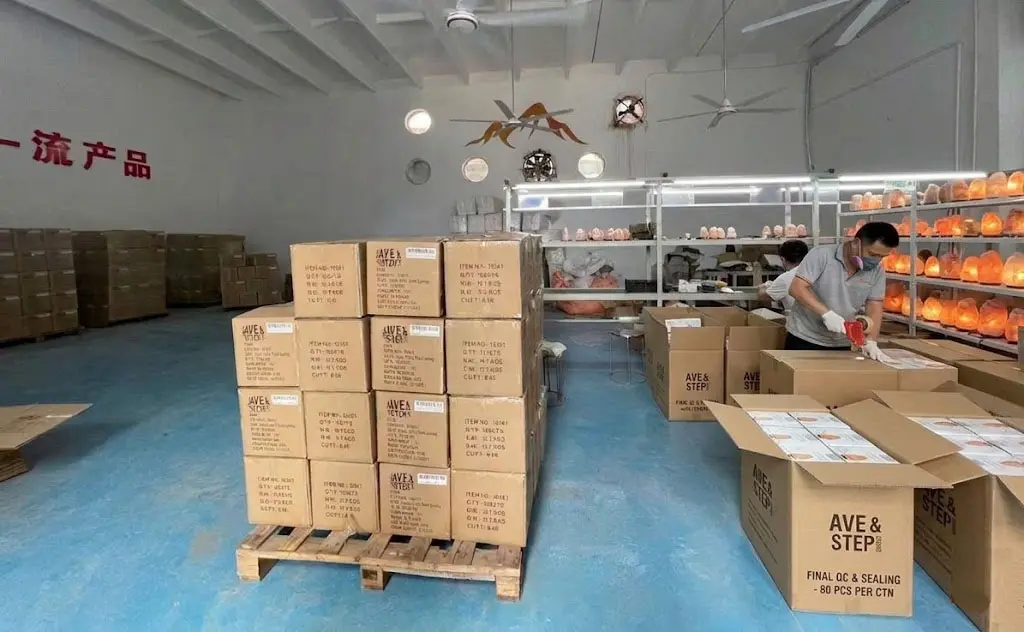
At Ever Creation, salt products are kiln-dried before packing. Each piece receives professional POF shrink-wrap protection, creating a sealed barrier against ocean humidity. These units are placed in protective inner boxes and packed into heavy-duty 5-ply reinforced corrugated master cartons designed for international pallet stacking.

For oversized lamps weighing 150 kg or more, we utilize custom-built, fumigated wooden crates. For importers in tropical climates, we add commercial desiccant packs inside the master cartons. More details are available in our bulk salt container shipping guide.
Quality Testing and Factory Certifications
Compliance is a shared responsibility. You must partner with a supplier that maintains institutional quality control:
- BSCI Audit: Verifies fair labor practices and safe working conditions. Ever Creation holds a current BSCI report, satisfying the strict sourcing mandates of major European retailers.
- ISO 9001: The baseline for any serious B2B manufacturer, ensuring standardized production and inspection protocols.
- CE, RoHS & UKCA: Mandatory for European and British markets. We provide certified cords verifying the absence of hazardous heavy metals (RoHS).
Partner with a Fully Compliant Supplier
Jilin Province Ever Creation Technology Co., Ltd. has been manufacturing and exporting Himalayan salt and wood products since 2004. With over two decades of factory-direct export experience, compliance documentation, ISTA-standard packaging, and rigorous testing protocols are built directly into our workflow.
We supply major retail chains, including Landi Switzerland, and offer DDP (Delivered Duty Paid) shipping directly to warehouses across the US, Europe, and Australia—including Amazon FBA fulfillment centers.
For brands looking to scale, our private-label OEM program allows you to customize retail packaging while maintaining absolute compliance. Trial orders begin at 100 pieces, with aggressive bulk pricing unlocking at 300 units.

Source Fully Compliant Himalayan Salt Today
CE/UL-certified lamps, FDA-registered food blocks, and complete export documentation. Talk to our factory compliance team to secure your DDP trial order.
Get a Wholesale Quote →Frequently Asked Questions (B2B Customs)
Do I need CE marking to import Himalayan salt lamps into Europe?
Yes. Any Himalayan salt lamp with electrical components (cord, switch, bulb holder) sold in the EU must carry CE marking, confirming compliance with the Low Voltage Directive and EMC Directive.
What HS code should I use for Himalayan salt lamps?
Himalayan salt lamps with electrical components are classified under HS 9405.4990 as electric lamps and lighting fittings. Non-electrical salt products such as cooking blocks, salt bricks, and animal licks fall under HS 2501.0019 or HS 2501.0020.
Is Himalayan salt regulated by the FDA in the United States?
Himalayan salt intended for food use (cooking blocks, edible salt, food preparation surfaces) falls under FDA jurisdiction. Foreign manufacturing facilities must be registered with the FDA, and prior notice must be filed for each food shipment.
What documents do I need to clear Himalayan salt through customs?
The core documentation includes a commercial invoice with accurate product descriptions and Incoterms, a detailed packing list, a certificate of origin, and relevant test reports (CE, RoHS, EN71, or FDA registration depending on the product’s intended use).
How do I prevent moisture damage during international salt shipments?
Himalayan salt is hygroscopic. Proper factory packaging is essential: kiln-dried products wrapped in individual moisture-proof POF shrink wrap, placed in inner boxes, then packed into 5-ply reinforced corrugated master cartons with desiccants.