Skip to content

Pen wood species is the specification line most buyers get wrong, because it is chosen for appearance and blamed for feel. A barrel that photographs beautifully can be too light to sit still on a page, too slick to hold without gripping hard, or too soft to survive a pocket. Comfort is not a property of the wood alone — it results from species, wall thickness, finish, diameter and mechanism working together.
This guide is for wholesalers, gift brands and private-label buyers specifying a wooden pen range: what determines writing comfort, what each of the four species we produce contributes to it, and where the mechanism and refill matter more than the wood. Gift-set positioning and packaging are covered in our guide to wooden pen gift sets; this one is about the instrument itself.
Key Takeaways
- Comfort is five variables, not one: weight and balance, barrel diameter, surface grip, thermal feel and mechanism. Species influences all five but decides none alone.
- Weight is a design choice, not a quality marker. A light barrel suits long sessions; a heavier one suits short signatures and reads as substantial in a gift box.
- Grip comes from the finish more than the grain. A high-gloss film is slick when a hand is warm; satin or oil holds. Specify the sheen, not just the colour.
- Wood feels warmer than metal or resin at the same temperature, which is a real part of why people prefer holding it — a property of the material, not of the marketing.
- The refill is the comfort nobody sees. A pen that writes badly is judged on its wood, and a pen that cannot be refilled is thrown away no matter how good the barrel is.
- Only the basswood hardness figure is quoted, because it is our own published first-party data. Hardness for other species varies by source and moisture and should be requested as batch data.
In This Guide
- What Actually Determines Writing Comfort
- The Four Species We Produce
- Pen Wood Species Compared
- Finish, Grip and Diameter
- Mechanism and Refill: The Comfort Nobody Sees
- Best For / Not For: Species by Pen Application
- What We Check on a Wooden Pen Order
- End to End: Specifying a Two-Pen Range
- Frequently Asked Questions
What Actually Determines Writing Comfort
Five variables decide whether a pen is comfortable; a buyer specifying only the species is specifying one of them.
- Weight and balance. Total mass matters less than where it sits. A pen balanced slightly behind the grip rests in the hand without being held up; one weighted at the rear tires the fingers. Wall thickness and any metal insert decide this, independent of species.
- Barrel diameter. Too thin and the hand closes hard to control it; too thick and it cannot be held without tension. Most adults sit in a narrow band, so a range offering one diameter excludes part of its own market.
- Surface grip. Set by the finish rather than the grain: a high-gloss film is slick, particularly once a hand is warm, while satin, matte or oil holds. The cheapest comfort improvement available, and the most often left unspecified.
- Thermal feel. Wood reaches hand temperature quickly and stays there, where metal stays cold and resin sits between — a large part of why people describe a wooden pen as pleasant to hold without being able to say why.
- Mechanism and refill. Line consistency, start-up reliability, and behaviour as the refill runs low. None of it is visible on a specification sheet, and all of it is what the customer experiences.

The Four Species We Produce
We produce in four species, each contributing something different to a pen. Only one hardness figure is quoted, because only one is our own published data.
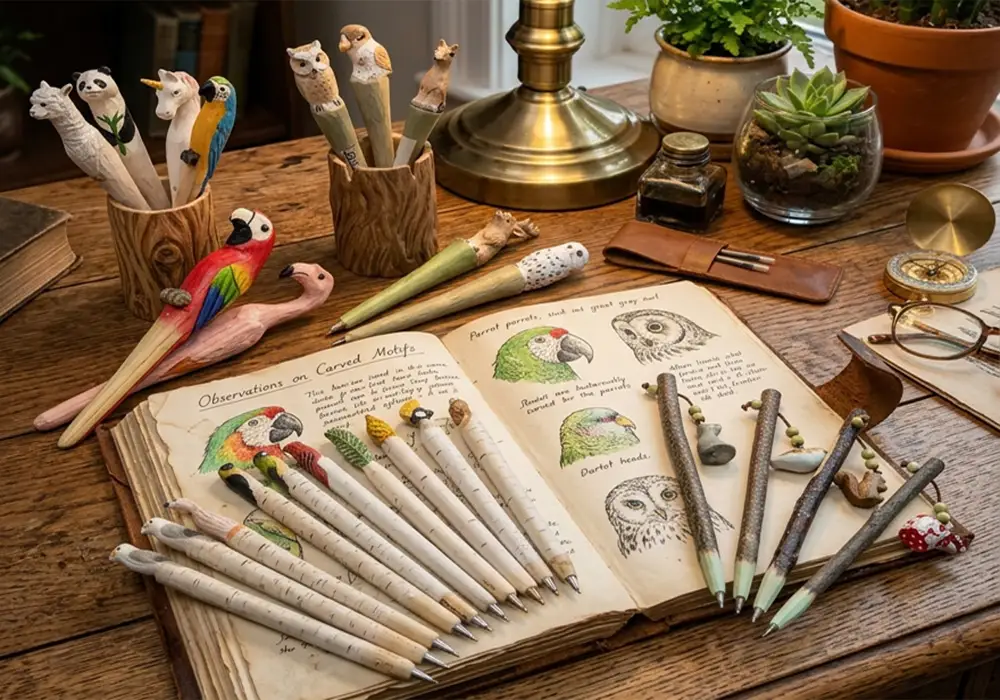
- Basswood. Pale, fine-grained and soft enough to carve detail into — our published figure is around 410 lbf on the Janka scale. That means clean engraving and an even base for paint or stain, but a thin wall dents under a knock, so barrels are built slightly thicker.
- Pine. Coarser, warmer and visibly figured, so it reads as rustic and suits a gift pen where the grain is the decoration. Resin content and figure variation make it less predictable under a light stain than basswood.
- Rubber wood. Dense, plain and stable, with a tight surface taking a smooth finish well — a barrel that resists handling marks and holds a printed or engraved mark cleanly, which suits a corporate run where every piece must look like every other.
- Birch. Pale, fine and moderately dense with a slightly silky surface, sitting between basswood and rubber wood — a good default where a buyer wants one species across a whole range.
A note on the wider market. Pens are also made in harder, more figured timbers we do not produce, and in softer open-grained alternatives such as poplar where cost is the priority. No hardness or density figure is given for any species other than our basswood, because published values vary by source, growth conditions and moisture content — ask any supplier for batch data on the material actually quoted rather than comparing a textbook number across two quotation sheets. Species selection for other families is in our guide to the best wood for coasters, and non-wood alternatives in our article on coaster materials.
Pen Wood Species Compared
| Species | Character | Contribution to comfort | Best used for |
|---|---|---|---|
| Basswood | Pale, fine-grained, carves cleanly; around 410 lbf Janka | Light, so walls are built thicker, which adds balance weight | Carved and engraved barrels, detailed subjects |
| Pine | Coarse, warm, visibly figured | Light and warm to hold; grain texture adds grip | Rustic gift pens where grain is the decoration |
| Rubber wood | Dense, plain, stable, smooth surface | Substantial without being heavy; resists handling marks | Corporate runs needing piece-to-piece uniformity |
| Birch | Pale, fine, moderately dense, slightly silky | Balanced weight; smooth but not slick under a satin finish | A single-species default across a whole range |
Finish, Grip and Diameter
The finish does more for comfort than the species does, and is the line most often left out of a specification. Three options cover almost every wooden pen. A film finish gives the most protection and shine and is the slickest to hold, suiting a pen displayed more than written with. A satin or matte film keeps the protection and drops the slickness — usually the right answer for a pen that will be used. An oil or wax finish is warmest and grippiest but needs re-treating, making it poor for a corporate run and good for a gift piece that will be cared for.
Diameter deserves its own line in the specification rather than being left to the sample. A range sold to the public should offer at least two, because hand size varies more than most catalogues allow for and one slim barrel excludes a substantial share of buyers. Where a pen is sold as a gift rather than a tool, the diameter that photographs well and the one that writes well all afternoon are not the same. Finish and marking options are in our guide to wooden pencil and desk set assortments.
Mechanism and Refill: The Comfort Nobody Sees
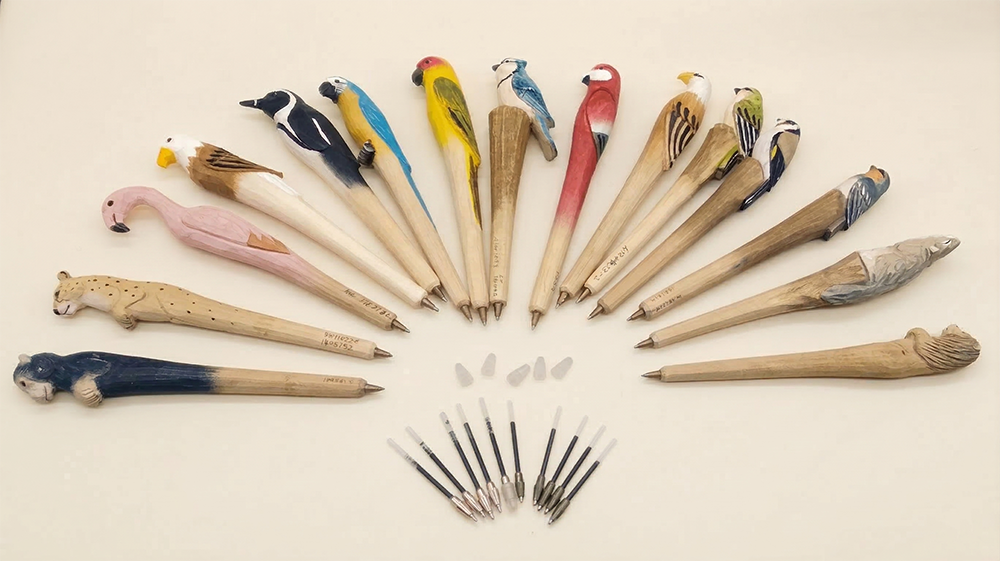
A wooden barrel is what a customer buys; the mechanism is what they experience. Two decisions matter more than any species choice. The first is the refill standard: a pen taking a widely available cartridge can be kept for years, while one taking an obsolete proprietary refill becomes waste no matter how good the barrel is. Refill compatibility belongs in the specification and on the packaging, because it is the question a customer asks after purchase and the one that generates complaints.
The second is mechanism type. A twist action is smooth with no click to wear; a click action is faster one-handed but has a spring that eventually fails; a cap protects a fountain nib and adds a step most users accept for the writing quality it buys. None is objectively right — desk, pocket and gift fountain pens are three different products. Our published HS codes include 9608.1000 for ball point pens. Range and mechanism options are in our wood carving pen guide, and the sustainability story behind a wooden barrel in our article on sustainable wooden pens.

Best For / Not For: Species by Pen Application
| Application | Strong fit | Poor fit |
|---|---|---|
| Carved or engraved gift pen | Basswood, thicker wall, satin finish | A thin wall in a soft species, which dents in a pocket |
| Corporate run, uniform look | Rubber wood or birch — plain, stable, printed or laser-marked | Pine, where figure variation makes pieces look inconsistent |
| Rustic or heritage gift line | Pine, figure left visible under an oil or matte finish | A high-gloss film, hiding the grain the line is selling |
| Everyday desk pen | Birch or rubber wood, satin finish, standard refill, twist action | An oil finish needing periodic re-treatment in shared use |
| Fountain pen gift | A denser species, with balance set behind the grip | Rear-weighting that tires a long writing session |
What We Check on a Wooden Pen Order
- Species matched to the intended use — basswood where carved detail carries the design, rubber wood or birch where uniformity and handling resistance matter, pine where figure is the point.
- Wall thickness and balance agreed against a retained sample, so weight sits behind the grip section rather than at the rear of the barrel.
- Finish system and sheen stated in writing, tested for grip after handling rather than judged on a fresh piece only.
- Mechanism and refill specified by standard, with compatibility printed on the packaging so the question is answered before the customer asks.
- Marking proofed on the actual material — engraving depth in the species used, print adhesion, legibility at the smallest type in the artwork.
- Packing and documentation confirmed — export packing to our standard: white paper wrap, 6 to 12 per three-ply inner box at 21 × 11 × 14 cm, 240 to 480 per five-ply master carton at 58 × 44 × 31 cm, 8.0 to 15.0 kg gross, rated to ISTA 3A; EN71 coating routes where a child may handle the article, on top of our ISO 9001 and BSCI standing; and photographs and video of finished goods before the 70% balance falls due.
End to End: Specifying a Two-Pen Range
A gift brand wants two pens — a carved gift piece and a plain desk pen — sold singly and as a boxed set.
Specify by job, not by species. The gift pen is defined by what it carries — a carved subject and an engraved name, so a detail-holding species with a thicker wall and a satin finish. The desk pen is defined by use: uniform appearance across a run, resistance to handling marks, a standard refill, a twist action. Two jobs produce two specifications, and one species for both is how a range compromises on both.
Sample against the specification. A trial of 100 pieces at a USD 500 minimum order value, air express DDP in 20–30 days, covers both pens and the boxed set. The samples are written with, not looked at — a pen is judged over an afternoon of use, and balance and grip show up only then. Sample options are in our wholesale sample kit guide.
Freeze and scale. Species, wall thickness, balance point, finish and sheen, mechanism and refill standard, marking method and set packaging are written down against the retained sample. The reorder moves to 300 pieces at a USD 3,000 minimum order value, sea freight, 60–90 days to port, with custom boxes at the 500-piece minimum and payment T/T at 30% deposit and 70% before shipment. Cost drivers are in our guide to custom logo products, MOQ and cost factors, and the wider range in our wholesale wooden crafts and custom product manufacturing guides.
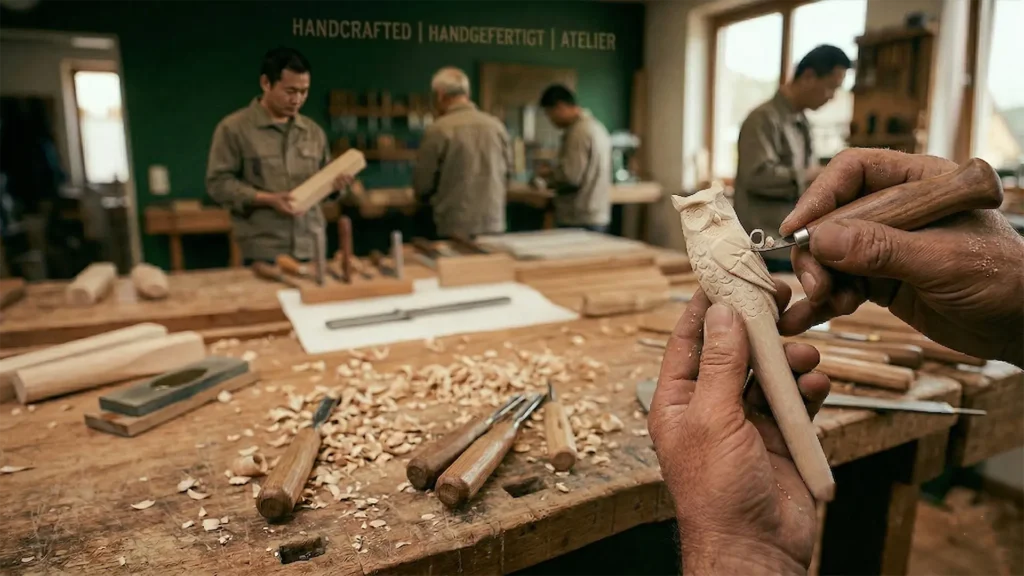
If you are specifying a wooden pen range and want species, wall thickness, balance, finish sheen and refill standard settled against how the pen will actually be used — with samples and carton quantities worked out — send us your brief and we will build the specification with you.
Frequently Asked Questions
Q: What is the best wood species for a pen?
It depends on what the pen has to do. Basswood holds carved detail and engraves cleanly, suiting a gift pen; rubber wood and birch are denser and more resistant to handling marks, suiting a corporate run or everyday desk pen; pine carries visible figure and suits a rustic line. We produce in all four.
Q: Does the wood species affect writing comfort more than the mechanism?
No. Comfort is weight and balance, barrel diameter, surface grip, thermal feel and mechanism. Species influences all of them but decides none alone — a well-chosen species with a rear-weighted barrel and a slick gloss finish feels worse than an ordinary species specified correctly. The refill standard matters most, since it decides whether the pen is kept.
Q: Which finish gives the best grip?
An oil or wax finish is grippiest and warmest but needs re-treating, which makes it unsuitable for a corporate run. A satin or matte film keeps most of the protection with far less slickness than a gloss and is usually right for a pen that will be used. Specify the sheen explicitly rather than leaving it to the sample.
Q: Why does a wooden pen feel nicer to hold than a metal one?
Thermal conductivity. Wood reaches hand temperature quickly and stays there, while metal draws heat away and stays cold and resin sits between. It is a measurable property of the material, not a marketing claim, most noticeable in a cold room or the first minutes of use.
Q: What is the minimum order for a custom pen range?
A trial order runs at 100 pieces with a USD 500 minimum order value on in-stock designs, air express DDP in 20–30 days, splittable across two designs and a boxed set. Wholesale and custom run at 300 pieces with a USD 3,000 minimum order value, sea freight, 60–90 days to port; custom printed boxes require 500 pieces.
Sources
Forest provenance frameworks for the species used in wooden products are described by FSC for businesses and the FAO forestry division. Our species list, basswood hardness figure, hand-carved and hand-painted construction, HS code for ball point pens, carton specification and ISTA 3A rating, minimums, order values, lead times and payment terms are our published first-party terms. No hardness, density or weight figure is quoted for pine, rubber wood, birch or any species we do not produce, and no ergonomic study result, user-preference percentage or comfort rating appears here: published hardness values vary by source, growth conditions and moisture content, so any figure must be requested as batch data from the supplier quoting the material. Comfort is treated as a set of specification variables to be tested on samples, not a property to be claimed.