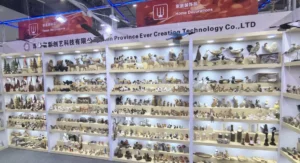
Skip to content

A wholesale catalog is not a brochure with prices attached. It is the interface a buyer uses to decide without speaking to you, and most wooden desk accessories catalogs fail the same way: they list items instead of describing a range, and omit the two things a professional buyer needs first — carton data and minimums.
This guide is for wholesalers, distributors and brands assembling a catalog of wooden desk accessories: how to structure it into families rather than a flat SKU list, what a specification line must carry, and how minimums and tiering decide whether the catalog gets ordered from or merely looked at. The retail-side equivalent — how a gift shop ranges these on a fixture — is in our guide to wooden pencil and desk set assortments.

Key Takeaways
- Structure by family, not by item. Writing instruments, small carved desk objects and tabletop pieces are three different buying conversations; a flat list forces a buyer to have all three at once.
- Carton quantity, dimensions and gross weight are what a professional buyer looks for first, because they decide freight and stockroom before price does.
- Every line needs a stated minimum. A catalog without them generates enquiries that cannot be fulfilled and wastes both sides’ time.
- Build from confirmed capability. A line you cannot produce at the stated specification is a claim, and the first order exposes it.
- Show the process, not only the product. In a hand-carved category, evidence of manufacture separates a catalog from a reseller’s price list.
- Version and date it. An undated sheet with a stale lead time is how a buyer learns not to trust the rest.
In This Guide
- What a Wholesale Catalog Has to Do
- SKU Architecture for Wooden Desk Accessories
- The Specification Line Is the Product
- Catalog Elements and Why Buyers Check Them
- Minimums, Tiering and How a Catalog Gets Ordered
- Best For / Not For: Catalog Depth by Business Type
- What We Supply for a Catalog Line
- End to End: Publishing a First Desk Accessories Catalog
- Frequently Asked Questions
What a Wholesale Catalog Has to Do
A catalog has three jobs, usually done in the wrong order. First, let a buyer see whether you can supply what they need — a range question, not a product question. Second, let them cost the order, which means carton data, weight, minimums and the incoterm a price is quoted against. Third, and only third, make the product attractive.
Most catalogs are built backwards, leading with photography and leaving commercial data to an email exchange, which costs both sides days. A buyer who can compute landed cost from the page will send an order; one who must ask four questions first often will not. The questions a buyer tries to answer unasked are set out in our guide to what buyers ask at a wholesale gift fair, and the terms a price is quoted against in our guide to payment terms with wood suppliers.
SKU Architecture for Wooden Desk Accessories
Wooden desk accessories span products with very different buying logic, which is why a flat list performs badly. Three families cover the category and each answers a different question.
- Writing instruments. Pens, pencils and carved toppers, bought on mechanism, refill availability, engraving quality and gift packaging. The family with the most specification depth and the most after-sales exposure, since a pen that cannot be refilled comes back as a complaint. Our wooden pen gift set and wood carving pen guides cover this family in full.
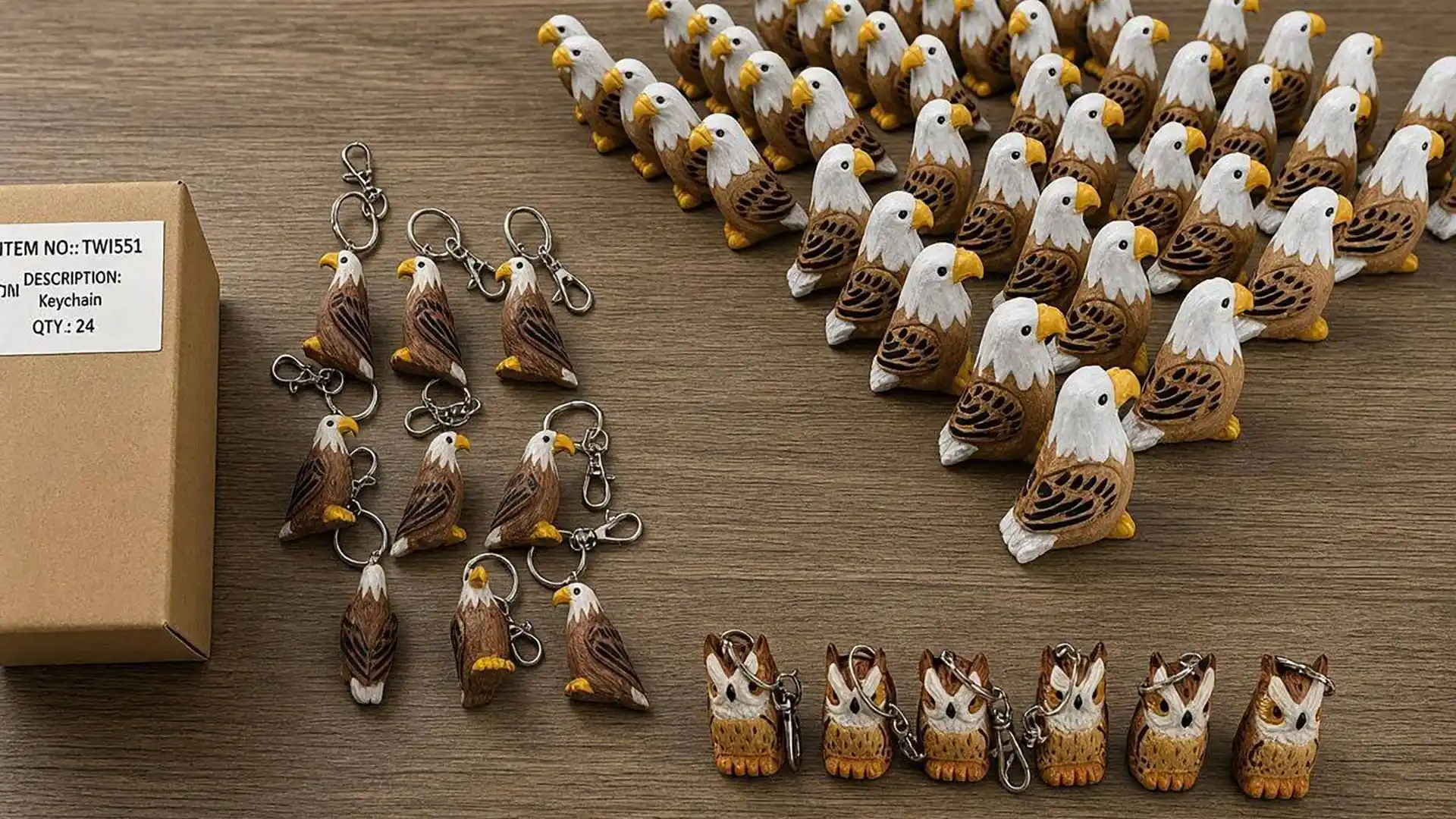
- Small carved desk objects. Animal figures, keychains, magnets, paperweights and miniatures in the 5 cm to 15 cm range — bought on subject and finish, low commitment, high impulse, and the family carrying the widest subject variation for the least specification risk.
- Tabletop functional pieces. Coasters, napkin rings, wine stoppers, trays and small stands. Bought on function and finish durability, and the family where food-contact questions arise — see the compliance section below. Range examples sit in our guides to wholesale wooden coasters and custom logo coasters, MOQ and cost factors.
Two rules keep a catalog navigable inside those families. Each needs a ladder — entry, mid and premium — so a buyer sees a range rather than a set of alternatives. And each needs one hero line carrying the photography and specification depth, because a buyer who understands one line properly assumes the rest are handled the same way. Adjacent families worth ranging alongside these are in our guides to wholesale wooden family puzzles and wooden piggy banks.

The Specification Line Is the Product
In a hand-carved category the specification line does work photography cannot, because it is what tells a buyer the piece is reproducible. Every line should carry: species, dimensions with a stated tolerance, finish system, marking method and its limits, hardware where relevant, retail packaging format, carton quantity, carton dimensions, gross weight, HS code, lead time by tier, and the minimum order.
Three are omitted most often and cost the most. Carton data, because a buyer cannot compute freight or plan a stockroom without it. Tolerance, because a hand-carved product with none stated invites a dispute at delivery — variation inside a stated range is craft, outside it is a defect. And lead time split by tier, since a single figure covering trial and bulk cannot be planned against.
On imagery: clean-background product photography is necessary but not sufficient. A catalog for hand-carved goods should also show the process — carving, painting, inspection, packing — because that is how a buyer distinguishes a manufacturer from a reseller, and it is the only claim they cannot verify another way. Where a line is food-contact relevant, finish documentation belongs in the specification rather than a footnote; United States buyers can start from the FDA food contact substances guidance and confirm the position for their own market. Labelling and artwork obligations are in our guide to labeling wooden gifts for the EU.
Catalog Elements and Why Buyers Check Them
| Element | What it must carry | Why a buyer checks it |
|---|---|---|
| Family structure | Three families with a ladder inside each | Shows whether there is a range or only a list |
| Specification line | Species, dimensions with tolerance, finish, marking, hardware | Decides whether the piece is reproducible across a run |
| Carton data | Quantity per carton, dimensions, gross weight, drop-test rating | Freight cost and stockroom plan come before price |
| Minimums | Piece minimum and order-value minimum, per design or per order | Decides whether the line is orderable at all |
| Lead time by tier | Trial and bulk stated separately, with the freight mode | A single figure cannot be planned against |
| Price with its term | A stated incoterm against every figure, and a validity date | A price without a term is not comparable to another quote |
| Process evidence | Carving, painting, inspection and packing imagery | The only way to tell a manufacturer from a reseller |
| Version and date | Issue date, revision and a named contact | An undated sheet with a stale lead time loses the buyer’s trust |

Minimums, Tiering and How a Catalog Gets Ordered
A catalog gets ordered from when the minimums match how a buyer actually tests a line. Our published structure gives two clear steps, and a catalog should state both on every line rather than only in the front matter.
The trial tier runs at 100 pieces with a USD 500 minimum order value on in-stock designs, air express DDP, 20–30 days. The wholesale and custom tier runs at 300 pieces with a USD 3,000 minimum order value, sea freight, 60–90 days to port, with custom printed boxes at a 500-piece minimum. Those two numbers do most of the qualifying work in a catalog: they tell a buyer at once whether a line is testable at their volume.
Two design consequences follow. Mark which lines are available at the trial tier, because those are what a new buyer orders first — a catalog showing only 300-piece lines reads as closed to small buyers. And state whether minimums apply per design or per order, since that decides whether a buyer can mix three subjects inside one trial. The levers around both figures are in our guide to MOQ negotiation for wooden gifts, and the low-volume route in our guide to low MOQ hand-carved wood crafts.

Best For / Not For: Catalog Depth by Business Type
| Business type | Catalog that works | Catalog that does not |
|---|---|---|
| Manufacturer, direct | Deep specification, carton data, process evidence, both tiers stated | A photography-led lookbook with terms available on request |
| Distributor or wholesaler | Family structure with clear ladders, plus channel-specific price lists | One undifferentiated list that resellers and retailers both price from |
| Private-label brand | A capability catalog: what can be developed, marking options, packaging tiers | A stock catalog, which invites comparison on price alone |
| Marketplace seller | Lines with identifiers, packaging that survives parcel networks, carton data | Open-bin formats with no protective retail pack |
What We Supply for a Catalog Line
- Capability stated accurately. We carve and produce in basswood, pinewood, rubber wood and birch, across three-dimensional sizes from 5 cm to 40 cm and flat carving to 80 cm, every piece carved and painted by hand. A catalog line should describe what is produced, not what could be attempted.
- Full specification per line — dimensions with tolerance, finish system, marking method, hardware, packaging format, carton quantity and dimensions, gross weight, HS code, and lead time split between trial and bulk.
- Carton and packing data to our standard: white paper wrap per piece, 6 to 12 per three-ply inner box at 21 × 11 × 14 cm, 240 to 480 per five-ply master carton at 58 × 44 × 31 cm, 8.0 to 15.0 kg gross, rated to ISTA 3A.
- Commercial terms on the page rather than on request: minimums and order values for both tiers, T/T at 30% deposit and 70% before shipment, and photographs and video of finished goods supplied before the balance falls due.
- Documentation and honest provenance. Our facility operates under ISO 9001 and BSCI with CE, RoHS and UKCA protocols on electrical lines and EN71 coating routes for painted articles children may handle. On provenance: we hold FSC chain-of-custody certification, but certified basswood is not currently available to us, so our carvings are not marketed as FSC-certified wood; official timber felling and transport permits are what we supply. A catalog claim carries the publisher’s name, so it must survive scrutiny. Frameworks behind such claims are described by the FAO forestry division.
End to End: Publishing a First Desk Accessories Catalog
A distributor wants to publish a desk accessories catalog for independent gift retailers and one online channel, starting from a mixed item list rather than a range.
Sort into families first. The list is regrouped into the three families, and any item that cannot be specified to a stated tolerance is dropped rather than published. Hero lines are chosen to carry each family.
Specify before designing. Each line gets a full specification: species, dimensions and tolerance, finish, marking method, packaging format, carton quantity and dimensions, gross weight, HS code, lead time by tier and minimums. Lines available at the 100-piece trial tier are marked, because those are what a new retailer orders first.
Shoot product and process. Clean-background shots for each line, plus carving, painting, inspection and packing imagery for the front of the catalog. A sample kit is ordered so the photography matches physical product, not a rendering — see our wholesale sample kit guide.
Publish, date and test. The catalog is issued with a version number, issue date and named contact, then tested on a small group of retailers whose first orders reveal which specification fields they actually used. Reorders move to the wholesale tier at 300 pieces with a USD 3,000 minimum order value, sea freight, 60–90 days to port, with custom printed boxes at the 500-piece minimum once a line justifies them. Sustainability positioning is in our guide to sustainable wooden pens, and the wider capability in our custom product manufacturing guide.

If you are publishing a desk accessories catalog and need full specification lines — dimensions with tolerance, carton data, HS codes, lead times by tier and both minimum figures — send us your line list and we will return the data in a form you can publish from.
Frequently Asked Questions
Q: How many lines should a first desk accessories catalog have?
Enough to fill three families with a ladder in each — usually nine to twelve lines. A larger catalog reads as a reseller’s list, and every additional line multiplies the specification, photography and stock you maintain. Two hero lines with full specification depth do more work than twenty thin ones.
Q: What data do professional buyers look for first?
Carton quantity, carton dimensions and gross weight, then the minimum order and lead time split by tier. Those four decide whether a line is orderable and what it costs to land, and they are checked before price. A catalog hiding them behind an enquiry form loses the buyer’s patience rather than gaining a conversation.
Q: Should prices be printed in a wholesale catalog?
If they are, they must carry a stated incoterm and a validity date: a price without a term is not comparable to another quotation, and a price without a date becomes a dispute. Where pricing varies by channel or tier, publish the structure and the term rather than a figure quoted back out of context.
Q: Why state a tolerance on a hand-carved product?
Because hand carving always varies, and an unstated tolerance leaves the acceptable range to be argued at delivery rather than agreed before production. Stating it protects both sides: variation inside the range is the craft being purchased, variation outside it is a defect with a documented remedy.
Q: Does a desk accessories catalog need food-contact documentation?
For the tabletop family, usually yes. Coasters, napkin rings, stoppers and trays may contact food or drink, and the material and finish both fall inside food-contact rules in that case. Put the finish documentation in the specification line rather than a footnote, and confirm the requirement for the destination market.
Sources
Food contact substance requirements for articles that may touch food or drink are published by the United States Food and Drug Administration, and forest provenance frameworks by the FAO forestry division. Our species list, carving size range, hand-carved and hand-painted construction, carton specification and ISTA 3A rating, HS codes, minimums and order values, lead times by tier, payment terms and certifications are our own published first-party terms. No wholesale price, margin percentage, catalog response rate or sell-through figure is quoted here, and no product line is described that is outside our stated manufacturing capability — a catalog is a promise about what can be produced at a stated specification, and publishing lines that cannot be met is how a first order becomes a last one.