Skip to content
A wooden coaster gift set earns shelf space for a reason that is easy to miss: it is one of the few gift items that is genuinely useful, small enough to box, and cheap enough to bundle at a margin. A single coaster is an accessory. Four coasters in a printed box with an insert card become a gift, and a gift is a different price band, a different buyer, and a different reorder rhythm.
This page covers the curation decision for retail and wholesale buyers: which set configurations actually sell, what to put in the box alongside the coasters, how the box and insert work, and how size, thickness and branding change what a set can be priced as. Species selection, MOQ structure and landed-cost maths live in the wholesale wooden coasters hub, so nothing here repeats them.
Key Takeaways
- Four to six pieces is the standard retail gift set; larger counts move it into bar-stocking territory and change what the box can be sold as.
- The box and insert card do more work on perceived value than the coaster artwork does — a plain set in a printed box with a story card outperforms a better set in a sleeve.
- Bundle only what you can source from one place. Mixing in glass, candles or ceramics splits the supplier list and hands you food-contact and labelling liability you did not design for.
- Gift-boxed sets pack into inner boxes then five-layer export cartons; the packing format, not the unit, is what usually breaks a first gift-set quote.
- Engraved sets in an even-grained species are the fastest route to a personalised gift; full-colour print suits licensed or illustrated artwork better.
- Set economics are a merchandising decision made before production: choose the box first, then spec the coaster to fit it.
Table of Contents
- Why bundling changes what a coaster can be sold as
- Four set configurations that sell
- What to put in the box — and what to leave out
- Size and thickness for a gift format
- Box, insert card and barcode specification
- Branding choices that read as gift rather than promo
- Pricing a set without a price list
- Season windows and artwork deadlines
- Minimums, sampling and lead time
- The coaster cluster map
- Final thoughts
- Frequently asked questions
Why Bundling Changes What a Coaster Can Be Sold As
Sold loose, a coaster is an impulse item priced against the till. Sold as a boxed set, it becomes a gift, and gifts are bought against a different mental budget — the buyer is solving a “what do I bring” problem, not treating themselves. That shift is why the same board, the same engraving and the same production line can support two very different shelf positions.
For a retailer, the practical benefit is basket consistency. A single coaster sells when someone remembers they need one. A set sells at every occasion on the calendar: housewarming, host gift, wedding, father’s day, corporate run. Sets also survive e-commerce better, because a boxed item photographs as a complete offer rather than as one flat piece of wood.
Four Set Configurations That Sell
| Configuration | What is in the box | Suits which channel |
|---|---|---|
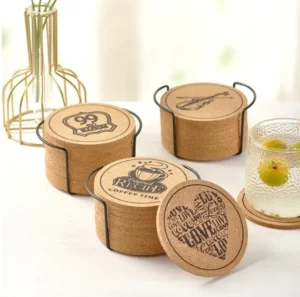
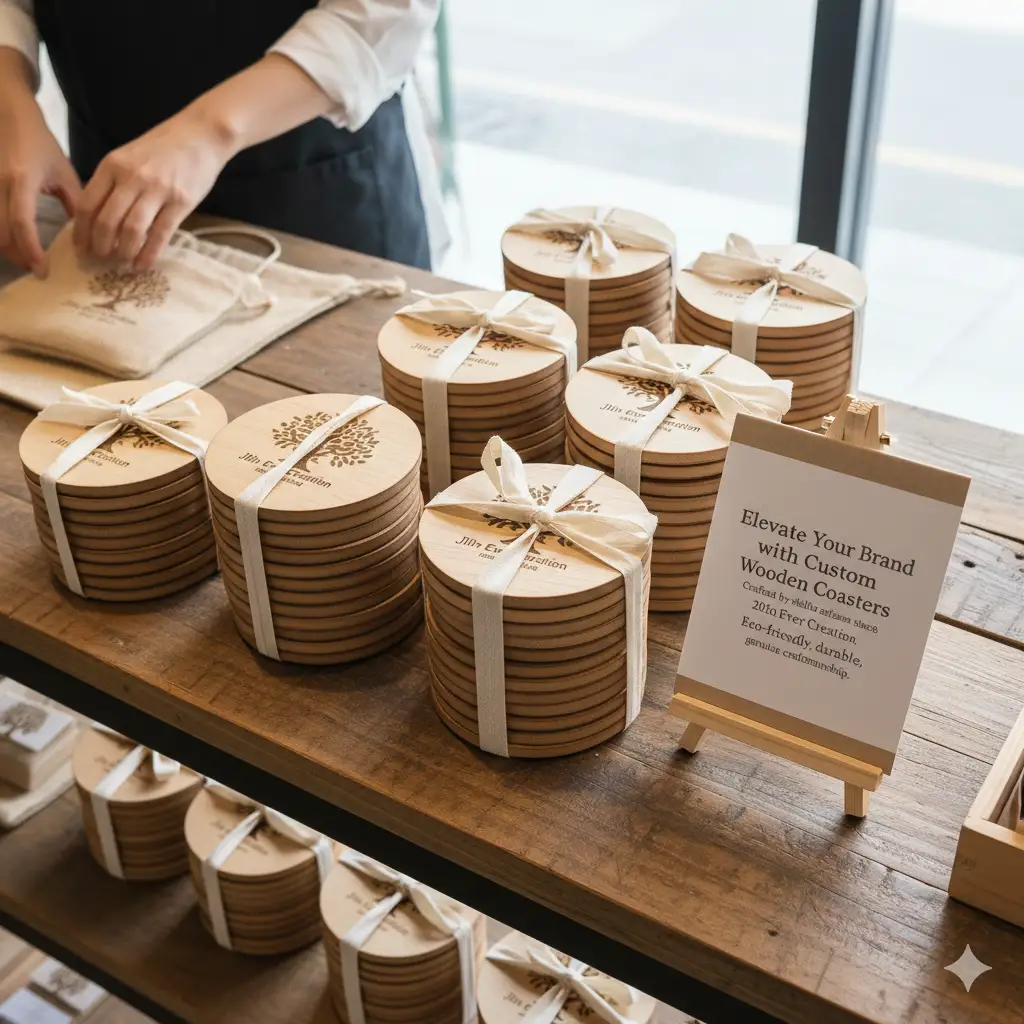
| Classic four-piece | Four matching coasters, one design, kraft or printed box, insert card | Gift shop, museum and attractions retail, hotel boutique |
| Bar pairing | Coasters plus a serving or carving board from the same timber story | Home-bar and spirits retail, brewery taproom counters |
| Desk-and-gift set | Coasters paired with a pen or stationery item under one lid | Corporate gifting, bookshop and stationery channels |
| Seasonal edition | Same coaster geometry, swapped artwork, holiday-specific box | Q4 gifting, market stalls, visitor attractions |
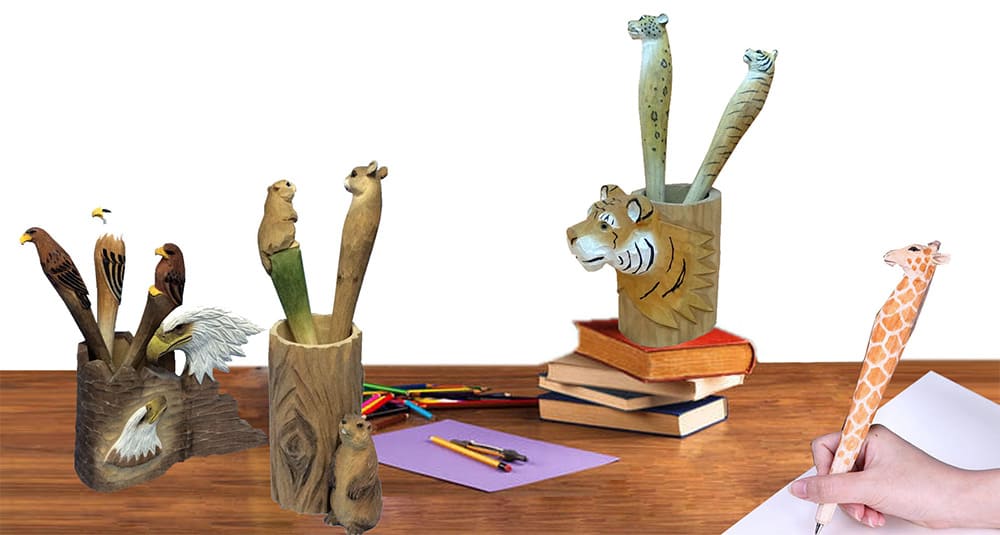
The pattern worth copying is the third column, not the first: the configurations that sell best are the ones that match an existing buying occasion rather than inventing one. A retailer who already sells wooden birds or engraved ornaments can add a coaster set to the same gift wall without changing their customer. Our own wooden bird gift sets and pen gift sets follow the same box-first logic, which is why the three lines can share one container.

What to Put in the Box — and What to Leave Out
The most common question from buyers building their first set is what to pair with the coasters. The honest answer has a constraint before it has a creative list: bundle only what one supplier can produce and one shipment can carry. Every additional component type adds a supplier, a spec sheet, a receiving check and a failure mode.
That rules out the obvious candidates. Glass tumblers, candles and ceramic mugs are the three items buyers most often want in a coaster box, and all three bring compliance obligations that wood does not — food-contact declarations, burn and wick labelling, breakage allowance, and a completely different transit profile. If you want them, source them as their own line item with their own documentation, not as filler inside a gift set you are buying from a carving factory.
What does work is pairing within the same material family: coasters with a serving board, coasters with a carved ornament, coasters with a pen set, coasters with a salt block gift set. These share timber handling, finishing and packing assumptions, so one golden sample and one document set covers the whole box. For display at the point of sale, a countertop display box turns several sets into one fixture rather than a shelf stack.
Size and Thickness for a Gift Format
Gift sets should be specified thicker than bulk bar coasters, for a reason that has nothing to do with durability: weight in the hand is how a buyer judges a gift. A thin print-grade blank feels like a promotional item even in a good box. A heavier board with a sanded or bevelled edge reads as an object rather than a giveaway, and it is the single cheapest upgrade available to a set.
Face size should follow the glassware your customer actually owns — a 4-inch face covers wine, spirits and most tumblers, and going wider costs box volume quickly. Shape is a merchandising choice: round and square are the safe defaults, while hexagon and custom silhouettes stand out on a crowded wall but waste carton volume at the corners. Whichever you pick, keep the shape identical across the set; mixed formats read as a clearance bin, not a gift.
Box, Insert Card and Barcode Specification
Fix the box before you fix the artwork. Box format decides the retail position: a kraft eco box says sustainable and honest, a printed colour box says gift, a sleeve says value. Each is a legitimate choice, and each has a different minimum — a printed custom colour box starts at a higher quantity than stock packaging, which is exactly the kind of detail that gets discovered too late.

Retail-ready means the box can be sold without you touching it: a scannable barcode on a registered prefix (the numbering rules are maintained by GS1), a price-ready face, and an insert card carrying care instructions. The care card is not decoration. Most coaster complaints are customers reacting to normal wood behaviour — a ring mark from a wet glass, a slight cup after soaking — and a card that explains what to do converts a return into a re-purchase. We print your artwork, barcode and safety text onto retail boxes and inner cartons, and pack gift sets into inner boxes then five-layer export master cartons.
Branding Choices That Read as Gift Rather Than Promo
Laser engraving on an even-grained species is the default for a gift set: the mark is permanent, it ages with the wood rather than flaking off, and it looks considered on a natural-finish face. It is also the cheaper personalisation route at low quantity, because there is no screen or die to pay for per colour.
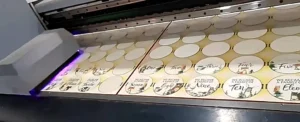
Full-colour print is the right answer when the artwork is the product — licensed illustration, photographic prints, a multi-colour crest — and the wrong answer for a one-colour logo on oak, where the grain will swallow it. Deboss sits between the two: quiet, durable, and best on even-grained hardwood. For sets intended to be washed and reused, remember that print is the first thing to fail under abrasion; the gift that survives is engraved. The durability comparison by process is covered in the beer and bar coaster guide, and the species side in best wood for coasters.
Pricing a Set Without a Price List
We quote factory-direct against a specification rather than publishing a price list, so this section is about the method rather than numbers. A set’s cost is the sum of five independently variable decisions: the coaster spec (species, thickness, edge), the branding process and colour count, the box format, the insert and barcode work, and the quantity per design. Move one and the quote moves; the mistake is comparing two quotes that differ in three of the five.
The retail side is a positioning question, not a formula. A boxed set competes with gifts, not with bar accessories, so it should be benchmarked against what else occupies that occasion on the shelf. Margin structure, weight-class economics and how packing density affects landed cost are modelled properly in the wholesale hub — read that after the specification is fixed, not before.
Season Windows and Artwork Deadlines
Gift sets are calendar products. The autumn build for holiday retail and corporate gifting is the peak, and a spring refresh picks up the remainder. Personalised runs are sequential — one artwork, then the next — so engraved and boxed formats fill production slots before bulk packing does.
Work backwards from the on-shelf date and treat artwork approval as the real deadline. Quantity growth after cutting starts can usually be absorbed; a branding change at the same stage cannot. Seasonal artwork strategy for this specific line is covered in seasonal wooden coaster designs, and the wider gifting calendar in wooden home decor collections.
Minimums, Sampling and Lead Time
Our published structure is fixed: 100 pieces against a USD 500 minimum order amount for a trial on in-stock blanks, 300 pieces against USD 3,000 for wholesale or custom production, and 500 pieces for a printed custom colour box. One design means one shape, species and branding combination, so a four-design gift range is four minimums — which is why most first-time buyers should launch with two designs rather than six.
Payment is 30% T/T deposit with the 70% balance before shipment, released against photographs and video of the actual packed goods. A stocked trial ships by air in roughly 20-30 days; a custom boxed run goes by sea at 60-90 days to port. Mixed-line consolidation is standard, so a coaster gift programme can ride along with birds, ornaments or salt products in one container instead of standing on its own minimum.
The Coaster Cluster: Where to Go Next
- Wholesale wooden coasters (quote page) — the commercial entry point
- Salt block gift sets and the carving factory behind them — the adjacent gift line
- Coaster wedding favours — the event version of a set
- Coasters for corporate branding and promotional product angle
- Non-toxic finish options — what a “sustainable” claim can honestly cover
- OEM and ODM customization — private-label shapes and boxes
Final Thoughts
A good coaster gift set is decided before the coaster is made. Choose the occasion, then the box, then the spec that fits the box — and keep the component list inside what one supplier can honestly document. Do that and four pieces of sanded hardwood become a gift line with repeatable seasonal demand. Skip it and you are left with a nice coaster that sells against the till.
Build a Coaster Gift Line From One Production Window
Coasters, boxes, insert cards and barcodes specified together, with matching carved items available in the same container. Trials from 100 pieces; custom colour boxes from 500.
Frequently Asked Questions
What goes well with coasters in a gift set?
Stay inside the same material family: a serving board, a carved ornament, a pen set, or a salt block gift set. These share timber handling and packing assumptions, so one golden sample and one document set covers the whole box. Glass, candles and ceramics bring food-contact, burn-labelling and breakage obligations that wood does not.
Is a set of four or six better for gifting?
Four is the retail default and the easiest to box, price and photograph. Six moves the item from gift toward household stocking and needs a deeper box, which costs carton volume. For a first programme, four pieces in a printed box with an insert card is the configuration that most consistently sells as a gift rather than as an accessory.
How do I make a themed coaster gift box?
Pick one occasion and keep every element inside it: one shape across the set, one species, artwork that carries the theme rather than explaining it. Specify the box and insert card before the coaster, because the box decides the shelf position. Change artwork seasonally and keep the geometry — that is how a themed range stays affordable to reorder.
What is the minimum order for a custom boxed set?
300 pieces against a USD 3,000 minimum order amount for custom production, and 500 pieces once you want a printed custom colour box. A trial of 100 pieces against USD 500 is available on in-stock blanks. Each design carries its own minimum, so a four-design range is effectively four times the threshold — reduce design count before chasing a lower MOQ.
Are wood coasters a good gift idea to stock?
As a retailer’s decision rather than a consumer’s: yes, because the item is useful, flat, light to ship, and it attaches to occasions already present in most gift shops. The commercial risk is low for the same reasons — no sizing, no expiry, no breakage allowance comparable to glass or ceramic. The main failure mode is ordering too many designs at once and paying several minimums for one shelf.