Skip to content
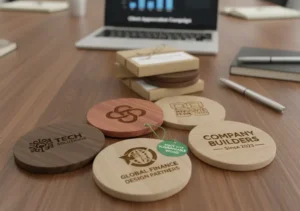
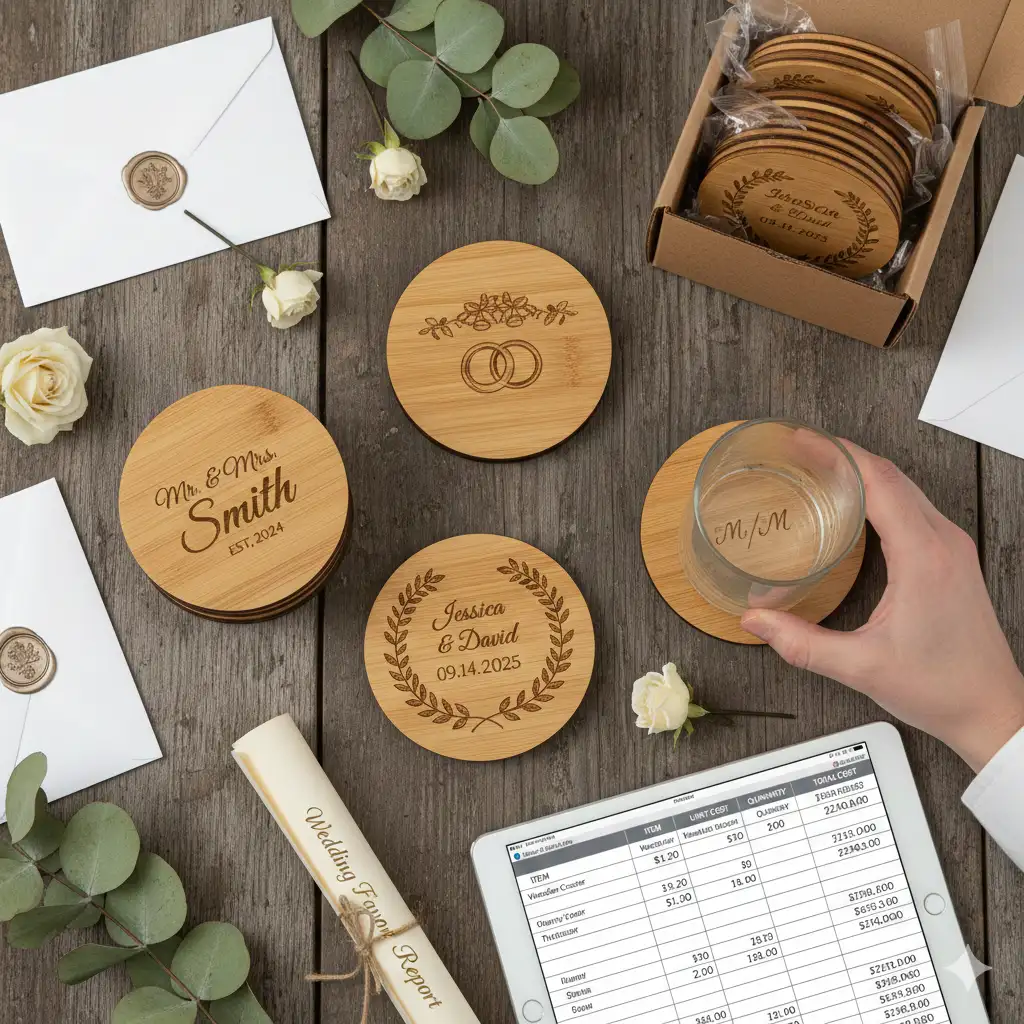
Most couples struggle with the same favour problem: guests do not want to carry home something that will be thrown away. Wooden coasters solve it because they are useful during the reception, flat enough to travel, and solid enough to keep using afterwards. A 4-inch engraved face carries names, a date or a monogram legibly, and the piece earns its place on a table at home rather than in a drawer.
This guide covers the favour decision itself: why guests keep coasters, how to specify one that fits your table and theme, what personalisation options exist, and how durability and lead time work when the order is engraved rather than stocked. Pricing tiers, species comparison and packing structure live in the wholesale hub linked at the end, so this page stays focused on the event.
Key Takeaways
- Plan one favour per guest plus spares, then match it to a published minimum: 100 pieces for a trial, 300 for wholesale or custom work.
- A 4-inch face fits standard drinkware and leaves room for names, dates or a monogram to stay legible after engraving.
- Order 20-30 days ahead for a stocked trial by air, 60-90 days to port for a custom container run.
- Cartons run 6-12 pieces per 3-Ply BC Flute inner and 240-480 per 5-Ply outer, cleared against ISTA 3A drop testing.
- Payment is 30% T/T deposit and 70% before shipment, with photos and video of your finished goods released before the balance.
- Timber moves under official felling and transport permits; BSCI, ISO 9001, CE, UKCA and EN71/RoHS paperwork ships with the order.
Table of Contents
Why Guests Throw Away Most Favors (But Keep Coasters)
Guests discard favours that are bulky, purely decorative or purposeless after the event. Coasters are compact, useful during the reception and easy to take home, which puts them in the small group of favours people actually keep.
Guests decide quickly, weighing usefulness against how easily an item travels. Trinkets, candles and small frames are the first to be left behind, especially when a guest is packing for a flight. The behavioural rule is simple: people keep things they expect to use again.
A coaster is already in use before the guest decides anything. It protected their drink for four hours, so its value is demonstrated rather than explained. Couples then add a second layer of usefulness by printing seating information, a hashtag or a short message on the face, which turns the coaster into a small keepsake card that happens to protect furniture. Flat, light and recyclable, it survives both the journey home and the first month afterwards.
The Utility Factor: Usefulness at the Reception and at Home
A wedding coaster has to do two jobs: stop condensation rings on linen and tables during the event, then keep doing it on a home surface afterwards. Thickness and finish decide the second job.
At the reception the requirement is physical rather than decorative. The face must be larger than the base ring of the vessel, or it leaves a wet crescent on the table — which is a specification error, not a manufacturing one. A 4-inch (roughly 100 mm) face covers water goblets, wine glasses and most tumblers; go wider if the programme includes beer mugs or shared cocktail vessels. A matte or satin surface avoids throwing venue lighting back into photographs, and keeps engraved text readable when the coaster is doubling as a place card.
At home, the same piece is judged by different criteria: whether it cups, stains or smells after a few uses. That is decided by the board and the finish rather than the artwork. A solid hardwood body with a cork backing resists moisture on both faces and grips the surface instead of sliding, which is what makes a favour survive as daily tableware. Guests who keep using it are also the guests who remember the wedding — the favour keeps working long after the event.

Decor Element: Adding to the Table Setting
Placed near the glassware, a coaster becomes part of the place setting rather than an accessory handed out at the door — it should read as though it belongs with the plates, linen and centrepiece.
Two decisions do most of the work. The first is tone: the wood colour and edge treatment should echo something already on the table, whether that is the napkin, the menu card or the centrepiece material. A burnt or rustic edge reads farmstead; a clean bevelled edge with a pale species reads modern. The second is consistency — one shape across the room, because mixed formats make a table look improvised.
Coasters also solve a small logistics problem. Because they are flat and stackable, the same printed piece can act as place card, table number and favour without adding three separate items to the setting. That is why planners often brief them alongside menus rather than with the gift table.
Personalisation Ideas: Dates, Names, and Monograms
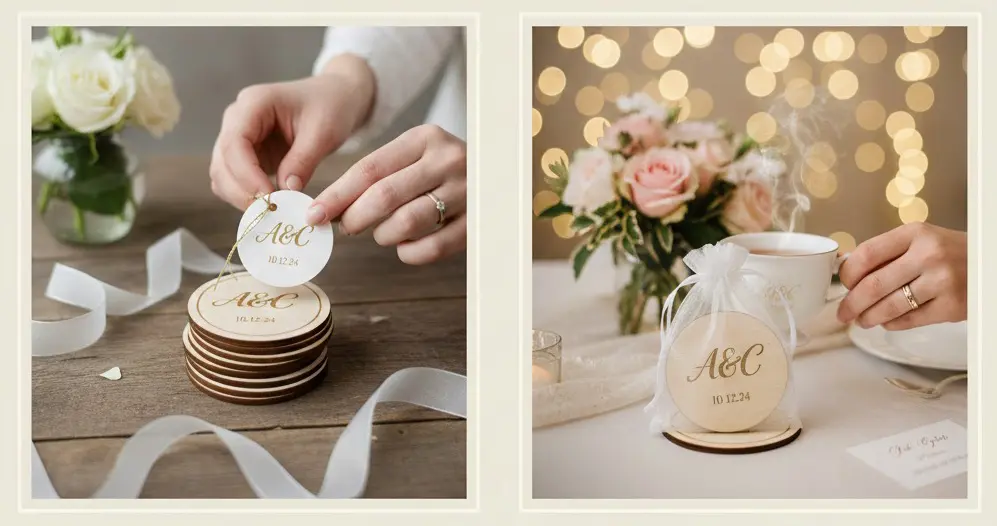
On a 4-inch face you have room for one to three lines of text plus a monogram. Anything denser loses legibility at the distance a guest actually reads it.
The layouts that work are the restrained ones: names on one line, date on the next, monogram or small emblem as the third element with clear margins around it. Contrast matters more than size — a fine script in pale engraving on a light species disappears in reception lighting, while a bold initial reads from across a table. If you want a crest, a floral motif or a venue outline, put that on the coaster and move the long text to the insert card or box lid.
For engraving, an even-grained, low-contrast species gives the cleanest mark: basswood is our standard engraving board, and birch behaves similarly while being harder. Open-grained species such as white oak carry more character but soften fine detail, so they suit a bold monogram rather than small script. Send vector artwork where you can, or raster at 300 dpi; if you want the design to run to the edge, allow bleed beyond the cut line and we will confirm the safe area on the proof.

Every order goes through a first-article approval before the run starts: you see and approve the actual engraved piece, not a digital mock-up, and that approved sample is retained so a later reorder matches it. If you are adding the same artwork to a gift box, insert card or outer carton, brief it in the same pass so all four items are approved against one golden sample — our gift set curation guide covers that combination, and MOQ and cost factors explains what moves the unit price.
Durability: A Lasting Keepsake
What separates a keepsake from a discard is the board thickness, the finish system and the backing — not the artwork.
| Component | What to specify | Why it matters at home |
|---|---|---|
| Body | Solid hardwood board, not particle board or MDF | Resists cupping when a wet glass sits on it for hours |
| Backing | Cork or felt layer | Stops scratching and keeps the coaster from sliding |
| Finish | Film-forming top coat for washable use; hard wax or oil for a natural feel | Determines whether ring marks are permanent |
| Edge | Sanded round or bevelled | A raw edge chips first and absorbs spills |
Choose the finish for the life you want the favour to have. A film-forming top coat blocks moisture effectively and survives regular wiping, which suits a guest who will actually use it daily; a penetrating wax or oil feels better in the hand and looks more natural, but needs occasional re-application and is a poor match for a hotel-style wash cycle. Include a short care card with the box and the returns conversation disappears — most “damaged” complaints on wooden coasters are unfinished boards that were soaked. The non-toxic finish comparison sets out which systems survive repeated wiping.
On sourcing: our timber moves under official felling and transport permits, and that documentation travels with the order. We hold FSC certification as a company but cannot source FSC-certified basswood at product level, so we do not describe these coasters as FSC-certified wood. For the legal-timber side of that documentation, the FAO forestry programme sets the framework our permit files are built against, and consumer product safety requirements for the United States market are published by the Consumer Product Safety Commission.
Designing a Coaster that Fits Your Theme
Shape does more theme work than colour does. A round coaster reads traditional and softens with candlelight and florals; a square one reads modern and sits cleanly in geometric or minimalist layouts; a hexagon or custom silhouette becomes the conversation piece and should be chosen only when the rest of the table is quiet. Keep the shape identical across the room.
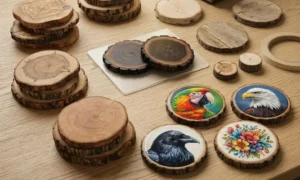
Then match species to the theme rather than to the price. Pale, even basswood suits contemporary and monochrome palettes and takes fine detail. Birch, slightly warmer and harder, suits classic table settings. Beech and white oak carry visible grain that supports rustic, farmhouse and woodland schemes, where the wood itself is part of the design. If the theme is nature-led, a live edge or a burnt rim does more than any printed artwork will.
Ordering Window and Lead Time
Work backwards from the wedding date, and treat artwork approval as the real deadline rather than the shipping date. A stocked trial order ships by air express in roughly 20-30 days; an engraved custom run takes 60-90 days to port by sea. Design approval must be complete before production opens, because engraving runs sequentially and late artwork changes cannot be absorbed once cutting starts. Eight to twelve weeks ahead is the comfortable window for a personalised favour order.
Quantity planning is simpler than it looks: count one favour per guest plus a spares allowance, then fit that to the published minimum rather than the other way around. If your guest count sits below the wholesale threshold, reduce the number of designs rather than chasing a lower minimum — one design across the room is also the better-looking result. For tier pricing, species comparison and packing formats, the wholesale wooden coasters hub covers the commercial side in one place.
Final Thoughts
A wooden coaster is one of the few favours that earns its place on the table before the guest even picks it up. It protects the surface, carries the couple’s details legibly, travels flat, and keeps working at home — which is the only test that matters for something bought in bulk and handed to two hundred people. Specify the size against your glassware, keep the artwork simple, choose the finish for real use, and give the engraving enough notice.
Custom Wooden Coasters, Engraved and Packed to Your Spec
Start with a 100-piece trial order or quote a 300-piece custom run, with your artwork, cork backing and cartons marked to your distribution centre.
Frequently Asked Questions
How much do custom wedding coasters cost?
Pricing follows your specification rather than a shelf rate, so we quote against quantity and finish: 100 pieces with a USD 500 minimum order amount, or 300 pieces with a USD 3,000 minimum for wholesale and custom production. A printed custom colour box adds a 500-piece run. Species, thickness and edge treatment move the number independently of one another.
Should I engrave the date or just a design?
Both, if the layout can carry them. Laser engraving handles names, dates and a monogram together, but a 4-inch face comfortably holds one to three lines of text. If your mark includes a crest or fine illustration, move the long text to the insert card so the engraving stays legible at table distance.
How do I display coasters at the wedding?
Either at the place setting or at the drink station. In the setting it works as place card and favour in one object; at a station, a simple holder keeps a small stack visible where guests already reach for a napkin — a countertop display box works for both roles. Avoid the gift table if you can — coasters left in a pile read as an afterthought, and ones already on the table read as part of the design.
What is the cheapest wood for favours?
Basswood is our most economical engraving board because it is soft enough to cut quickly and even enough to take fine detail without rework. Birch costs slightly more and is harder, which suits favours you expect guests to wash and reuse. Cork-backed boards sit above both on unit cost but are what make a wooden coaster safe on a lacquered table.
How far in advance should I order?
Eight to twelve weeks. A stocked trial order takes 20-30 days and ships by air express; an engraved custom production run takes 60-90 days to port by sea. Artwork approval comes before the deposit clears, which is what keeps both clocks honest.