Skip to content
Every few months a buyer tells us the same story. A wooden slingshot lands on a shelf as a test buy — one carton, 108 pieces, barely a shelf row. Two months later it is reordered, and this time it sits next to the register, where it outsells half the toy section. Wholesale handmade wooden slingshots are that kind of product: inexpensive to stock, easy to display, and quietly emotional in a way molded plastic never is.
The problem sits on the other side of the market. Search for wholesale handmade wooden slingshots and the first ten results are supplier listings, not information — untested units, unspecified wood, no safety documentation, no way to tell a retail-grade product from a market stall. That gap is exactly what this guide fills. It walks through what a retail-grade wooden slingshot is, how it is made, which designs stock which channels, what compliance a factory must prove, and how to order without buying a thousand untested pieces.
Every number here comes from one factory’s actual production: our hand-carved slingshot line in Jilin Province, carved from Changbai Mountain basswood, tested to EN71-1/-2/-3, packed 6 pieces to an inner box and 108 to a carton, with custom runs starting at 324 pieces per model.
Why Wholesale Wooden Slingshots Are Back on Shelves
Three retail currents push the same product. Gift shops keep hunting for analog items that parents and grandparents buy for the nostalgia of it; why handmade charm outsells moulded plastic is the story those shelves sell. Museum stores want objects that look handmade next to the exhibition catalog. Outdoor stores want an impulse item that costs less than a pocket knife and feels more like a story. A hand-carved wooden slingshot lands in all three.
The material choice does the positioning for you. Metal and alloy slingshots read as hunting or target-shooting gear — a serious, higher-priced purchase with its own shelf logic, its own buyer, and its own insurance conversation. Wood reads as toy, craft, and keepsake at once. That is why the wooden version shows up at the register of a coastal gift shop and in the camping section of a national chain without anyone feeling the shelf is confused. It is the same reason a broad wholesale wooden crafts assortment usually works harder when it mixes everyday wood items with one genuinely novel line.
There is also a margin dynamic hiding in the comparison. Hand-carved wood commands a craft premium that injection-molded plastic cannot reach, while wholesale wooden slingshots still price far below metal outdoor gear; splitting a range into collectible and target-practice lines is how retailers protect both price points. The result is a product that can sit in the impulse zone of a gift shop and hold its margin, then sit in an outdoor store’s junior section and still undercut the metal rack next to it. Buyers rarely get both ends of that spread in one SKU.
None of this needs a market report. Ask the buyer who first test-stocked it. The slingshot line at our workshop has been part of the Novelty and Giftware range since the company started carving in 2004, and the reason it survives catalog cuts is simple: it reorders itself.
How Handmade Wooden Slingshots Are Made
The process starts with the wood, and the wood starts on a specific mountain. Our slingshots are carved from basswood harvested from the Changbai Mountains in northeastern China. Basswood earns its place here twice over: the grain is dense and resilient enough to hold the fork shape under band tension, and it carves cleanly, so fine detail on an animal-shaped frame does not chip out mid-cut. Buyers who want a different character can spec beech, rosewood, or wenge instead.
From the blank, a carver cuts the Y-frame and works the detail by hand. The teams doing this have spent an average of ten years at the bench. After shaping comes sanding, then finishing with water-based, non-toxic paint — the same approach we use across the handmade wooden crafts range. Water-based finish matters for more than ecology: it means no solvent odor in the packaging and no residue question when a compliance check comes.
One step buyers rarely ask about is the one that prevents returns. Every slingshot goes through an anti-cracking treatment on the wood before finishing. A carved item shipped by sea crosses climate zones, sits in containers, and lands in stores with wildly different humidity. Untreated basswood can check and split in a dry winter showroom. The treatment is what keeps a piece sold in a desert-state gift shop from coming back as a warranty claim. Standard dimensions run an 18–20 cm handle with about 10 cm of width — small enough for pegboard, big enough to feel substantial in the hand.

Types and Designs Retailers Actually Stock
Most buyers assume one shape. The catalog is wider than that, and the width is what lets different channels stock the same product category without colliding.
| Type | What It Is | Channel Fit | Stocking Note |
|---|---|---|---|
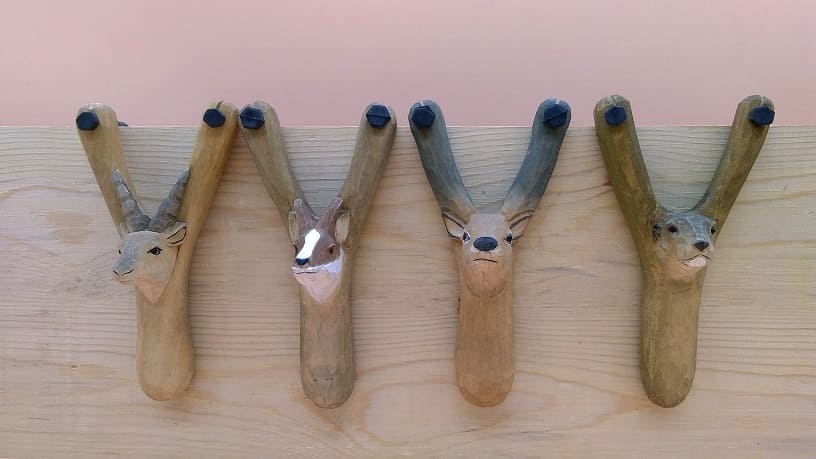
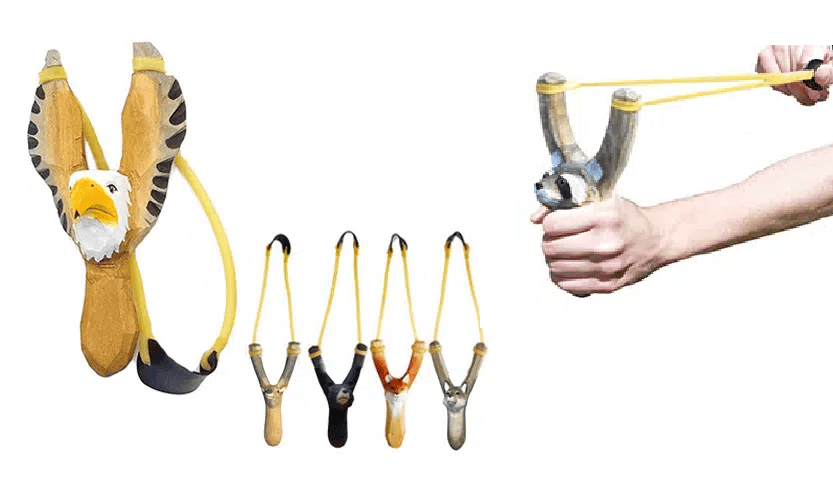
| Animal-shaped novelty | Carved animal silhouettes forming the frame | Gift shops, museum stores | The signature line; many animal designs |
| Classic Y-frame | Clean symmetrical fork, minimal detail | Outdoor and toy stores | Simplest display, broadest shelf appeal |
| Natural fork style | Branch-like fork silhouette, rustic finish | Nature and eco-themed stores | Pairs with wooden decor displays |
| Custom and private label | Buyer-supplied shapes, logos, colors | Any channel running own-brand programs | OEM from 324 pieces per model |
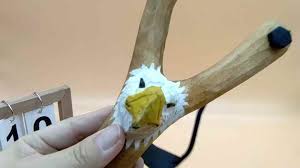
The animal-shaped line deserves the most attention, because it is the one that turns a slingshot from a commodity into a collection. Retailers who stock one animal get asked for the rest within a season — customers complete the set the way they complete a family of figurines. That is also where the full slingshot product range gets interesting for repeat business: the designs are open to custom shapes and sizes, so a buyer can add a local animal, a mascot, or a private-label twist rather than competing on the same product everyone imports.
The Retailer’s Safety and Compliance Checklist
Here is the uncomfortable truth about this category: most slingshot listings online sell untested units. The supplier pages dominate search results, and on those pages the compliance story is either absent or a copied paragraph. A retailer who puts an untested wooden toy on the shelf is carrying the liability personally — small parts, paint chemistry, and band failure are all foreseeable claims.
The test that matters for European and most other toy markets is EN71, and it is three separate standards, not one stamp:
| Standard | What It Tests | Why It Matters for Slingshots |
|---|---|---|
| EN71-1 | Physical and mechanical safety | Drop, small parts, sharp edges, band tension |
| EN71-2 | Flammability | Wood and finish must not flash-ignite |
| EN71-3 | Migration of eight toxic elements | Lead, cadmium, and the paint chemistry question |
EN71-3 checks migration limits for eight elements — lead, mercury, cadmium, chromium, arsenic, selenium, barium, and antimony — which is the test that catches cheap imported paint. Our line passes all three parts, and the paint itself is water-based and non-toxic, which removes the paint question before testing starts. RoHS coverage applies on top of that. The three-part scope is worth confirming against the published descriptions from testing houses like Intertek’s EN71 service page, so you can hold a supplier’s claims up to an independent definition.
For the US market the equivalent is ASTM F963 under CPSIA, so buyers shipping across the border should ask for that coverage at the quoting stage rather than discovering the gap at customs. Two final checklist items: request the supplier’s declared age grade in writing, and make sure that grade — plus any band warnings — is printed on the packaging you actually receive. A tested slingshot with unmarked packaging is a half-finished compliance job.
One more check belongs on the shelf, not in the paperwork. The band is the stressed component, and it is the first thing customers replace or tinker with. Ask the supplier how bands are attached and what the packaging says about replacement and adult supervision. A slingshot whose frame is perfectly safe but whose band instructions are absent will still end up in a claims conversation, and those conversations are won by the retailer who can point to written warnings on the box.

What Quality Control a Factory Should Show
A factory that cannot describe its QC is a factory that does not have QC. The standard we run is three-stage: incoming material checks on the basswood blanks, in-process checks while pieces are carved and painted, and a final inspection before packing. On the slingshot line, the final check has a concrete bar — every piece is examined for cracks, splinters, and blemishes, and held to a 95% likeness standard against the reference design. A buyer can hold that number up to any supplier and watch who blinks.
The likeness standard deserves a word, because it handles the question every first-time buyer asks about hand carving: how do you keep hundreds of pieces consistent? The honest answer is that you do not make them identical — you make them within tolerance. Two hand-carved slingshots differ slightly, and that variance is the feature buyers pay for. The 95% bar is what keeps the variance inside a brand rather than letting it drift into a different product. This is the same discipline we apply across quality control in hand carving generally.
The last QC element is procedural and costs the buyer nothing. Before the 70% balance is due, we send photos and video of the finished goods — the actual cartons, the actual pieces. If the batch is wrong, that is the moment to stop payment, not after the container lands. Any supplier that resists pre-shipment proof should be crossed off the list immediately.
MOQ, Pricing, and Ordering Terms
Ordering terms are where wholesale slingshot buyers usually get surprised, so here is the full picture without the fine print. Company-wide, stocked items start at 100 pieces and custom runs at 300. The slingshot line carries its own terms: 324 pieces per model, with a USD 3,000 minimum order amount. Orders under the MOA can ship LCL for USD 300, which keeps a first trial order realistic for a single store.
Payment runs T/T: 30% deposit to lock the order and start production, 70% before shipment — after you have seen photos and video of the finished goods. Small sample orders can settle through simpler payment channels, and our low MOQ terms page spells out the tiers for the rest of the catalog.
Timing is the part to plan around, not discover. Standard production takes 4–6 weeks from order confirmation; custom specs add 1–2 weeks. Large quantities stretch toward the 60–90 day range. Then shipping splits two ways:
| Method | Transit Time | Best For |
|---|---|---|
| Air express (DDP) | 15–20 days | Seasonal restocks and trial orders |
| Sea freight | 60–90 days | Planned, volume orders with lead room |
Both run door-to-door with DDP to the US, Europe, and Australia — customs and duties handled, delivery straight to your warehouse or Amazon FBA. EXW, FOB, and CIF are available for buyers with their own forwarders. Packaging is standardized and shelf-ready: 6 pieces to an inner box, 108 pieces to a master carton, with barcode labels and shipping marks added on request.
The seasonal note is worth stating outright, because wholesale wooden slingshots follow the same calendar as every other gift item. The demand spike lands in the fourth quarter, so sea-freight orders for holiday shelving need to be placed while summer stock is still on the floor — roughly four months before the shelf date. Trial orders in spring and early summer, reorders by air in season, and the sea container planned before August: that is the rhythm that keeps the register display full without an air-freight panic.
Custom OEM Shapes, Logos, and Packaging
Custom is where this product line separates from commodity imports. A buyer can change the shape, the size, the wood, the paint color, the logo placement, and the packaging — and have the factory manage the whole path from drawing to carton. The standard 18–20 cm handle is a starting point, not a rule.
The wood choice runs basswood, beech, rosewood, or wenge. Colors follow the water-based paint system, matched to a reference or a color code. Logos can go on the frame or live on the packaging — barcode labels, shipping marks, and branded inner boxes are all part of the same spec. This is the same custom wood manufacturing OEM process we run for every line in the catalog.
What the factory needs from you is concrete: target market and standards (which drives testing), dimensions, wood species, color references, packaging spec, and quantity per model. What you should expect back is a concept confirmation, then samples, then production — custom adds 1–2 weeks to the standard 4–6 week window, and the 30% deposit locks the run.

Treat the sample stage as the real contract. The sample is where a drawn shape meets grain, paint, and the 95% likeness bar, and it is the cheapest moment in the whole project to change anything. A buyer who approves samples in writing, with photos, has a standard to hold the production run against; a buyer who skips straight to bulk has nothing but hope. In this factory the sample step is part of every custom slingshot order, not an option.
How to Vet a Wooden Slingshot Supplier
Vetting a slingshot supplier is four documents and one question sequence. First, ask for the EN71-1/-2/-3 reports and RoHS documentation before you pay anything — a factory that has them sends them the same day. Second, ask for company-level evidence: our ISO9001 quality system, official logging permits, and phytosanitary compliance sit behind the product claims. Third, ask for the wood origin statement. Fourth, ask for the sample policy in writing, because the only reliable test of a wholesale wooden slingshots supplier is a box in your hand — this is exactly what our sample policy for wholesale buyers exists to clarify.
Then ask the timeline questions in order: production lead time, shipping method and days, and what happens when a batch fails inspection. The answers should be specific, because ours are — 4–6 weeks production, 15–20 days by air or 60–90 by sea, pre-shipment photos before the balance. A supplier that answers “it depends” to all three is telling you something worth hearing.
The path from here is short. Request reports and samples from two or three factories. Compare them on the 95% likeness standard, the age-grade marking, and the honesty of the lead times. Then order a trial run and watch how the shelf responds — most buyers who do end up back at the register display, reordering by carton.
Get Slingshot Samples & Wholesale Pricing
Stocked from 100 pieces, custom OEM from 300 — with EN71 test reports and DDP delivery.
Frequently Asked Questions
Are wooden slingshots safe for children?
Yes, when they carry the right testing. Our slingshots pass EN71-1/-2/-3: physical and mechanical safety, flammability, and migration limits for eight toxic elements. Confirm the supplier’s declared age grade, and check that the grade appears on packaging before you list the item.
What wood is used for handmade slingshots?
Basswood from the Changbai Mountains is the standard. Beech, rosewood, and wenge are available on request. Basswood is dense with a resilient grain that carves cleanly and holds its shape through transport.
What is the minimum order quantity?
The slingshot line runs at 324 pieces per model with a USD 3,000 minimum order amount. Orders below the MOA can ship LCL for USD 300. Other stocked lines in the catalog start at 100 pieces.
Can I order custom shapes or logos?
Yes. Shapes, sizes, wood species, paint colors, and packaging can all follow your spec. Custom runs add one to two weeks to standard production, and the deposit structure stays 30/70.
Do you provide safety test reports?
Yes. EN71-1/-2/-3 and RoHS reports are available before you pay the deposit. For the US market, ask about ASTM F963 coverage at the quoting stage.
How long does production take?
Standard production runs four to six weeks from order confirmation; custom specs add one to two weeks. Large quantities run sixty to ninety days. Air express with DDP takes fifteen to twenty days; sea freight takes sixty to ninety.