Skip to content
Understanding the future of wood crafts is critical for protecting retail margins against the flood of automated, low-value decor. Stocking machine-molded replicas creates a direct path to price wars and commoditization, eroding brand value and leaving businesses with inventory that lacks a compelling story.
This analysis shows how to future-proof your inventory by partnering with factories that deliver ‘Hand-sculpted Authenticity.’ We evaluate manufacturers on their use of Premium Basswood and their ability to offer flexible MOQ terms, ensuring a stable supply of differentiated products that technology cannot replicate.
Why is “Human Touch” becoming a premium luxury commodity?
AI fatigue is making genuine human interaction scarce. Consumers now pay a premium for authentic experiences and handcrafted products, transforming the ‘human touch’ into a rare commodity.
The Scarcity of Authenticity in a Digital World
Consumers are experiencing ‘AI fatigue.’ They are tired of interacting with impersonal chatbots and dealing with algorithmic suggestions that miss the mark. This saturation of automated, low-quality interaction makes genuine human judgment and conversation feel like a luxury service.
High-end brands are shifting their focus from simply selling products to selling an emotional transformation. This experience depends on empathy and real understanding—things an algorithm can’t fake. The market is also changing. Millennial and Gen Z buyers, who will soon dominate luxury spending, value cultural relevance and transparency far more than pure automation.
Hand-Sculpted Authenticity as a Tangible Asset
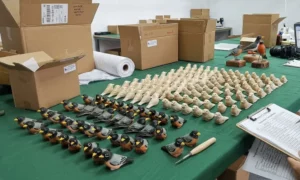
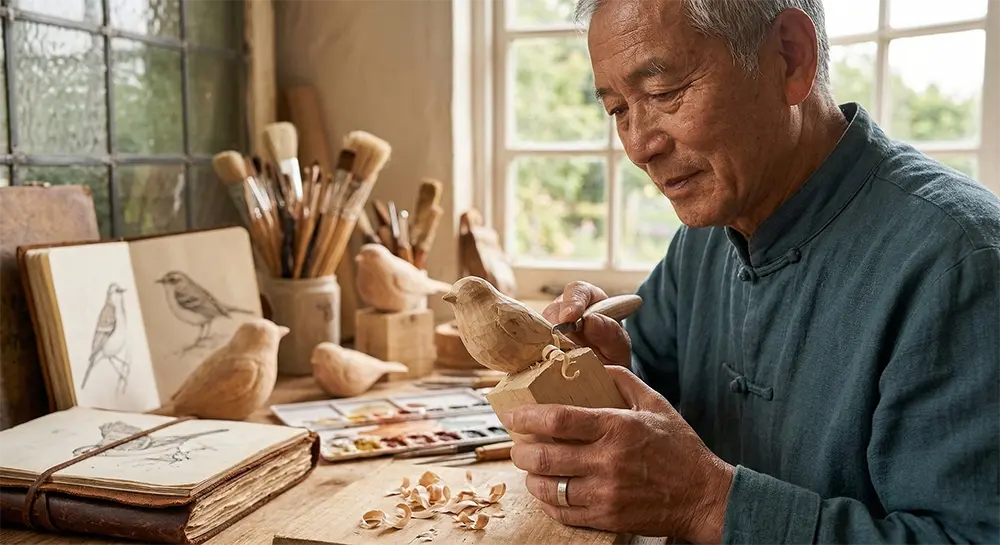
This trend isn’t just about service; it applies directly to physical products. Our wooden songbirds are a direct rejection of machine-molded replicas. Every piece is 100% hand-carved from premium Basswood and then hand-painted by a skilled artisan. This process is a deliberate choice to preserve true craftsmanship.
We call the slight variations between each bird **Artisanal Variance**. These small differences aren’t defects; they are the hallmark of true hand-craftsmanship, proving that a real person created the piece. This approach, rooted in **Master Craftsmanship**, ensures every songbird has an **Artisan-Carved Soul**—a unique quality and tangible authenticity that simply cannot be automated or mass-produced.
How will R&D in wood craftsmanship evolve in the next 5 years?
By 2026, R&D will advance on two fronts: integrating digital tools for efficiency and refining hand-carving techniques to meet growing demand for authentic, bespoke products.
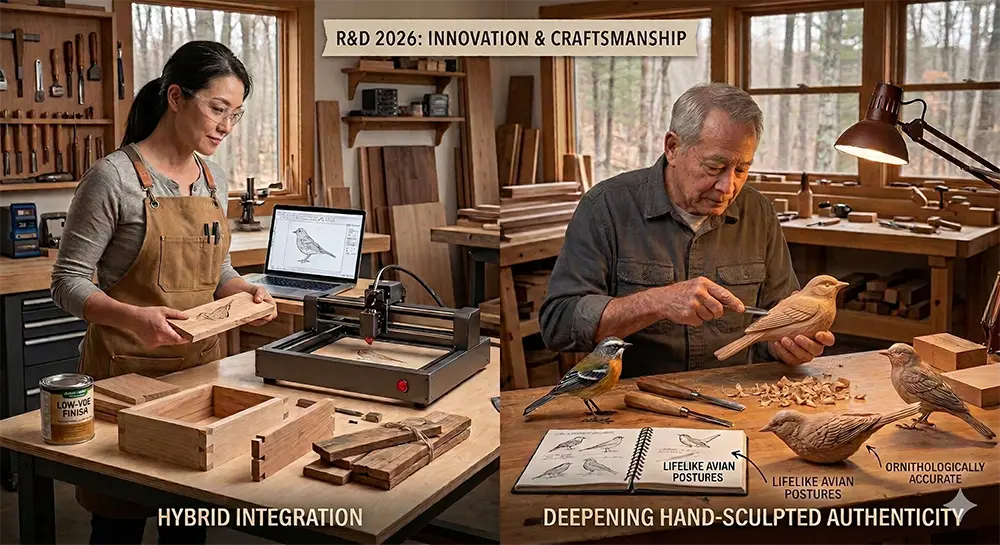
Research and development in woodworking isn’t just about bigger saws or faster machines anymore. The entire field is splitting into two distinct, but complementary, directions. One path focuses on smartly integrating technology to improve precision and reduce waste, while the other doubles down on the irreplaceable value of the human hand, especially for high-margin, bespoke markets.
Hybrid Integration of Digital Tools and Hand Skills
The dominant R&D trend is not replacement, but partnership. Accessible digital tools like CAD software and laser cutters are being adopted to support artisans, not make them obsolete. The primary goal is to handle the repetitive, high-precision tasks that are prone to error, which improves consistency and significantly reduces material waste. This lets the craftsperson focus on assembly, finishing, and detail work.
This hybrid model also extends to materials and techniques. R&D is driving the use of reclaimed lumber and low-VOC finishes as standard practice. At the same time, engineers are figuring out how to adapt classic joinery methods for modern, digitally-assisted manufacturing. The objective is to maintain the structural integrity and aesthetic of traditional craftsmanship while benefiting from the speed of a modern workflow.
Deepening Hand-Sculpted Authenticity for Bespoke Markets
As automation becomes common, the market for genuine, 100% hand-made goods grows. For specialized manufacturers like us, R&D isn’t about new machines; it’s about refining human skill. We focus our development on enhancing purely hand-carved and hand-painted details to create ‘Ornithologically Accurate’ songbirds. The goal is to capture a level of realism that production lines simply cannot match.
Instead of trying to eliminate imperfections, we embrace them. ‘Artisanal Variance’ is positioned as a key feature for wholesalers—it’s the proof of authenticity that justifies a premium price point. R&D here means developing new hand-painting techniques to create vivid feathering detail or perfecting carving methods to capture ‘Lifelike Avian Postures’. These are the subtle, dynamic qualities that give a piece its character and soul, and they remain firmly in the domain of the skilled artisan.
Stock Unique Hand-Carved Birds at Factory Prices
Can traditional carving survive in a digital-first retail world?
Traditional carving is thriving by integrating with digital retail. E-commerce gives artisans global reach, and consumers now pay a premium for the authentic story behind handcrafted goods.
The Hybrid Model: Blending Artisan Skill with Digital Reach
The idea that digital tools will replace traditional carving is a fundamental misunderstanding of the market. Instead, we see a hybrid model where technology acts as an amplifier, not a replacement. E-commerce platforms and social media give artisans direct access to a global audience, breaking down old geographic barriers to entry. The market for wood carving services is seeing robust growth precisely because of this online expansion.
For B2B partners, digital tools like AR visualizers and rapid prototyping accelerate the design and client approval cycles for custom orders. This synergy allows skilled carvers to meet modern production demands without sacrificing the integrity of their craft. It’s about using technology to make authentic craftsmanship more accessible and commercially viable, not to eliminate it.
Why ‘Hand-Sculpted Authenticity’ Is the Key Differentiator
As markets become saturated with AI-generated content and mass-produced goods, consumers are actively seeking products with a real story. This is the demand for “narrative interiors.” Our commitment to 100% hand-carved and hand-painted craftsmanship directly meets this need. Each wooden songbird isn’t just a decor item; it’s a piece of tangible artistry.
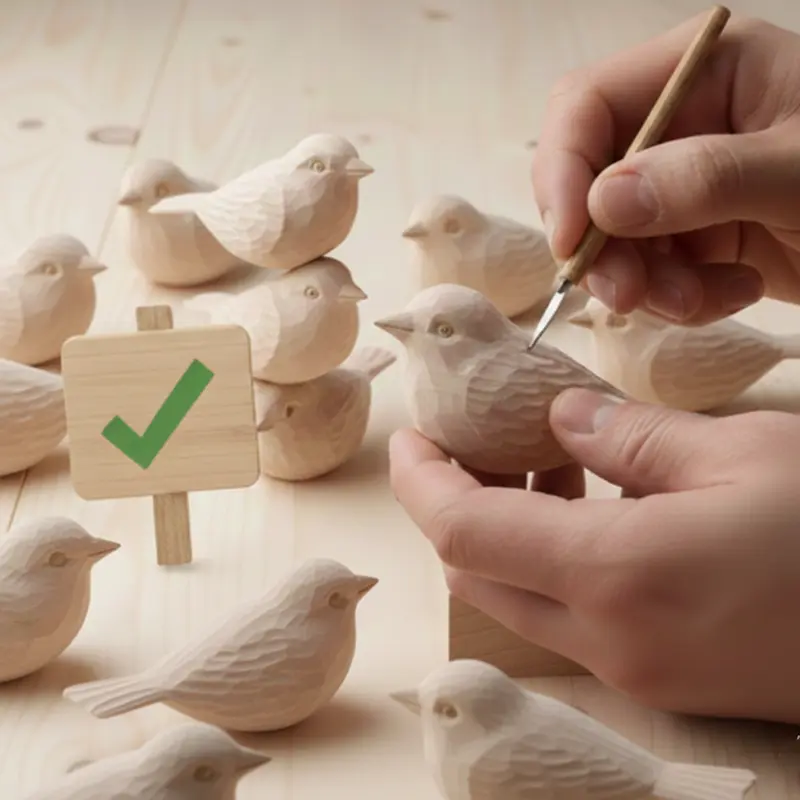
We call the slight variations between pieces ‘Artisanal Variance.’ This isn’t a flaw; it’s the hallmark of authenticity. It’s the proof that a skilled artisan, not a machine, created the work. This becomes a powerful selling point for retailers. Using fine-grained Basswood and time-honored techniques ensures a level of detail and character that automated processes simply cannot replicate.
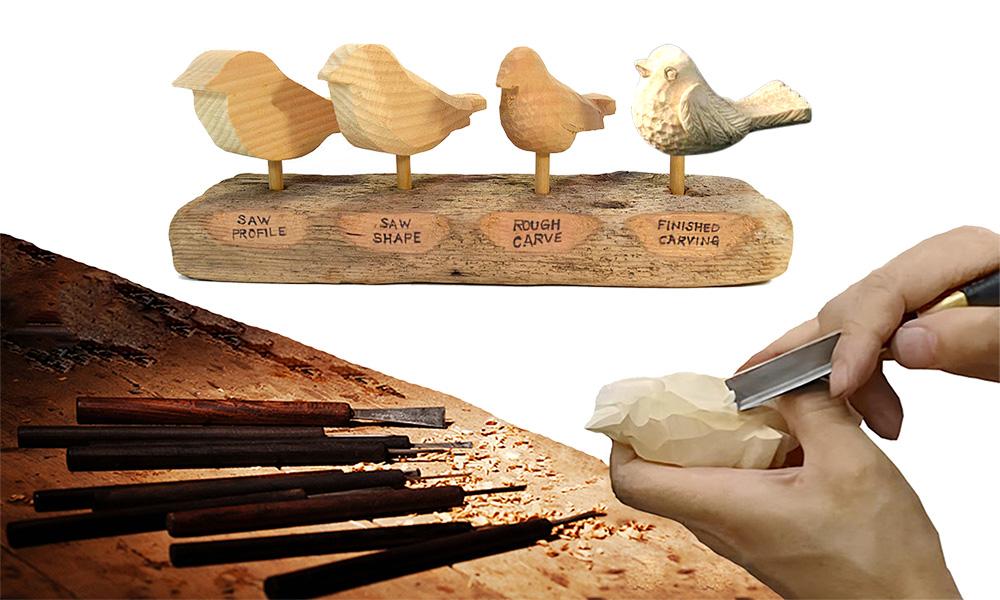
How to future-proof your retail inventory against automation trends?
Retailers must pair autonomous tech for supply chain efficiency with unique, hand-carved goods. The goal is stocking inventory defined by an ‘Artisanal Variance’ that machines can’t replicate.
| Strategy Focus | Core Technologies / Products | Key Business Outcome |
|---|---|---|
| Operational Efficiency | Agentic AI, Predictive Analytics, RFID Sensors | Reduced waste, automated reordering, real-time supply chain visibility. |
| Product Differentiation | Hand-carved goods with ‘Artisanal Variance’ and ‘Master Craftsmanship’ | Immunity to machine replication, higher perceived value, authentic customer connection. |
Integrating Autonomous Systems for Supply Chain Efficiency
The first part of the strategy is leaning into automation for back-end operations. To stay competitive, retailers need to remove manual guesswork from inventory management. This isn’t about replacing people everywhere; it’s about using technology to make faster, more accurate decisions at scale.
- Agentic AI Systems: Deploy AI agents that can independently forecast demand, automate stock reordering when levels are low, and even reroute shipments without human intervention.
- Advanced Analytics: Implement machine learning models to optimize stock levels. This helps fine-tune purchasing to reduce overstock and minimize waste, directly protecting margins.
- Real-Time Visibility: Use RFID-enabled tools and smart sensors across the supply chain. This provides a clear, live picture of where every piece of inventory is, from the source factory to the shelf.
Capitalizing on ‘Artisanal Variance’ and Hand-Sculpted Authenticity
The second part of the strategy is a direct response to the rise of AI. As automated systems and generic products flood the market, consumers develop “AI fatigue” and place a higher value on genuine human touch. This creates a massive opportunity for products that technology cannot replicate. Your inventory needs a category that is immune to automation.
This means prioritizing goods defined by their ‘Hand-sculpted Authenticity’—a quality that machine-molded replicas simply can’t achieve. You must position ‘Artisanal Variance’ as a hallmark of premium, unique goods, not a defect. Slight variations in carving or painting become proof of authenticity. Products that embody ‘Master Craftsmanship’, like our 100% hand-carved and painted wooden songbirds, retain their appeal and value against mass-produced alternatives because their story is embedded in the human effort it took to create them.
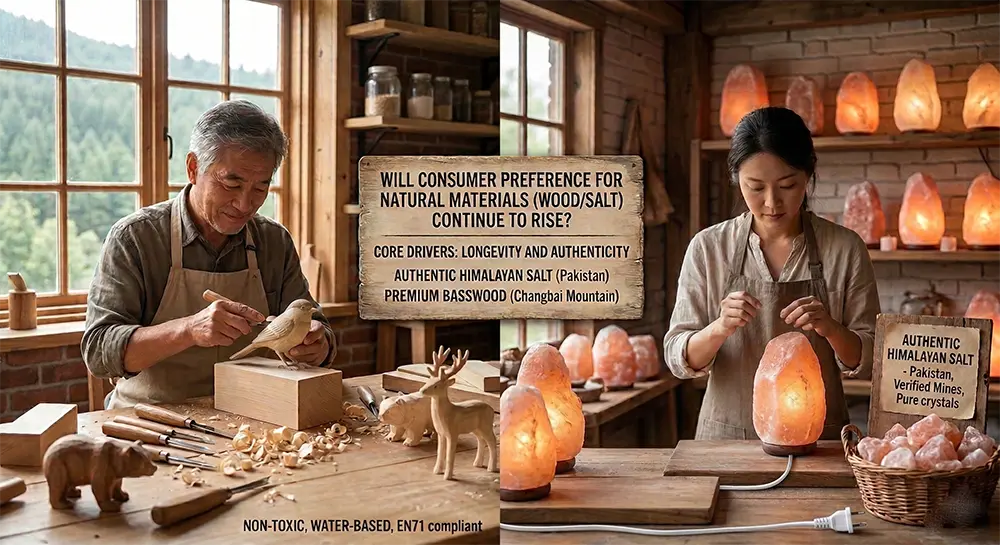
Will consumer preference for natural materials (Wood/Salt) continue to rise?
Yes, the trend toward wood and salt will strengthen into 2026, driven by a clear market demand for durable, sustainable, and authentic handcrafted goods over mass-produced alternatives.
Core Drivers: The 2026 Demand for Longevity and Authenticity
The market is shifting away from disposable decor. Wholesalers and retailers are seeing increased demand from consumers who value items with a story and a sense of permanence. This isn’t a niche trend; it’s a fundamental change in purchasing values, driven by a few key factors.
- A focus on heirloom-quality pieces. Buyers are prioritizing durability and sustainability, seeking products built to last for years, not just a single season.
- Appreciation for authentic character. Natural materials are valued for their “imperfection.” Wood grain and slight variations in handcrafted items are seen as marks of quality that improve with age.
- The rise of craft-forward design. Artisan and well-crafted products are central to modern interior aesthetics, moving from a rustic niche to a luxury standard.
Sourcing Integrity: Premium Basswood and Authentic Himalayan Salt
For a brand like Jilin Ever Creation, meeting this demand starts at the source. Our entire business model is built on providing the authentic, natural materials that the market is asking for. We ensure our partners receive products with verifiable origins and quality, aligning directly with consumer expectations for transparency and ethics.
- Premium Basswood Sourcing. We use fine-grained Basswood exclusively from the sustainable forests of Changbai Mountain, ensuring a consistent, high-quality base for intricate carving and painting.
- Authentic Himalayan Salt. Our salt lamps and wellness products are crafted from pure, authentic salt crystals sourced directly from verified mines in Pakistan, not synthetic substitutes.
- Commitment to Eco-Conscious Craftsmanship. This principle guides our entire process, from sustainable forestry to using non-toxic, water-based paints that meet EN71 and ASTM standards.
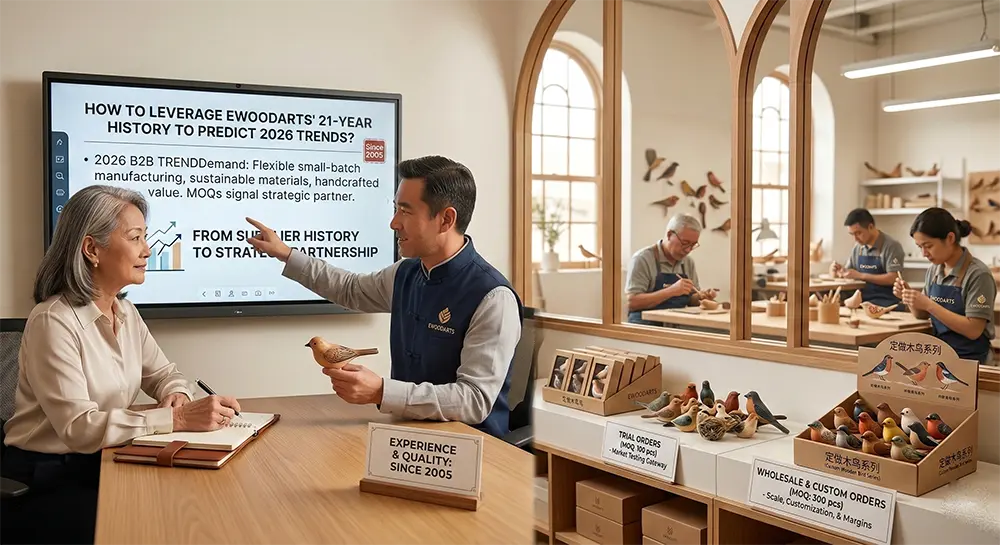
How to leverage ewoodarts’ 21-year history to predict 2026 trends?
2026 B2B trends show a clear demand for flexible small-batch manufacturing, sustainable materials, and handcrafted value. Tiered MOQs signal a move from simple supplier to strategic partner.
From Supplier History to Strategic Partnership
Looking back, the business model has clearly shifted from mass production towards flexible, small-batch OEM/ODM services. This pivot accommodates the modern retailer’s need for agility and reduced inventory risk. The market is moving away from giant, one-size-fits-all orders and rewarding manufacturers who can act as nimble production partners for both emerging and established brands.
As automation and AI saturate the market, the value of ‘Hand-sculpted Authenticity’ continues to climb. Products made by skilled artisans with decades of experience carry a premium that machines can’t replicate. This isn’t just about aesthetics; it’s about providing retailers with a product story rooted in human skill, which is a powerful differentiator on crowded shelves.
Smart manufacturers are also diversifying. Expanding from a core category like wood carving into complementary wellness products, such as Himalayan salt lamps, is a strategic move. It allows them to offer curated packages to retailers, simplifying sourcing and ensuring a consistent brand aesthetic across different product lines. This makes the manufacturer a more integrated and valuable partner.
Tiered MOQs as a Predictor for 2026 B2B Agility
A company’s commercial terms often reveal its market predictions. Ewoodarts’ tiered MOQ structure is a direct response to where the B2B decor market is heading. It’s built to serve two distinct but vital segments of the retail ecosystem.
- Trial Orders (MOQ: 100 pcs): This low entry barrier is designed for market testing. It allows smaller boutiques or online retailers to validate new product concepts with their audience without committing to massive inventory. It’s a low-risk gateway to handcrafted goods.
- Wholesale & Custom Orders (MOQ: 300 pcs): This tier serves established brands ready for scale. It provides access to full customization and better margins for larger volume, supporting growth and private label development.
This flexible structure indicates a future where the most successful manufacturing relationships are true partnerships. They must offer both accessible entry points for new players and the robust production capacity that established brands require to scale effectively.
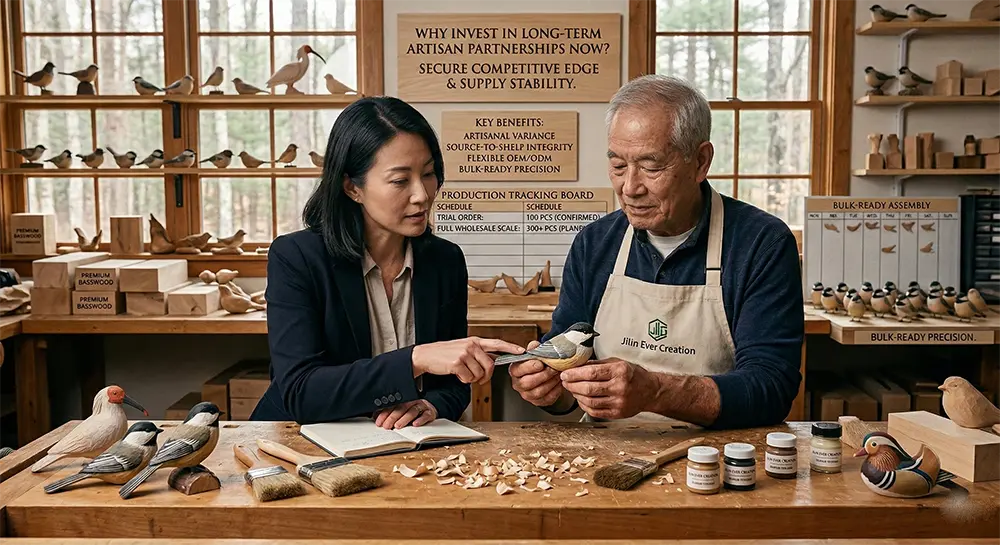
Why should B2B buyers invest in long-term artisan partnerships now?
Investing in long-term artisan partnerships secures a stable supply of unique, hand-crafted products. This approach builds trust and enables collaborative development, ensuring inventory reflects authentic craftsmanship.
As markets become saturated with automated, mass-produced goods, consumers are placing a higher value on authenticity and human skill. For B2B buyers preparing for 2026, establishing a dedicated relationship with an artisan manufacturer isn’t just about sourcing products; it’s a strategic move to secure a competitive edge. It shifts the dynamic from simple transactions to a collaborative partnership focused on mutual growth, product integrity, and supply chain reliability.
Achieving Supply Chain Stability and Product Differentiation
A long-term partnership with a source factory like Jilin Ever Creation builds the trust necessary to move beyond generic inventory. You gain a partner with deep expertise in handcrafted goods, allowing you to differentiate your brand in a crowded market. This relationship allows you to confidently leverage what we call ‘Artisanal Variance’—the slight, unique variations in hand-carved products—as a key selling point that proves authenticity against machine-made replicas. Working directly with the source provides complete ‘Source-to-Shelf Integrity,’ giving you transparency and direct quality control that third-party sourcing agents simply cannot offer.
Unlocking Growth with Flexible OEM and ODM Services
This partnership model directly translates into tangible manufacturing advantages. You can develop exclusive product lines using our comprehensive OEM/ODM custom manufacturing services, creating items unique to your brand. For wholesalers concerned about consistency, we ensure ‘Bulk-ready Precision,’ a process that blends the charm of handmade goods with the reliability needed for large orders. We also support your growth with flexible MOQ strategies. You can start with a trial order of just 100 pieces from our in-stock inventory and then scale up to full wholesale production of 300+ pieces to maximize your margins.
Frequently Asked Questions
What are the major trends shaping the future of wood crafts?
The wood crafts industry in 2026 is being redefined by three primary forces: a strong shift toward sustainability and responsible sourcing of local wood species, high demand for personalized and custom pieces, and the blending of traditional craftsmanship with modern technology.
What is the difference between hand-carved and AI-generated wood art?
Hand-carved work involves a skilled artisan physically working with wood, applying their expertise and decision-making throughout the process. AI carving, on the other hand, only generates realistic-looking digital images of wooden sculptures from text prompts without any physical craftsmanship taking place.
What are the key wood decor trends for 2026?
In 2026, wood is making a strong comeback as a primary design element. Key trends include the use of diverse wood tones, especially rich dark woods like walnut, architectural details such as fluted and reeded finishes on furniture, and an appreciation for high-quality craftsmanship that creates an authentic, collected-over-time aesthetic.
Is wood carving a dying art?
No, market data shows the industry is experiencing consistent growth. Projections indicate that both the wood carving tools and services markets will expand steadily, driven by a surge in DIY culture and growing consumer demand for custom, handcrafted wood elements in home decor and construction.
Final Thoughts
While machine-molded replicas offer a lower initial cost, they leave your inventory vulnerable to price wars and consumer AI fatigue. Our commitment to 100% hand-carved Basswood provides the tangible “Artisanal Variance” that justifies a premium price point. This strategy protects your margins and builds a customer base that values true craftsmanship.
The best way to verify this market shift is to feel the quality yourself. We recommend starting with a flexible trial order of 100 pieces to test our hand-carved songbirds with your customers. Contact our team to secure your trial order or to discuss a custom OEM project.
While looking for specific styles, don’t forget to check our full catalog of [wholesale-wooden-songbirds] to see all available options.
As a comprehensive [Wooden Bird Factory], we also produce cardinals, owls, ducks and robins.