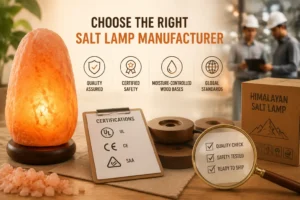
Sourcing the correct salt lamp bulbs determines whether a retail shipment thrives or fails due to moisture damage. Generic, low-heat alternatives cause salt crystals to sweat, creating liquid runoff that destroys wooden bases and triggers expensive returns. This technical mismatch compromises product durability and erodes wholesale margins through preventable warranty claims.
We standardize 15W and 25W heat-resistant bulbs to ensure necessary hygroscopic evaporation. Every assembly features UL, CE, or SAA certified holders for global distribution. This guide evaluates wattage selection and 5-ply export packaging to help you secure inventory integrity and reduce transit breakage.
Why Electrical Components Matter Most
The electrical components are the lamp’s functional heart. The bulb provides essential heat to prevent moisture damage, while certified wiring ensures safety and global market access.
The Dual Role of the Bulb: More Than Just Light
The bulb in a salt lamp does a lot more than just provide light. Its main job is to generate a steady, low-grade heat that warms the salt crystal from the inside out. This heat is what makes the lamp work as intended.
- The consistent warmth prevents the salt crystal, which naturally attracts water, from accumulating moisture and “sweating.” This is critical for the lamp’s durability.
- This heat is also believed to be necessary for the emission of negative ions, a core feature that consumers look for.
- We specifically use incandescent bulbs because they are effective heat producers. While our components are compatible with LEDs, LED bulbs run cool and do not provide the heat required for the lamp’s primary functions.
Certified Components for Global Market Access
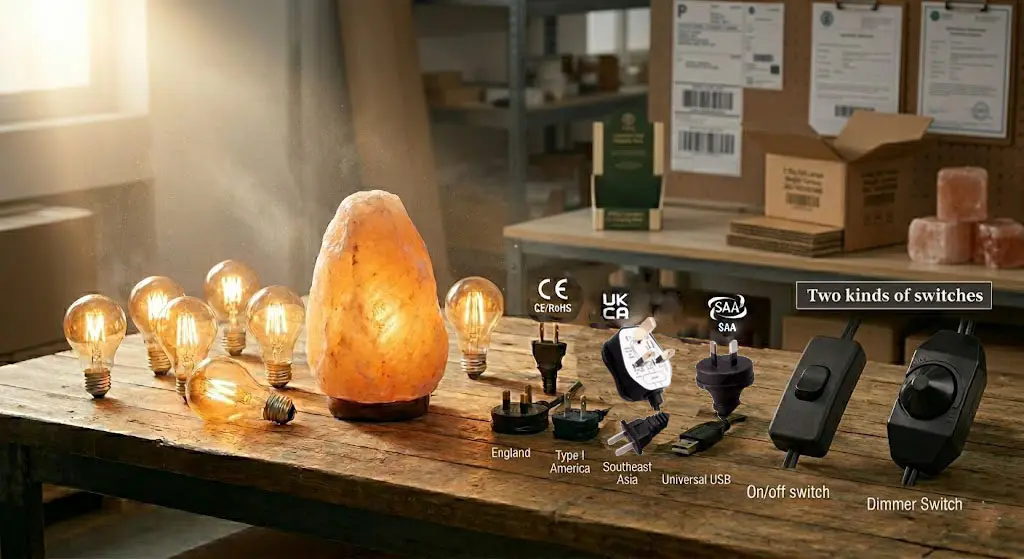
For any distributor or retailer, getting products to market without compliance headaches is everything. We build our lamps with globally certified, market-specific electrical components to remove these barriers and ensure product safety.
- Full Certification: Our components are certified for major global markets, including UL/ETL for North America, CE/RoHS for Europe, UKCA for the UK, and SAA for Australia.
- Market-Ready Plugs: We provide plugs tailored for each region (Types A/B, C/F, G, I), so your customers don’t need clumsy or unsafe adapters.
- Flexible Controls: We offer both Rotary Dimmer Switches for adjustable brightness and standard Rocker Switches for simple on/off operation, catering to different consumer price points and preferences.
15W vs. 25W Incandescent Oven Bulbs
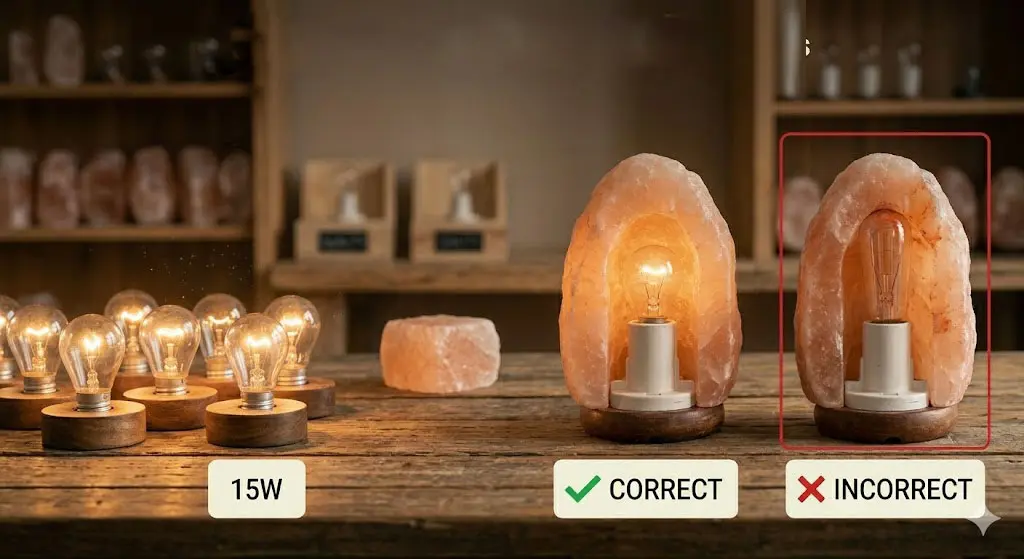
A 15W incandescent bulb is smaller and cooler, making it the correct choice for most standard salt lamps. Using a larger, hotter 25W bulb can create a safety hazard.
| Feature | 15W Incandescent Bulb | 25W Incandescent Bulb |
|---|---|---|
| Physical Size | Shorter (approx. 47mm) | Longer (approx. 55mm) |
| Heat & Brightness | Gentle warmth, soft ambient glow | Significant heat, brighter light |
| Primary Application | Standard 2-5kg salt lamps | Larger lamps; only if specified |
| Safety | Ideal for standard assemblies | Risk of overheating in lamps designed for 15W |
Key Differences in Size, Heat, and Brightness
The main distinction between these bulbs is physical. A 15W bulb is shorter, at about 47mm, while a 25W bulb is longer at 55mm. This size difference is critical, as a 25W bulb may not fit inside the cavity of a salt lamp or under its protective cover. Functionally, a 25W bulb produces far more heat and brighter light. The 15W bulb provides a much softer, ambient glow with gentle warmth. Both types are manufactured as appliance bulbs, specifically designed to withstand extreme temperatures up to 300°C, which is why they are suitable for high-heat applications.
Recommended Wattage for E12/E14 Salt Lamp Holders
Our salt lamps come with certified E12 or E14 heat-resistant bulb holders, engineered for specific wattages to ensure safety and performance. For most of our salt lamps in the popular 2-5kg range, the 15W incandescent bulb is the standard. It supplies the perfect amount of warmth to activate the salt without any risk of overheating the electrical assembly. Using an incorrect wattage, like forcing a 25W bulb into a lamp designed for 15W, is a safety hazard. It can damage the electrical components and shorten the life of the product.
Premium Factory-Direct Himalayan Salt Lamps Wholesale
The Problem with LED Bulbs in Salt Lamps
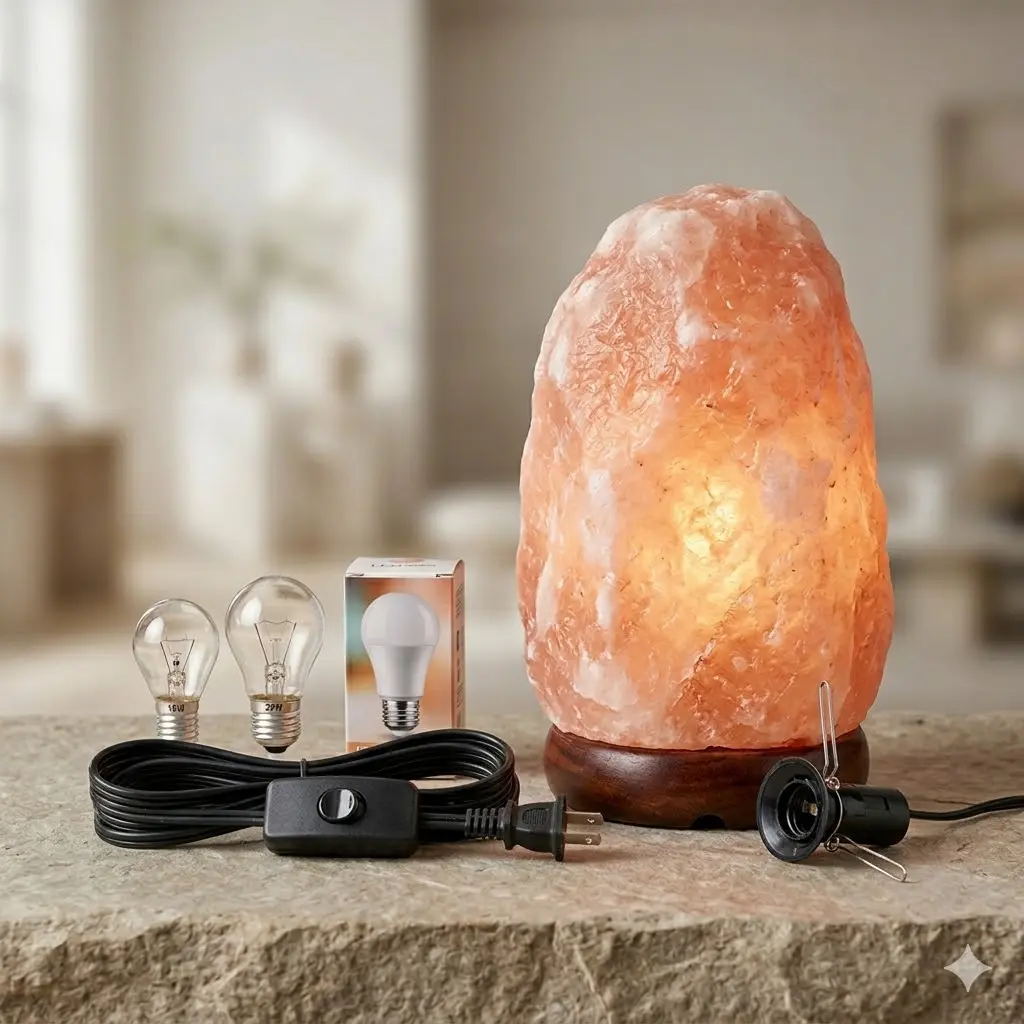
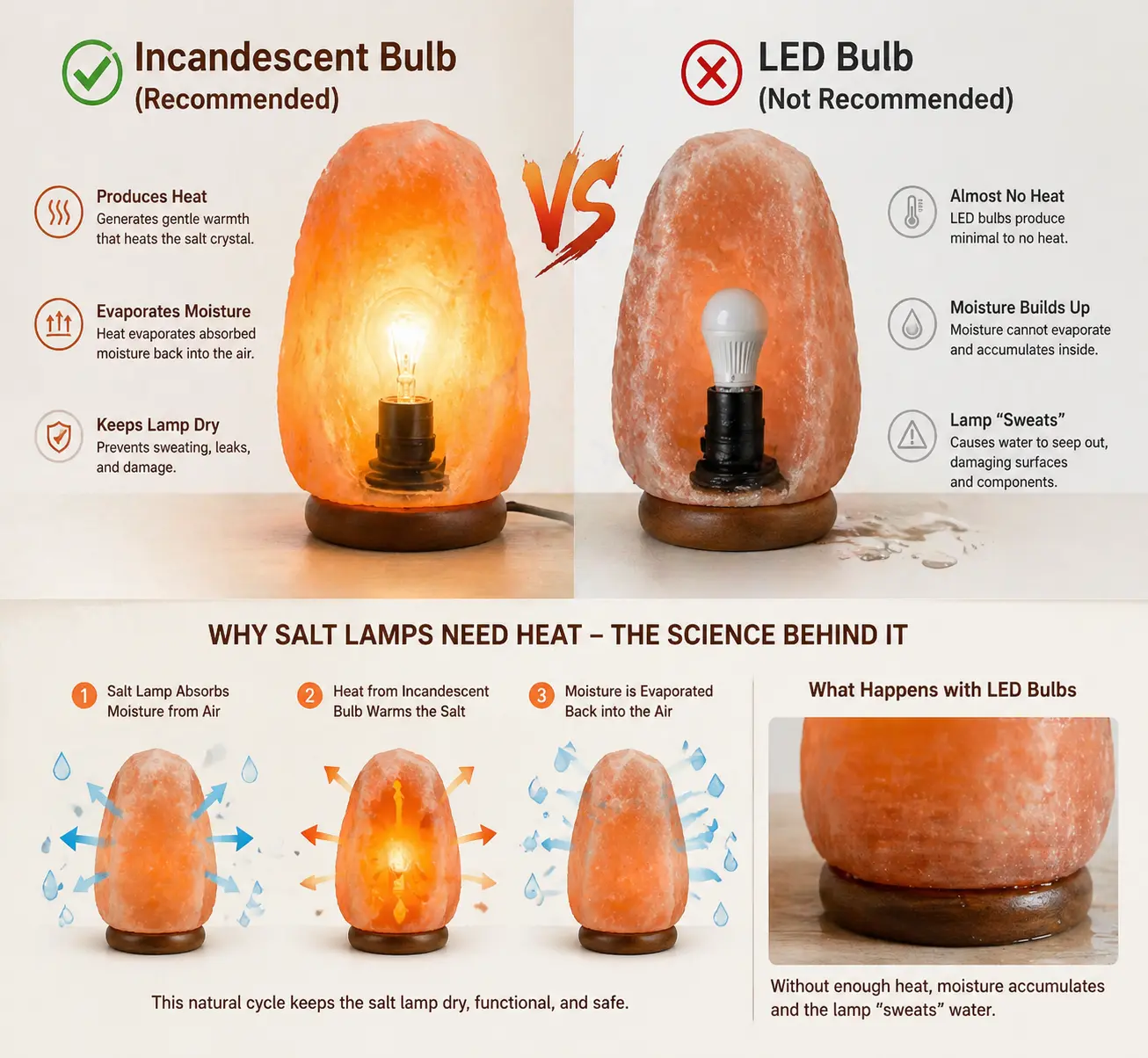
LED bulbs don’t produce enough heat to evaporate the moisture salt lamps naturally absorb. Without that warmth, the lamp can “sweat” water, potentially damaging surfaces and components.
Why Salt Lamps Need Heat (And LEDs Don’t Provide It)
Himalayan salt is naturally hygroscopic, which means it pulls moisture directly from the air. This is a fundamental property of the material. In humid environments, a salt lamp will constantly draw in microscopic water molecules.
The gentle warmth from a traditional incandescent bulb is crucial. It heats the salt crystal just enough to evaporate the collected moisture back into the environment. This process prevents the lamp from weeping or forming puddles at its base.
LED bulbs are engineered for high energy efficiency, so they produce almost no heat. While this is great for standard lighting, it makes them unsuitable for a salt lamp’s primary function. An LED simply can’t perform the essential evaporative job, leaving the lamp wet and prone to damage.
Focusing on Safe, Compatible Electrical Components
We recommend incandescent bulbs to ensure the lamp functions as it should. Our electrical assemblies are specifically built to support them safely and reliably.
Our lamps feature heat-resistant E12 or E14 bulb holders, depending on the target market. These are paired with globally certified components—including UL, ETL, CE, and SAA—to meet international safety standards.
Whether your order specifies a standard rocker switch or a rotary dimmer, our electrical systems are engineered for compatibility with bulbs that provide the necessary warmth. The entire assembly is designed for reliable performance, not just illumination.
Spring-Clip vs. Screw-In Bulb Assemblies
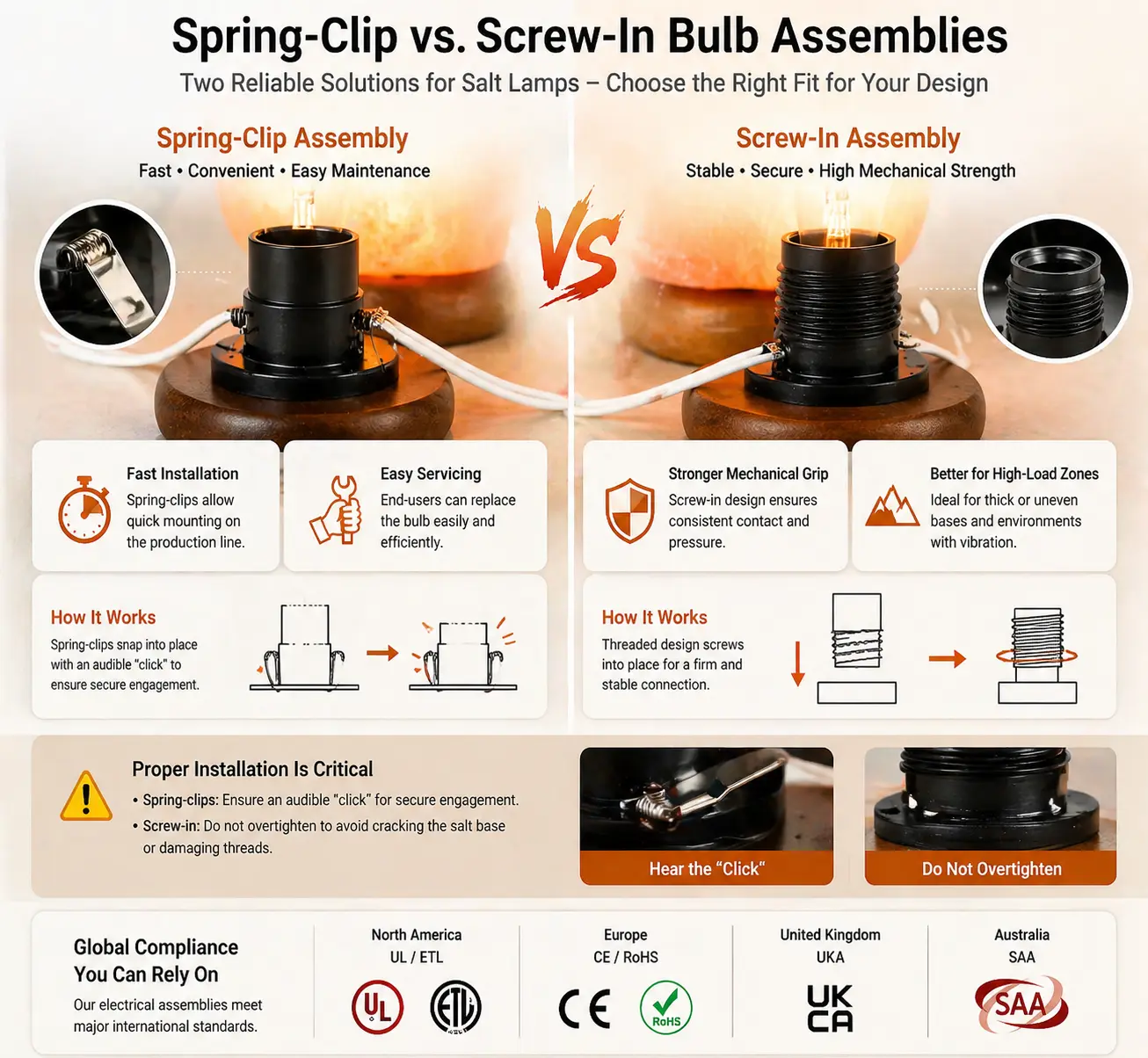
Spring-clips offer fast installation and easy servicing. Screw-in designs provide a stronger mechanical grip, better for high-load zones. The choice balances speed with mechanical stability.
Key Differences in Performance and Installation
Spring-clip assemblies allow for much faster installation on the production line and give end-users easier access for bulb replacement. This makes them highly efficient for manufacturing and user-friendly for routine maintenance.
Screw-in designs provide a superior mechanical grip. This is a better solution for lamps with thick or uneven bases because it ensures consistent contact and pressure on the fixture. The stability is critical in high-load zones or where vibration might be a concern.
Proper installation is critical for both types. The spring clips require an audible ‘click’ to confirm a secure engagement. Technicians must handle screw-in types with care to avoid cracking the lamp base or damaging the component threads during assembly.
Component Selection for Global Compliance
Regardless of the assembly mechanism, our component selection prioritizes safety and international market access. We use heat-resistant E12 and E14 bulb holders specifically engineered for durability and safe operation within enclosed salt lamps.
All our electrical assemblies are fully compliant with major international standards, ensuring your products have seamless entry into key markets. Certifications include:
- North America: UL / ETL
- Europe: CE / RoHS
- United Kingdom: UKCA
- Australia: SAA
Rotary Dimmers vs. Touch Dimmers
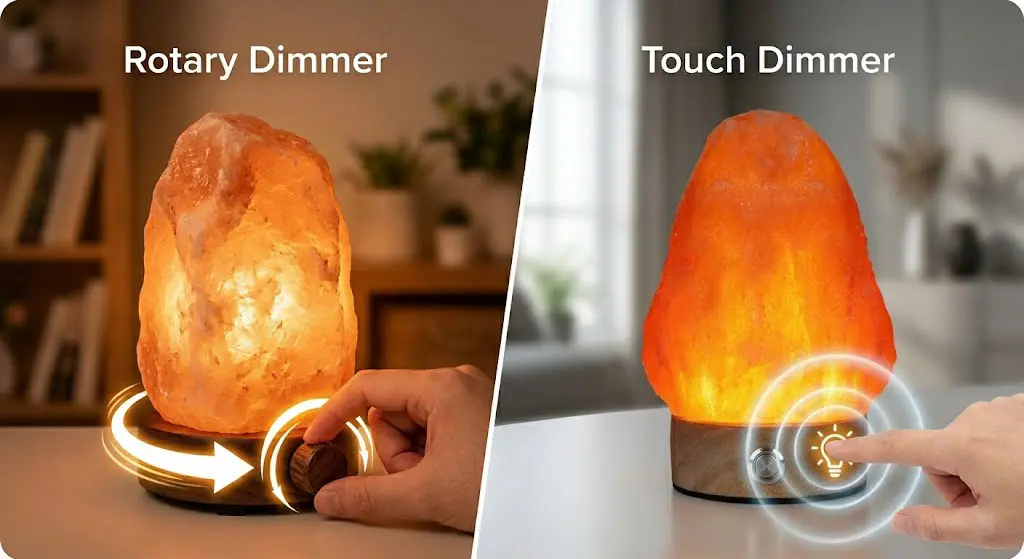
Rotary dimmers use a knob for precise, tactile control, while touch dimmers offer a modern tap/swipe interface. For salt lamps, rotary dimmers excel at fine-tuning the ambient glow.
Comparing Control Styles: Physical Knobs vs. Capacitive Surfaces
The difference comes down to the user interface. Rotary dimmers feature a classic, tactile knob that users turn to adjust brightness, providing direct physical feedback with every adjustment. It’s a simple, reliable mechanism. Touch dimmers use a flat, capacitive surface that responds to taps or swipes. This creates a sleek, modern look with no moving parts, integrating cleanly into the product design.
Why Rotary Dimmers Enhance the Salt Lamp Experience
For creating a specific mood, precise control is key. Our optional rotary dimmer allows users to adjust the brightness from a soft nightlight to a vibrant amber glow. This intuitive control improves the user’s ability to create a specific ambiance. That’s why this dimmer is highly recommended for premium retail products where the user experience is a major selling point.
Bulb Lifespan and Replacement Sourcing
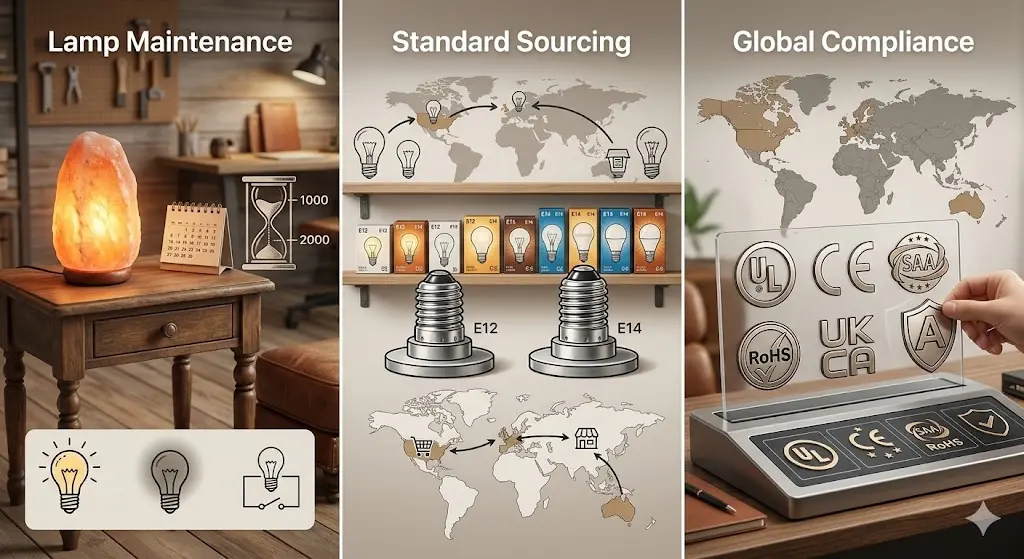
Bulbs last 1,000-2,000 hours. We use standard E12/E14 holders and are fully certified for the US, EU, and Australia, making local replacements easy to find.
Expected Lifespan and Replacement Indicators
A standard incandescent bulb in a salt lamp has an operational life of about 1,000 to 2,000 hours of continuous use. It’s time to replace the bulb when you notice clear signs of failure.
- The lamp flickers or provides inconsistent light.
- The light becomes noticeably dim, even at the highest setting.
- The bulb fails to turn on at all.
Simplified Sourcing with Globally Compliant Components
We build our lamps to make replacement sourcing straightforward for distributors in any major market. Each lamp is fitted with either a standard E12 or E14 heat-resistant holder, depending on the region’s electrical standards. This removes any guesswork.
Our entire electrical system is certified to meet key international safety and performance standards. This ensures our lamps are compatible with locally sourced incandescent or ERP-compliant bulbs, giving your customers easy access to replacements. Our certifications include:
- North America: UL / ETL Listed
- Europe: CE / RoHS / ERP Compliant
- United Kingdom: UKCA Certified
- Australia: SAA Approved
Packaging Spare Bulbs in Master Cartons
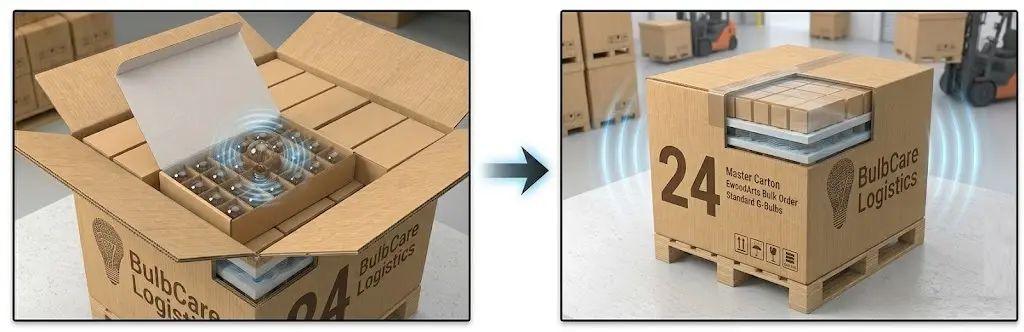
We ship spare bulbs in master cartons using durable, multi-layered boxes with internal dividers. This protects fragile filaments, ensuring wholesale orders arrive undamaged and ready for distribution.
Preventing Damage in Bulk Shipments
Shipping fragile components like bulbs in bulk requires specific protective measures. The goal is to isolate each bulb and absorb any shock from transit, which can easily snap delicate filaments. Standard practice involves a multi-layered approach to minimize breakage.
- We use internal trays or cardboard dividers to create individual cells for each bulb. This prevents glass-on-glass contact, a primary cause of fractures and breaks during shipping.
- Foam supports are also used within the packaging to absorb shock and cushion the bulbs from vibrations common in both sea and air freight.
Our Use of Export-Engineered Cartons
The outer master carton provides the first line of defense. We don’t use standard boxes that can collapse or get crushed in a container. All components are shipped in cartons specifically built for international logistics.
- Carton Material: All master cartons are made from 5-Ply BC Flute Export Cartons.
- Purpose-Built: This reinforced corrugated board is engineered to withstand the compression, moisture, and handling stress of long-distance sea and air transportation, ensuring your components arrive safely.
Frequently Asked Questions
Can I use an LED bulb in my salt lamp?
Yes, you can use an LED bulb, and it will save energy. Many are also dimmable. Keep in mind that traditional incandescent bulbs produce a gentle heat that helps evaporate any moisture absorbed by the salt, which is why they are standard.
Why do my salt lamp bulbs burn out so quickly?
High humidity is the main cause. Salt is hygroscopic, meaning it absorbs moisture from the air. This moisture can condense on the bulb and cause it to fail. Other factors include faulty dimmer switches or frequent vibrations.
What type and size of bulb do I need for my salt lamp?
Most salt lamps use a standard incandescent bulb with an E12 candelabra base. The correct wattage depends on the lamp’s size. Smaller lamps (around 2–3kg) typically use a 15W bulb, while medium lamps may require a 25W bulb.
How do you change the bulb in a lamp with a spring-clip base?
First, unplug the lamp and let the bulb cool down completely. Gently squeeze the metal spring clips on the base to release the bulb holder. You can then pull it out, unscrew the old bulb, and replace it with a new one of the correct wattage. Finally, squeeze the clips again to re-insert the holder into the lamp.
Final Thoughts
Selecting the correct bulb is critical for both the safety and performance of a Himalayan salt lamp. High-quality, heat-resistant bulbs (such as E12 or E14) are essential to ensure the salt reaches the optimal temperature for ion release while reducing customer returns due to premature burnout.
We integrate these quality benchmarks into every ewoodarts order, sourcing only certified, long-life bulbs that meet rigorous international safety standards for heat dissipation. To understand how these essential components fit into a professional procurement strategy, please consult our [Ultimate Guide to Sourcing Wholesale Himalayan Salt Lamps]
Explore our [Salt Lamps Wholesale] collection for our full range of replacement parts and electrical components. If you require bulk quantities or specific voltage specifications for your local market, please [Reach out to our team] today for a tailored quote.