Skip to content
Every experienced B2B buyer in the cross-border crafts trade has faced this nightmare: You wait months for a container to clear customs, eager to unpack your wholesale order of hand-carved wooden ducks, delicate shorebirds, or intricate owl figures. But upon opening the boxes, you find broken beaks, snapped tails, and chipped toes. To make matters worse, the outer carton is completely intact, meaning your freight forwarder and insurance will instantly deny the claim, citing “insufficient inner packaging.”
If you are currently in the sourcing process and want to ensure you are selecting high-quality products from the start, check out our comprehensive guide on buying wooden ducks to better understand the craftsmanship and quality benchmarks we uphold.
When this happens, many sourcing managers panic and start looking into expensive, over-engineered solutions like CNC-molded polyurethane foam or custom die-cut inserts. But let’s be brutally honest: you are purchasing natural, handcrafted wood crafts with wholesale price points, not $3,000 camera lenses. If you force your manufacturer to use custom-molded foam, your packaging costs will skyrocket, eating directly into your net profit margin.
So, how does a veteran export factory solve this without burning your margins? We skip the gimmicks and rely on fundamental, cost-effective materials like bubble wrap, paired with a ruthlessly strict ISTA 1A manual drop test SOP. It’s not about spending more money; it’s about factory-floor discipline.
The Pragmatic Approach: Targeted Bubble Wrap
Wood grain naturally weakens at narrow extremities. The extended beak of a duck, the thin tail feathers of a shorebird, or the separated toes of an owl are always the first to snap under shear force. Many amateur factories simply wrap the entire carving in a single sheet of bubble wrap, tape it up, and toss it into a box. Under heavy impact, the sharp beak easily pierces the bubble wrap, strikes the carton wall, and shatters.
“Mummy-Style” Protection for Fragile Extremities
To prevent this, we utilize a labor-intensive but highly effective “layered reinforcement” method. Before wrapping the whole product, our packing line workers use small, pre-cut pieces of bubble wrap to tightly bandage the most vulnerable points—the beak, the tail, and the toes. We wrap these extremities two to three times to create an independent, shock-absorbing cushion.
Only after this localized protection is secured do we wrap the entire carving in a larger sheet of bubble wrap. Think of it as putting a cast on the most fragile bones before putting on a protective suit. When the outer carton hits the ground, this targeted inner packaging transforms concentrated, lethal shear force into a distributed, gentle compression. The material remains cheap, but the intelligent application saves the product.

The Truth About ISTA 1A Manual Drop Testing
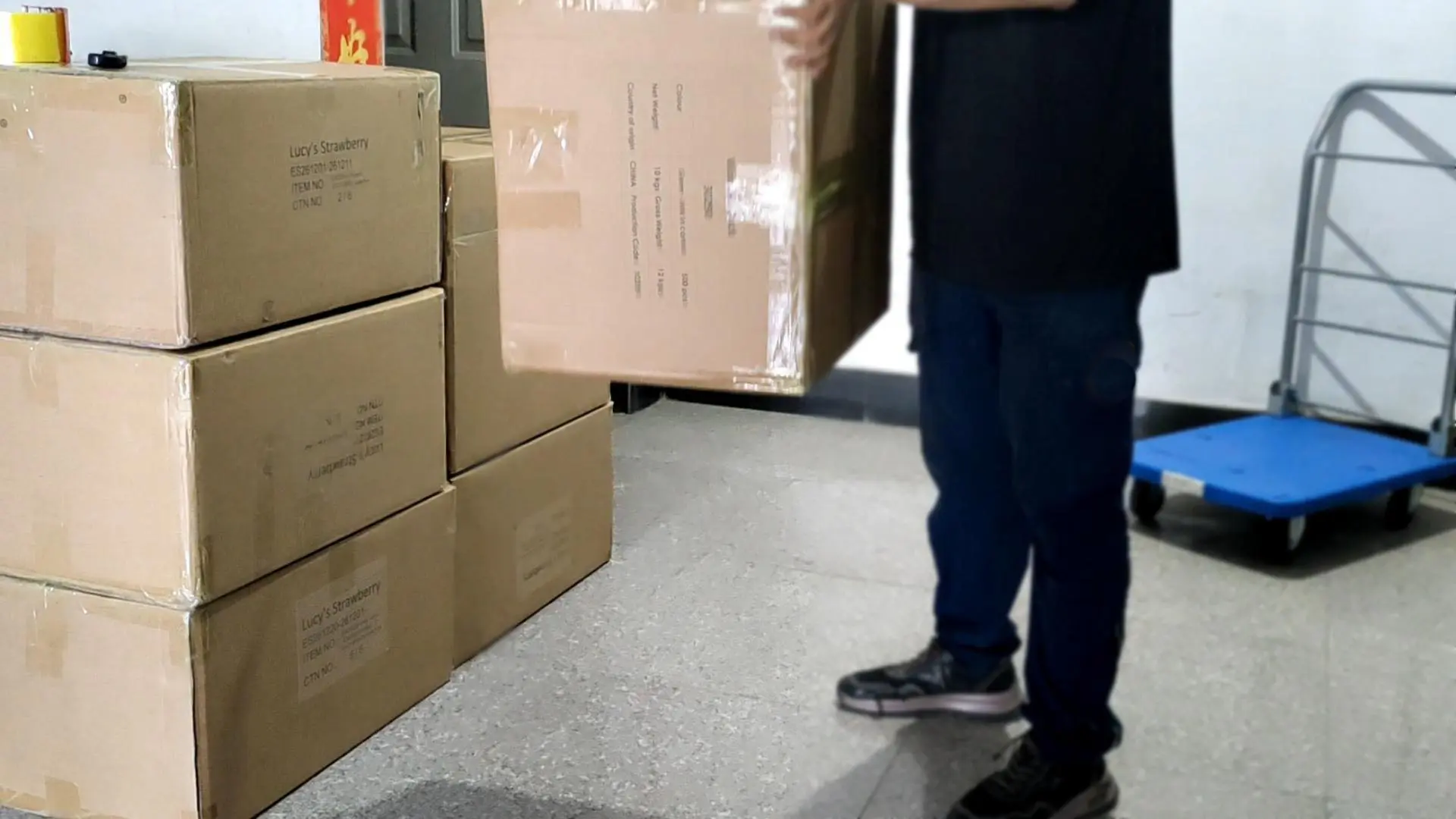
When buyers hear “drop test,” they often imagine pneumatic mechanical arms in pristine laboratories. The reality of B2B manufacturing is that 99% of source factories conduct manual drop tests on the factory floor. However, “manual” does not mean random. We strictly adhere to the internationally recognized ISTA 1A transit testing standard.
The 61cm (24-Inch) Benchmark
To give your QC team peace of mind, here are the exact metrics we use:
- Weight Range: Our master cartons typically weigh between 11 kg and 19 kg (24 lbs to 42 lbs). This is the most common weight tier for bulk e-commerce and wholesale shipments, and it is the exact weight that warehouse workers are most likely to drop during container loading.
- Drop Height: Precisely 61 cm (24 inches). Why this height? Because it accurately simulates a carton slipping from a worker’s waist, or falling off a standard warehouse pallet. During factory audits, our QC inspectors use pre-painted reference lines on the wall to ensure this height is never compromised.
The “1 Corner, 3 Edges, 6 Faces” Protocol
A true drop test isn’t just dropping a box flat on its bottom and calling it a success. The structural integrity of the packaging is tested through how it falls. Our manual drop test involves a brutal, non-negotiable sequence of 10 consecutive drops, known in the industry as the “1 Corner, 3 Edges, 6 Faces” protocol.
1. The Most Destructive Drop (1 Corner)
The test begins with the most severe impact. The box is angled so that it falls 61 cm (24 inches) directly onto its weakest bottom corner. All the kinetic energy is concentrated on a single point, guaranteeing carton deformation. This is the exact moment where the “mummy-style” bubble wrap on the beak proves its worth.
2. The Structural Integrity Drop (3 Edges)
Next, the carton is dropped onto its shortest edge, its medium edge, and its longest edge. This sequence tests the burst strength of the carton’s glued seams and ensures the inner cushioning hasn’t shifted after the initial corner impact.
3. The Shifting Test (6 Faces)
Finally, the box is dropped flat on all six sides: top, bottom, front, back, left, and right. This guarantees that the hand-carved wood crafts inside are tightly packed. If there is dead space, these 6 flat drops will cause the wood to clash together and chip the paint. After all 10 drops, we open the box. If a single beak is fractured or a tail is chipped, the packaging SOP is rejected.
Securing Your Claim: The Power of Video Proof
International trade is unforgiving. If a container faces severe turbulence at sea and your goods arrive damaged, insurance companies will immediately question your factory’s packaging standards. You don’t need to argue about having “premium custom foam.” All you need is evidence.
Because we strictly follow the ISTA 1A manual drop protocol, we can provide you with unedited video proof of our QC inspectors dropping a 24-42 lb carton from 24 inches, executing the full 10-drop sequence. When you hand that video to a freight forwarder, it instantly clarifies liability and streamlines your reimbursement process.
At the end of the day, successful B2B sourcing isn’t about telling the best story; it’s about minimizing risk without inflating costs. Bubble wrap isn’t outdated, and manual drop testing isn’t inferior—as long as the execution is flawless, the standards are rigid, and the factory doesn’t cut corners. That is how we protect your margins and ensure your goods arrive ready for the shelf.
Frequently Asked Questions
What is the standard drop test for packaging?
The standard we strictly follow for international bulk shipping is ISTA 1A. For handcrafted wood carvings, this involves a rigorous sequence of manual drops designed to test the outer carton’s structural integrity and verify that our targeted inner bubble wrap protects fragile extremities like beaks and tails.
How is drop test height determined for packaging?
Drop height is determined by the total gross weight of the carton per ISTA guidelines. For standard B2B wholesale orders weighing between 11 kg and 19 kg (24 to 42 lbs), the mandatory drop height is exactly 61 cm (24 inches), simulating a fall from a worker’s waist or a warehouse pallet.
Why are drop test standards important in packaging quality control?
Following strict standards provides undeniable video proof of packaging integrity. If a carrier mishandles a container, having documented ISTA 1A drop test results prevents insurance companies from denying your freight claim due to “insufficient inner packaging,” thereby protecting your profit margins.
What is a drop test in packaging?
A drop test is a physical simulation of the severe impacts a package might endure during cross-border transit and rough warehouse handling. It involves dropping the fully loaded carton onto a hard concrete surface to expose and fix weak points in the inner cushioning before mass production begins.
How many drops are in a standard packaging test?
The standard ISTA 1A manual drop test consists of exactly 10 consecutive drops. The sequence is rigorous: 1 drop on the weakest corner, 3 drops on the edges, and 6 drops flat on all faces. If a wooden carving survives this entire sequence without damage, the packaging SOP is approved.