Skip to content
A woman in Sag Harbor told me last summer that she’d stopped selling seagulls entirely. “Too tacky,” she said. “Every tourist shop has those garish painted things with the googly eyes. My clients want something they can put in their living room without being embarrassed.”
She was right. And she was wrong. As someone who has supplied wooden seagull decor wholesale to coastal retailers for over twenty years, I have strong opinions about which designs actually work in elevated interiors. She was right that the market is drowning in cheap, kitschy seagull tchotchkes — the kind you find in a barrel outside a boardwalk fudge shop. She was wrong to abandon the category entirely. Because the seagull, done properly, is the single most versatile bird in coastal decor. It fits a $12 million Hamptons beach house and a $40,000 lakeside cabin. It reads “coastal” without screaming “tourist trap.”
The trick is knowing which seagull designs belong in a high-end context and which ones belong in the clearance bin. After twenty-odd years of carving these things and shipping wholesale bird carvings to four continents, I’ve got opinions. Here are the five seagull styles that actually work for elevated coastal interiors — ranked by how consistently they sell into design-forward channels.
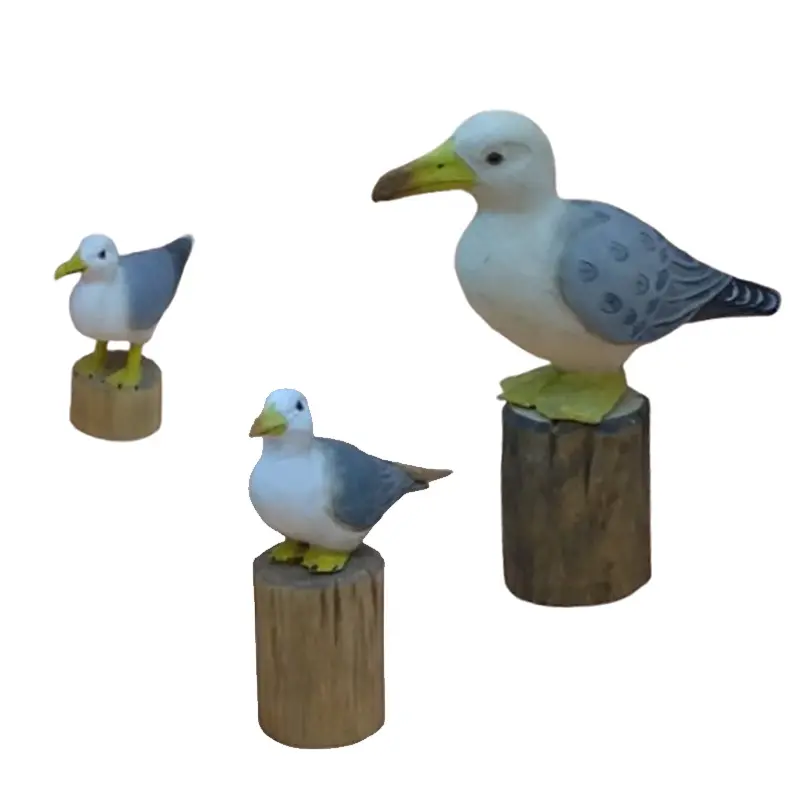
#4 The Classic Standing Gull (Painted, 8 in)
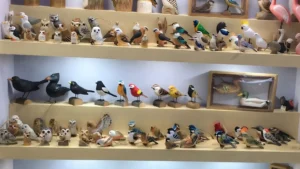
Let’s get this one out of the way. The standing painted seagull — white body, grey wing tips, yellow beak — is our volume mover. It’s not “silent luxury.” It’s a solid, honest, mid-market coastal bird that sells by the hundreds into gift shops from Cape Cod to Cornwall. For more on hand-painted wooden birds and what buyers should know before ordering, this is the entry point. I’m putting it at #5 not because it’s bad, but because it’s the entry point. If a buyer is new to coastal decor, this is where they start. It’s safe, it’s recognizable, it doesn’t require the customer to have any design vocabulary.
Where it lives: gift shops, seaside B&Bs, online marketplaces. Where it doesn’t: interior design studios, luxury home staging, architectural projects. Know the difference.
#3 The Weathered White Gull (Distressed Finish, 10 in)
Now we’re getting somewhere. Take the same standing form, but finish it in our distressed white — layers of chalky paint sanded back at the edges, subtle wood grain showing through, like the thing spent twenty years on a porch railing in Nantucket. This is the bridge between “gift shop bird” and “decor object.” Interior stylists use these in vignettes: a stack of old books, a piece of driftwood, one weathered gull. It photographs beautifully for shelter magazines.

The distressing has to be done by hand. You can’t machine-sand this look — it comes out uniform and dead. Our painters use a two-coat technique: base coat, top coat, then selective hand-sanding with different grits depending on where natural wear would occur. Breast, wing edges, tail tip. It takes three times longer than a solid paint job. That’s why it costs more wholesale, and why retailers can charge significantly more at the register.
Where it lives: upscale coastal gift shops, farmhouse-modern interiors, home staging companies, Etsy sellers targeting “weathered coastal decor.”
#2 The Hanging Gull Trio (Ceiling-Suspended, Wings Spread)
Three gulls in flight, different sizes (roughly 6, 8, and 10 inches wingspan), suspended from thin monofilament at staggered heights. This is the one that stops people in the doorway. I’ve watched it happen at trade shows — someone walks past a booth, catches the movement of hanging birds from the corner of their eye, and just stops. There’s something about a bird overhead that triggers a primal “look up” response.

For commercial spaces — restaurant lobbies, hotel atriums, high-ceilinged retail — the hanging trio is disproportionately effective relative to its cost — they’re among the best coastal impulse buys for commercial spaces. The birds themselves are simple forms (wings spread, body streamlined, no fussy detail), so they’re light. A set of three weighs under a pound total. Installation is a ceiling hook and fishing line. But the visual impact fills an entire room.
Where it lives: restaurants, boutique hotels, beach house entryways with vaulted ceilings, retail window displays. This is the design that commercial buyers reorder most consistently once they’ve seen it in situ.
#1 — The Abstract Gull (Simplified Form, Sculptural, 14 in)
Here’s where we leave “bird carving” behind and enter “wood sculpture.” The abstract gull is a reduction — we take the essential gesture of a seagull (the upswept wing line, the forward lean, the sense of wind) and strip away everything else. No eyes. No individual feathers. No beak detail, just a clean taper. The silhouette reads “gull” from ten feet away, but up close it’s pure form. Smooth planes, gentle curves, the grain of the basswood running through the wing like a brushstroke.
This is the piece that gets placed on a marble console table in a foyer. The one an architect specifies for a boutique hotel lobby. The one that sells in a gallery for three or four times what a painted bird brings, because the buyer isn’t buying a “seagull” — they’re buying a sculpture that references the coast. The emotional register is completely different. Nobody puts an abstract gull next to a “Life’s Better at the Beach” sign. It demands a more considered environment, and buyers know that instinctively.
We make these in limited runs because the carving is slower — each one is essentially hand-shaped rather than roughed out on a band saw and refined. The form has to be perfect because there’s no detail to hide behind. I reject about one in eight at final inspection. A slight asymmetry in the wing sweep, a flat spot where there should be a curve — gone. Into the seconds bin. The ones that pass are genuinely sculptural objects.
Where it lives: galleries, design showrooms, luxury hospitality, architectural projects, private collections. This is the top of the pyramid. Volume is low. Margin is not.
What “Silent Luxury” Actually Means for Your Buying Decisions
The term gets thrown around a lot. Let me make it concrete for someone actually writing purchase orders — especially if you’re a low MOQ manufacturer buyer:
Material honesty. The wood looks like wood. Not painted to look like something else, not coated in thick lacquer that hides the grain. The buyer should be able to see and feel that this is a natural material shaped by hand.
Restraint in form. Fewer details, better executed. A bird with 47 individually carved feather lines is “craft.” A bird with three perfect curves is “design.” The high-end buyer responds to the second one.
Neutral palette. Whites, natural wood tones, soft greys. No primary colors. No glossy finishes. If it looks like it could be in a Pottery Barn catalog or an Architectural Digest spread, you’re in the right zone.

Weight and presence. Cheap coastal decor is light — hollow resin, thin plywood. A solid basswood carving has heft. You pick it up and it means something. That physical density communicates quality before the buyer even looks closely. This is why proper kiln-drying matters — we get the moisture content right so the wood stays dense and stable, not light and punky.
Spec Reference
| Detail | Spec |
|---|---|
| Styles available | Standing painted, distressed white, hanging flight trio, natural oil-sealed, abstract sculptural |
| Sizes | 6 in to 14 in (15–35 cm). Hanging trio: 6/8/10 in wingspan. Abstract: 12–14 in. |
| Material | Kiln-dried basswood, single-block carving. Solid throughout — no laminations, no hollow sections. |
| Finishes | Hand-painted, distressed (two-coat hand-sanded), natural matte oil, custom Pantone (300+ pcs). |
| Mounting | Standing: flat base, ships assembled. Hanging: pre-drilled eye hook + monofilament included. Abstract: flat base or wall-mount bracket on request. |
| MOQ | 300 pcs total across all styles. Mix freely — 100 natural, 100 distressed, 100 hanging is fine. |
| Lead time | 60–90 days for custom orders. Partial stock on classic standing painted — ask when inquiring. |
| Shipping | DDP available for small orders (a few cartons). LCL for larger volumes. Hanging gulls nest flat — efficient packing. |
In the 20/60/20 merchandising framework, seagulls play a unique role — they’re the “silent luxury” tier, commanding premium positioning in high-end coastal boutiques. The finish selection matters enormously here: natural matte reads upscale, distressed white reads farmhouse-casual. And at this price point, consistent quality control across a 300-piece run is non-negotiable.
Source Seagulls That Belong in a Design Magazine, Not a Dollar Bin
Natural basswood. Hand-sanded. Sculptural form. Five styles from gift-shop classic to gallery-grade abstract.
Tell us your channel and we’ll recommend the right mix.
For more on how to price and position these in your retail mix, see The 20/60/20 Rule: Merchandising Wooden Shorebirds for Maximum Profit.
Frequently Asked Questions
How do you make a wooden seagull look high-end rather than kitschy?
Three things: finish, form, and restraint. High-end means natural or neutral tones (no bright primary colors), smooth hand-sanded surfaces where you can see the wood grain, and simplified forms that read as sculpture rather than cartoon. Our natural oil-sealed and abstract styles are specifically designed for design-forward retail — no glossy paint, no googly eyes, no “Life’s Better at the Beach” energy. The wood does the talking.
Do you offer seagulls designed to hang from the ceiling?
Yes. Our hanging flight trio comes with pre-drilled eye hooks and monofilament line. Each bird weighs under 6 oz, so a standard ceiling hook handles all three at staggered heights. They ship flat-nested for efficient packing and arrive ready to suspend — no assembly needed. Restaurants, hotel lobbies, and retail window displays are the most common applications. We can also produce single hanging gulls in larger wingspans (up to 14 in) for dramatic high-ceiling installations.
Can I order seagulls in a natural, unpainted basswood finish?
Yes — it’s actually our #2 best-seller for design channels. The natural finish is sanded to 220-grit smoothness and sealed with a food-grade matte mineral oil. No paint, no stain, no lacquer. The grain and carving detail are fully visible. It’s the finish that interior designers and luxury home stagers request most. If you want the wood to age to a slightly warmer honey tone over time, we can skip the oil and ship raw-sanded — just note that raw wood is more susceptible to moisture in humid environments.
What is the “Hamptons coastal” or “quiet luxury” design style, and which seagulls fit it?
Hamptons coastal (sometimes called “quiet luxury” or “elevated coastal”) is an interior style built on white and neutral palettes, natural materials, clean lines, and an absence of kitsch. Think linen upholstery, bleached oak floors, one perfect object on a shelf rather than twelve cluttered ones. For this aesthetic, our natural oil-sealed gull (#2) and the abstract sculptural gull (#1) are the right choices. The distressed white (#4) also works in farmhouse-coastal variants. What doesn’t fit: bright painted birds, primary colors, anything with signage or novelty elements.
Do you supply seagulls to interior design sourcing agencies or trade buyers?
Yes, and we understand how trade purchasing works. We provide high-resolution product photography on white backgrounds, dimension drawings, and material spec sheets that you can drop into client presentations. For design agencies ordering on behalf of multiple projects, we hold consistent finishes across repeat orders (same oil, same sanding sequence, same basswood lot where possible). Minimum order is 300 pieces total — mix styles freely. We can also develop a custom form or finish exclusive to your agency at that volume. NDA available before sharing any custom development work.
What’s the lead time for a mixed order of natural and distressed seagulls?
60–90 days from order confirmation, depending on total quantity and finish complexity. Distressed finishes take longer than natural oil (the two-coat hand-sanding process adds time). If you need product faster, ask about partial stock — we typically hold some quantity of the classic standing painted gull ready to ship. For small orders (a few cartons), we can arrange DDP delivery direct to your door, which simplifies logistics considerably.