Skip to content

Ask any home-decor buyer what their retail customers now request, and wood certifications — FSC, PEFC and related claims — come up within the first five minutes. Sustainability has moved from a nice-to-have badge to a purchasing requirement for many European and North American retailers. This guide explains what the major wood certifications actually mean, which ones your customers will ask for, and how to verify a supplier’s claims before you commit to a wooden decor program.
The two schemes you will encounter most are the Forest Stewardship Council (FSC) and the Programme for the Endorsement of Forest Certification (PEFC). Both aim to assure that wood comes from responsibly managed forests, but they differ in structure and regional strength. Understanding the difference lets you match the right certificate to the right market and avoid paying for a label your customers do not value. Start with the official scheme owners: the Forest Stewardship Council and the PEFC.
Key Takeaways
- FSC and PEFC both certify responsible forestry but differ in governance and regional dominance.
- Chain-of-custody certification is what lets a finished product carry a label, not just the forest.
- Retailers increasingly ask for certification plus legal-timber documentation as a package.
- Verify certificates against the scheme’s public database, not a PDF emailed by the supplier.
- Certified goods can command a premium, but only if the claim is credible and well-merchandised.
Two documents settle most of this in practice. Ask for the legal-timber paperwork first — felling and transport permits for the actual species in your order — because that is the evidence that survives a customs query even where no scheme certificate applies. Then ask the supplier to state plainly which of your lines carry scheme-certified wood and which do not. We publish our own position rather than leaving buyers to infer it: our facility holds FSC chain-of-custody certification and operates under ISO 9001 and BSCI social compliance, and because certified basswood is not currently available to us we do not market our carvings as FSC-certified wood. The verification sequence is set out in our factory audit checklist, and the material side of the question is covered in our sustainable basswood decor guide.
Wood Certifications FSC PEFC: What Each Scheme Actually Certifies
FSC is a single, global standard with strong brand recognition among environmentally motivated consumers, particularly in North America and the UK. PEFC is an umbrella organization that endorses national forest-certification schemes, giving it deep coverage across Europe and strong recognition in continental markets. For a retailer, the practical difference is geographic: FSC tends to resonate where the brand is heavily marketed to consumers, while PEFC aligns well with European public-procurement and mainstream retail sustainability policies.
Neither scheme is automatically “better”; the right choice depends on where your product sells. Some suppliers hold both to keep options open. What matters is that the certificate covers the specific wood species and product type you are buying, and that it is current.

Chain of Custody: From Forest to Finished Figurine
A forest certificate alone does not let a finished ornament carry a label. The wood must travel through a documented chain of custody (CoC), meaning every handler — mill, trader, factory, exporter — holds a valid CoC certificate and keeps certified material segregated or correctly percentage-accounted. If any link is missing, the claim breaks. When evaluating a factory, ask for its CoC certificate and confirm it is issued by an accredited body and covers carving and finishing operations, not just raw timber trading.
What Retailers Ask For and Why
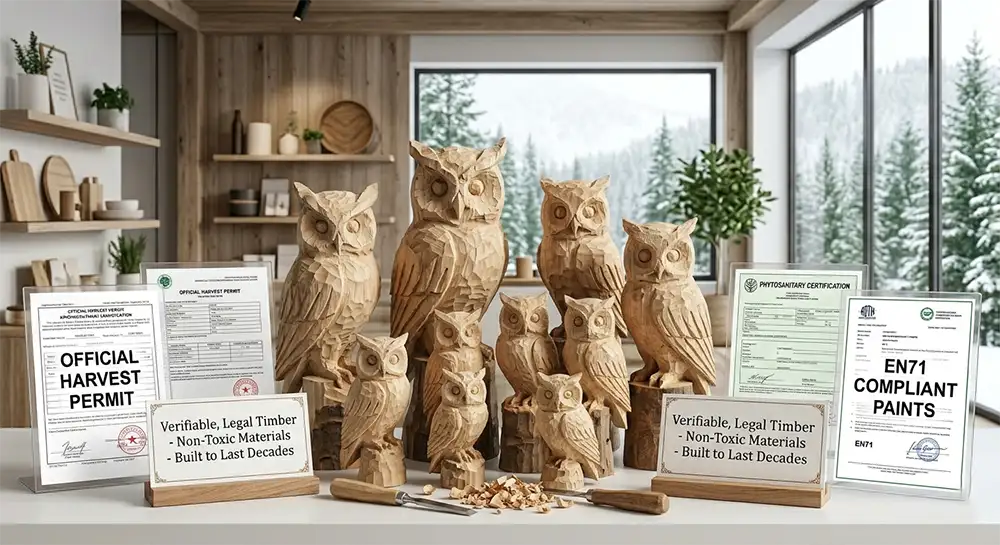
Modern retail sustainability teams rarely ask for a single label. They request a package: a valid FSC or PEFC CoC certificate, legal-timber documentation (harvest permits or export licenses), and often a social-compliance audit. This package de-risks the retailer against illegal-logging regulations such as the EU Timber Regulation and the U.S. Lacey Act. A supplier who can present the full package — certification plus legality — wins the order over one who offers only a logo.

How to Verify a Supplier’s Certification Claims
Never rely on a PDF certificate emailed during a sales call; documents can be altered or expired. Both FSC and PEFC maintain public online databases where you can look up a company’s certificate number and confirm its status, scope, and expiry. Make this lookup a standard step in your supplier onboarding, and re-check annually. Pair it with a remote or on-site audit of the factory’s material handling to confirm certified and non-certified wood are not silently mixed on the production floor.

Merchandising Certified Wooden Decor
Certification only pays off if customers see it. Use shelf talkers and hangtags that name the scheme and explain it in one line, and train staff to answer the basic “what does FSC mean?” question. Certified lines pair well with a broader responsible-sourcing story, so consider anchoring them within a curated wholesale wooden crafts collection. Buyers who value traceability also tend to appreciate seeing the making process, so linking certification to a transparent wood carving factory and an open factory tour strengthens credibility. For private-label programs, build the certification requirement into your custom manufacturing specification from day one.
Beyond FSC and PEFC: Other Labels You May Encounter
Depending on your market, buyers may also reference adjacent claims. “Reclaimed” or “recycled” wood appeals to circular-economy messaging but requires its own documentation trail. Bamboo and fast-growing species are marketed as renewable alternatives, though they are grasses rather than timber and fall outside FSC/PEFC forest schemes. And broader social-compliance audits such as BSCI or SEDEX often accompany certification requests from large retailers, covering labor conditions rather than forestry. Treat each as a separate claim with its own evidence, and never let one stand in for another.
One adjacent requirement now comes up in almost every European enquiry: the EU Deforestation Regulation. Where FSC and PEFC answer “was this forest managed responsibly”, EUDR answers “can you prove the plot this timber came from was not deforested after the cut-off date”. The two are complementary rather than interchangeable, and buyers supplying EU retail chains are increasingly asked for both. A scheme certificate does not by itself satisfy the geolocation and due-diligence evidence EUDR expects, so if your market is European, treat them as separate lines of documentation and confirm what a supplier can actually produce before committing to a programme. Our EUDR wooden decor import checklist breaks down the evidence pack.
Building Certification into Your Private-Label Spec
If you develop private-label wooden decor, write the certification requirement into the product specification before the first sample, not after the first purchase order. Specify the scheme (FSC or PEFC), the required CoC scope, the documentation package, and the on-product labeling rules, including how the logo may and may not be used. Label misuse is a compliance risk in its own right, so confirm artwork with the supplier’s certification body where required. Embedding these terms early avoids costly rework and gives your retail partners the clean, verifiable story they need to approve the line.
The Cost of Certification and Who Bears It
Certification is not free, and buyers should understand where the cost lands. Factories pay for annual audits, chain-of-custody administration, and a percentage fee on certified sales, and these costs are typically built into the FOB price of certified goods. Expect a modest premium over non-certified equivalents, often in the low single digits per unit. The premium is usually recoverable at retail because the label supports a higher price point, but you should confirm the incremental cost with your supplier so you can model it into your margin rather than absorb it silently.
Also budget for the internal cost of verification: someone on your team must check certificates, maintain records, and handle retailer sustainability questionnaires. For a small importer this is a few hours a month; for a larger one it may justify a dedicated compliance role. Either way, treating verification as a real line item keeps the program honest and audit-ready, and it prevents the slow drift where a lapsed certificate goes unnoticed until a retail partner flags it.
The direction of travel is clear: wood certification is moving from differentiator to baseline in many retail channels. Buyers who build credible, verifiable FSC and PEFC programs now will find it easier to win shelf space, pass sustainability reviews, and command a premium, while those who wait will be reacting to requirements on a compressed timeline. Start with one certified hero line, prove the model, and expand from there. And keep your marketing claims precise: regulators in the EU and US increasingly scrutinize environmental claims, so anchor every claim to a named certification and keep the certificate on file, turning your sustainability story into both a sales tool and a defensible compliance position.
In practice, the strongest supplier relationships are the ones where certification is treated as shared infrastructure rather than a sales gimmick: the factory maintains current certificates and welcomes verification, and the buyer commits to certified volume that makes the audits worthwhile. That mutual investment is what turns a compliance checkbox into a durable competitive advantage for your wooden decor range.
Frequently Asked Questions
What is the difference between FSC and PEFC?
FSC is a single global standard with strong consumer brand recognition; PEFC is an umbrella that endorses national schemes and has deep European coverage. Both certify responsible forestry; the choice depends on your target market.
Does a forest certificate let a finished product carry the label?
No. The finished product needs chain-of-custody certification covering every handler from forest to factory. Without an unbroken CoC, the label claim is not valid.
How do I check if a supplier’s certificate is real?
Look up the certificate number in the official FSC or PEFC public database to confirm status, scope, and expiry. Do not accept an emailed PDF as proof, and re-verify annually.
Will customers pay more for certified wooden decor?
Often yes, but only when the claim is credible and well-merchandised. Certification supports a premium when paired with clear shelf communication and a coherent sustainability story.
Do I need certification for every market?
Not always. Certification is most demanded in Europe and by large North American retailers. For markets with lighter requirements, legal-timber documentation may suffice, but certification future-proofs your line.
Source Traceable Wooden Decor with Full Documentation
Work with a factory that supplies legal-timber permits, social-compliance audits, and a plain statement of which lines carry scheme-certified wood. Our facility holds FSC chain-of-custody certification and runs under ISO 9001 and BSCI; because certified basswood is not currently available to us, we do not market our carvings as FSC-certified wood.
Explore Wholesale Wooden Crafts →