Skip to content
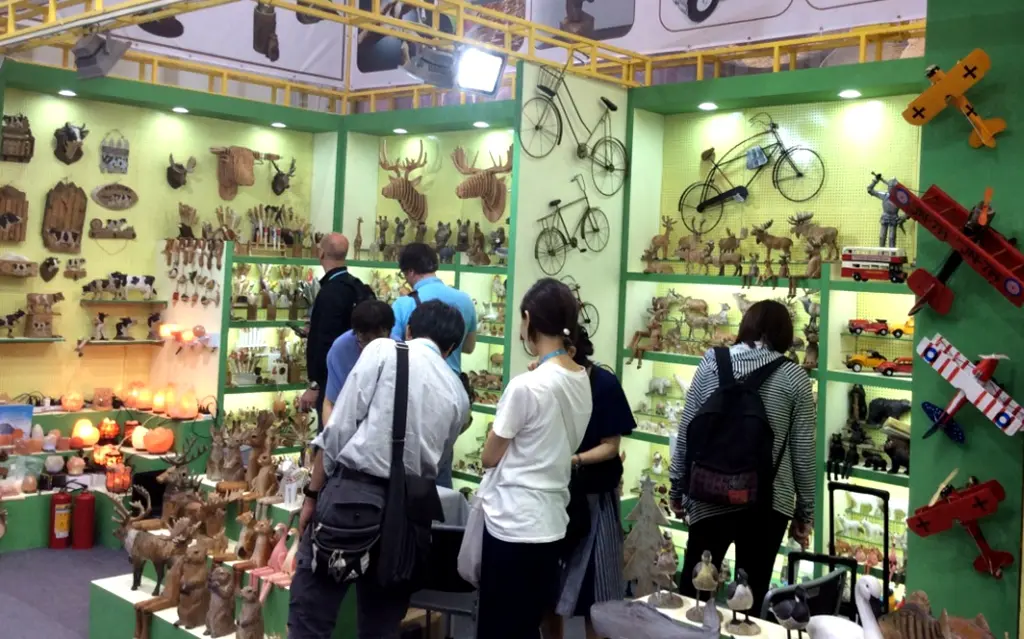
A Christmas market booth has to stop someone walking past in a coat, in the dark, with forty other stalls competing for the same glance. Christmas market booth setup is not decoration work; it is a merchandising problem with a fixed footprint, poor lighting and a two-day window, and the sellers who clear their ornaments solve it deliberately rather than arriving with three folding tables and a cloth.
This guide is for retailers, maker-market sellers and boutique owners who buy hand-carved wooden ornaments wholesale and resell them at seasonal markets and craft fairs. It covers footprint and sightlines, building height so small carved pieces are seen, lighting that makes wood grain read at night, price laddering across one table, and the stock arithmetic that decides whether you sell out or carry a carton home. Ordering figures are our own published terms, not estimates.
Key Takeaways
- Height wins markets. A flat table of small ornaments is invisible past the front row; three display levels put several times more stock into a sightline that a passer-by can read without stopping.
- Wood needs a dark or neutral background and warm light. Carved detail disappears against a white cloth under cold LED — the most common and most fixable mistake on a stall.
- Carry three price points, not one. An entry piece pays for the pitch, a mid piece carries the margin, and a carved showpiece makes the other two look reasonable.
- Size stock from the event’s own footfall, not from optimism. The arithmetic is simple and it decides whether you sell out or haul half a carton back.
- Order against lead time, not the event date. Trial orders of in-stock designs run 20–30 days; bulk production runs 60–90 days to port, so a December market is a midsummer decision.
- Pack for a stall, not a shelf. Market stock is van-loaded, carried across a field and handled in the cold, so export cartons and per-piece wrapping matter more than for shop delivery.
In This Guide
- Christmas Market Booth Setup: Height, Depth and Sightlines
- Building Height So Ornaments Are Seen
- Lighting and Background: Making Carved Detail Read
- Price Laddering Across One Table
- Stock Math: Sizing a Weekend Without Guessing
- Best For / Not For: Which Formats Suit a Market Booth
- What We Check Before a Market Order Ships
- End to End: Ordering for a December Market Season
- Frequently Asked Questions
Christmas Market Booth Setup: Height, Depth and Sightlines
Most pitches are sold by linear metre and then filled at waist height. A banquet-height table puts stock near hip level while a passer-by’s eye travels at head height, so anything below the back edge stays invisible until someone stops — and few people stop for a stall they cannot read from three metres away. Measure and draw your footprint before you pack. Depth matters as much as width: a deep table with stock only on the front row wastes its back half, while the same table with risers uses it.
| Pitch Size | Workable Layout | Levels | Common Mistake |
|---|---|---|---|
| 2 × 2 m stall | One table front-on, two crates behind, seller to one side | 2 | Standing directly behind the display, blocking the sightline |
| 3 × 2 m pitch | Two tables in an L: one showcase, one selling rail | 3 | Both tables at one height, so nothing leads the eye |
| 3 × 3 m gazebo | Back wall of shelving plus a front table, walkway kept clear | 3–4 | Filling the walkway, which stops people entering at all |
The same logic governs a permanent shop fixture, which is why a market run is good preparation for one: our planogram basics guide works through the shelf version of these decisions.
Building Height So Ornaments Are Seen
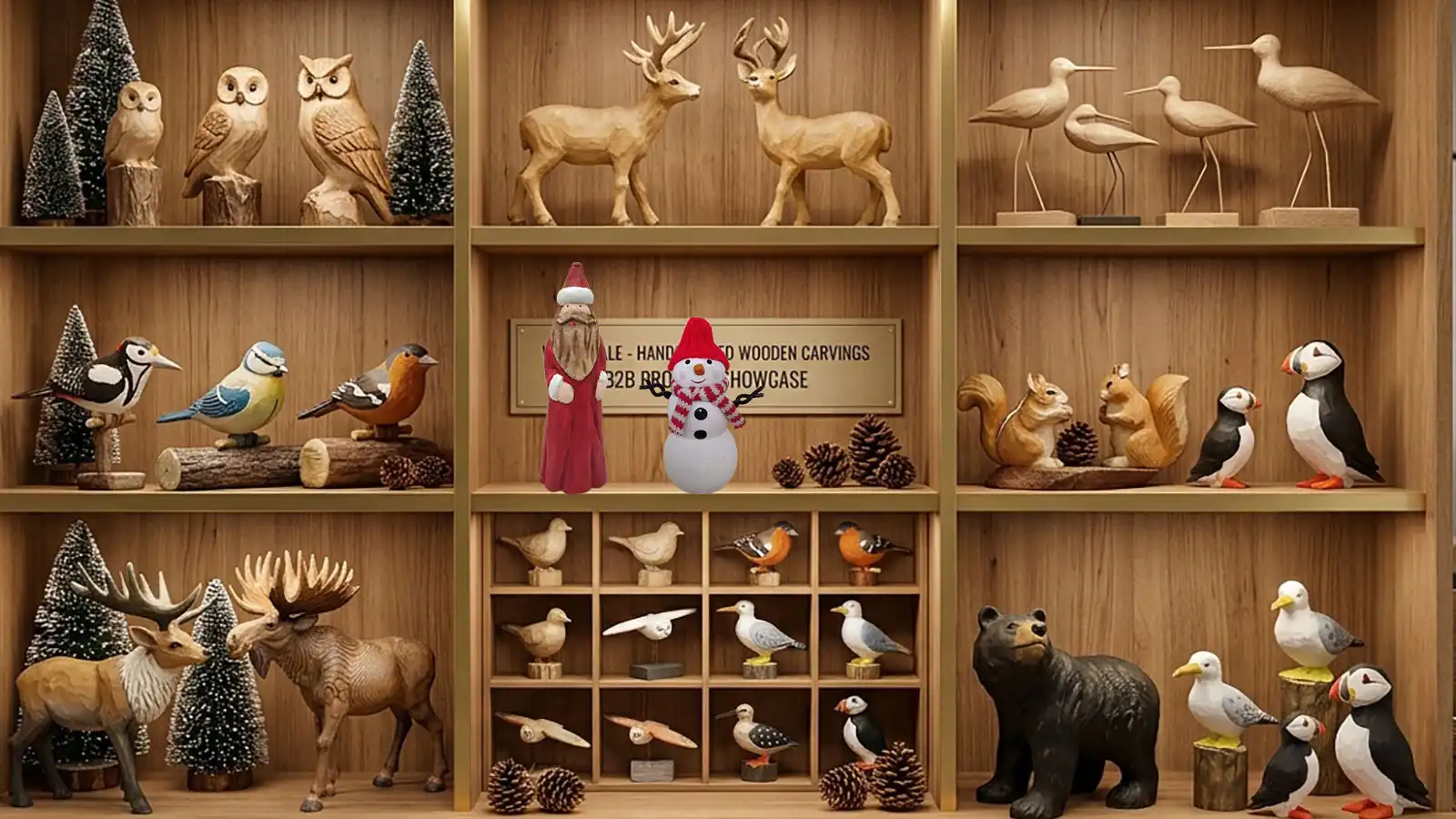
Wooden ornaments are small — a carved bird or hanging star typically sits between 5 and 15 cm — so a flat table shows one row and hides everything behind it. Tiered display is the whole game: each level lifts a row into a sightline the row in front would otherwise block. Three levels is the practical minimum, four is comfortable. Build them from what you can carry: stepped risers, crates on their sides, a ladder shelf, or boxes wrapped in the table cloth. Each step must clear the piece in front of it, and the top level should carry your showpiece rather than your cheapest item.
Group by silhouette, not by price. A cluster of stars reads from a distance; a mixed row of stars, birds and snowflakes reads as clutter. Hanging pieces need their own structure — a branch, a hoop or a sta
nding rail — because a hanging ornament laid flat loses the thing that makes it worth buying. Our guide to Christmas ornament retail displays covers the in-store version of the same grouping rules, and the hanging stock we make for it is listed in the wooden Christmas ornament buyers catalog.
Lighting and Background: Making Carved Detail Read
Christmas markets run in the dark, and hand-carved detail is entirely a function of shadow. A carved feather, a knife line or a painted eye reads only when light falls across it at an angle; lit flat from above or by a cold overhead LED, the same piece looks smooth and loses the reason it costs more than a plastic alternative. Bring your own light and aim it across the work rather than down on it: two small warm-white clamp spots at table height, angled from either side, do more for sales than any extra stock. Battery packs and spare bulbs belong in the kit, because market power is either absent or shared.
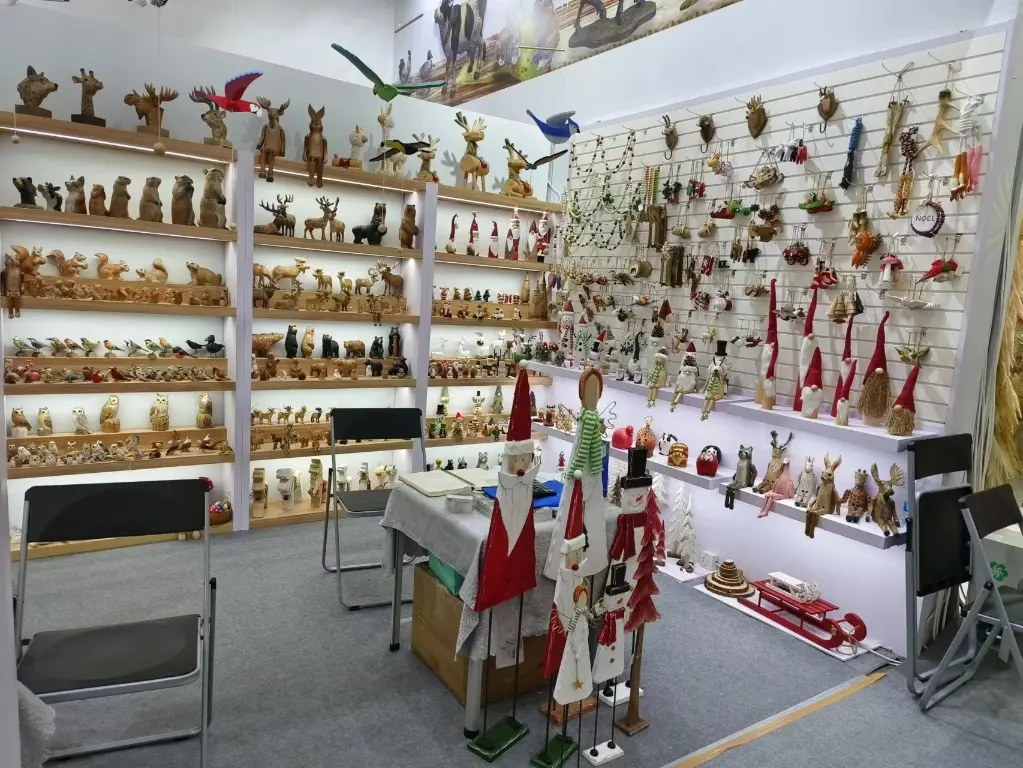
Background is the other half. Pale wood against a white cloth disappears; the same piece against charcoal, deep green, hessian or unbleached linen gains an outline. Keep the cloth matte, since a shiny surface throws light back at the buyer and flattens the carving. Where your range mixes natural-finish and painted pieces, put them on different levels so each reads as a collection rather than a remainder.
Price Laddering Across One Table
A market table should carry three price points, each with a distinct job. The entry piece converts a browser with minimal deliberation and pays for the pitch. The mid piece is where the margin lives. The showpiece rarely sells in volume, but it anchors the other two and gives the stall a reason to be photographed.
Do not set these by feel. Work backwards from landed cost per unit — ex-works price plus freight share plus duty plus packaging — then decide the multiple each tier must carry. A stall that sells only its entry tier at a thin multiple can gross more than a shop day and still make nothing. Freight share is where first-time market sellers go wrong, because ornaments are light but bulky and cube rather than weight drives the per-unit figure; our procurement guide for wooden crafts works that through. Signage does the rest: one clear price per group, legible without picking the item up, removes the hesitation that kills market sales.
Stock Math: Sizing a Weekend Without Guessing
Nobody can tell you how many ornaments a given market will sell, because it depends on that event’s footfall, weather and pitch position — anyone quoting a confident number is guessing. What you can do is build the estimate from figures the organiser will give you, then add a deliberate margin.
Ask for three things: expected visitor numbers, stall count, and whether your pitch sits on a main thoroughfare or a side row. From those, work out your share of traffic and apply a conversion rate you have observed yourself, or a conservative one if this is your first event. Multiply through to units and split across your three tiers in display ratio.
Then add the part most sellers forget: a market is a sampling exercise as well as a sales channel. Stock enough entry-tier product that the table still looks full on Sunday afternoon, because an emptied table stops selling on day two.
Sell out and you have learned your ceiling; come home with half a carton and you have learned your price point. Both are useful, but only if you wrote the numbers down on the day.
Best For / Not For: Which Formats Suit a Market Booth
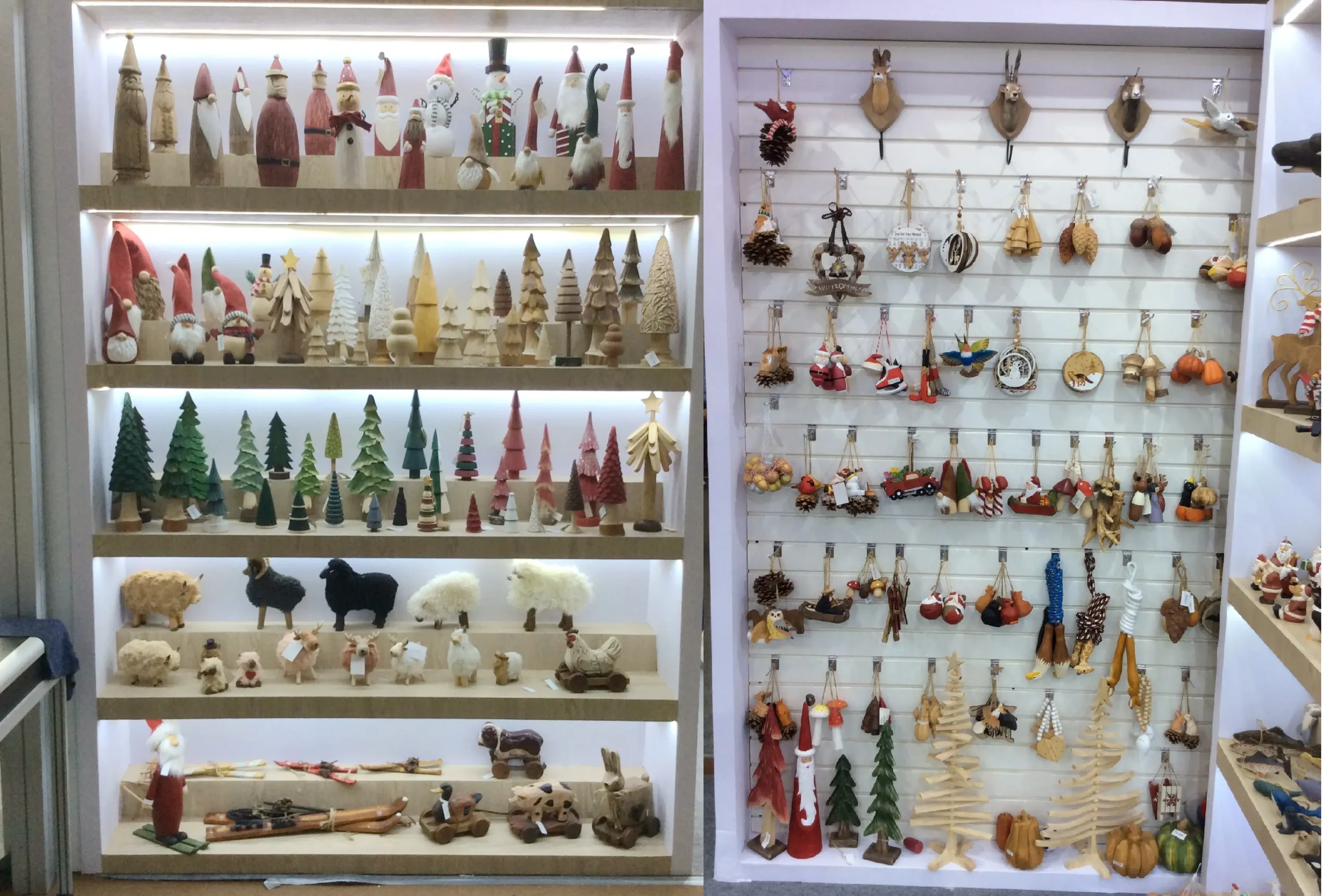
Not every ornament format survives a market weekend, and not every one earns its table space.
| Format | Best For | Not For | Handling Note |
|---|---|---|---|
| Hanging flat-cut ornaments | Volume entry tier, rail and branch displays | Showing carving skill — little depth to catch light | Light, stacks flat, tolerant of cold and repeat handling |
| Hand-carved figures and birds | Mid and top tier; the pieces that justify a market over a supermarket aisle | High-traffic tables where stock is picked up all day | Samples out, sellable stock boxed until purchase |
| Large statement carvings | Anchoring the top level and pulling people into the pitch | Volume; treat one sale as a bonus, not the plan | Heavy and awkward in the cold — bring a trolley and its own crate |
| Gift-boxed sets | The last trading hour, when buyers switch to presents | Wet or crowded pitches, where boxes soften and corners crush | Keep boxed stock under the table and dry until asked for |
If your range mixes carved and laser-cut pieces, know the difference before pricing them side by side, because buyers will ask. Our comparison of hand-carved versus laser-cut ornaments sets it out plainly.
What We Check Before a Market Order Ships
Market stock takes more abuse than shop stock: van-loaded, carried across a field, handled by hundreds of people, packed away again. Packing specification is part of the product. These are our standard checks and specs.
- Per-piece wrapping. Every item is wrapped in white paper before boxing, which stops painted surfaces rubbing when a crate is carried rather than wheeled.
- Inner box quantity. 6–12 pieces per three-ply corrugated inner box at 21 × 11 × 14 cm, sized so a seller can open one box on a stall without unpacking the order.
- Master carton spec. 240–480 pieces per five-ply export carton at 58 × 44 × 31 cm, adjusted to product dimensions, with gross weight held between 8.0 and 15.0 kg so one person can lift it.
- Drop-test rated construction. Cartons are built to pass an ISTA 3A drop test, the relevant standard for a parcel handled many times before it reaches a stall.
- Moisture content before finishing. Blanks are checked against our wood moisture content standard, because a piece that moves after painting will crack in an unheated gazebo.
- Paint safety documentation. Water-based non-toxic finishes throughout, with EN71 toy safety testing available for articles children may handle — relevant where a stall has no age-gating at all.
Buyers verifying a supplier can work through our factory audit checklist; the wider range for mixed-stall buyers sits in the wholesale wooden crafts line.
End to End: Ordering for a December Market Season
A boutique owner trades four December markets and wants one coherent range: an entry tier of flat-cut hanging shapes, a mid tier of carved birds, and two large statement pieces for the top of the stand. Here is how the order runs against our published lead times.
July — range and quantity decision. Quantities are set per design, because the minimum applies per design rather than per order. A first-time buyer can start on trial terms: 100 pieces with a USD 500 minimum order value on in-stock designs, shipped air express DDP so duties and clearance are handled for you.
August — sample approval. Physical samples of the carved pieces are approved in writing before any bulk run starts. For a market seller there is no second chance to swap a design once the season has begun.
September to November — bulk production. Wholesale and custom orders run at 300 pieces minimum per design with a USD 3,000 minimum order value, and production takes 60–90 days to port. That window decides whether stock arrives before the first market, and it is why a December event is planned in midsummer. Payment is T/T, 30% deposit and 70% balance before shipment, with photographs and video of finished goods supplied before the balance falls due.
Late November — landing and prep. Goods clear, cartons open, and the display kit is test-built once at home. Building the stand before the event turns a two-hour pitch setup into forty minutes in the dark.
December — trading and reorder. Sell-through per tier is recorded on the day, because that data sets next year’s order. Design files are archived against the order number, so a reorder is a quantity confirmation rather than a new project. For the calendar in more detail see when to order Christmas stock.
If you are trading Christmas markets this season and want a three-tier ornament range costed per design — including carton quantities, cube and the packaging spec your stall will be carried in — our team can put that sheet together with you.
Frequently Asked Questions
Q: How many display levels does a Christmas market stall need?
Three is the practical minimum, because a flat table only shows its front row to someone walking past. Build to eye level at the back and keep the top level for a statement piece. On a deep pitch, four levels let you separate natural-finish from painted stock.
Q: What lighting works best for carved wooden ornaments outdoors?
Warm-white spots aimed across the carving rather than down onto it, since carved detail is read as shadow and flat overhead light erases it. Two clamp-mounted battery spots at table height do not depend on the market’s shared power.
Q: What is the minimum order when buying ornaments for market stalls?
Trial orders start at 100 pieces with a USD 500 minimum order value on in-stock designs, shipped air express DDP. Wholesale and custom orders run at 300 pieces minimum per design with a USD 3,000 minimum order value, and custom printed boxes require 500 pieces.
Q: When should I order for a December market season?
Trial orders of in-stock designs take 20–30 days, so those can still work into autumn. Bulk production runs 60–90 days to port, which puts the realistic decision point in midsummer, before sea freight and clearance.
Q: How do I work out how much stock to bring to a weekend market?
Ask the organiser for expected visitor numbers, stall count and pitch position, then apply an observed or deliberately conservative conversion rate. Split the units across three price tiers in display ratio, and add enough entry-tier stock to keep the table looking full on the final afternoon.