Skip to content
Most labeling problems at an EU border are not printing problems. They are classification problems settled too late: a decorative gift packaged like a toy, a consignment on raw-wood pallets with no treatment mark, artwork approved by marketing rather than by the importer of record. Labeling wooden gifts for the EU is a sequence of scope questions, and each answer changes what has to appear on the pack.
This guide works through those questions in order, and separates what we supply as manufacturer from what only an EU importer can decide. It is for wholesalers, importers and private-label brands shipping carved wooden gifts and ornaments. For the deforestation-documentation side see our EUDR checklist for wooden decor imports.
Key Takeaways
- Toy or decorative gift is the first question and the costliest to get wrong: it decides whether EN71 testing, CE marking and age warnings apply at all.
- CE declares conformity with applicable EU harmonisation legislation; it is not a quality mark. Putting it on an article outside that scope is a problem, not a shortcut.
- ISPM 15 applies to wood packaging material — pallets, crates, dunnage — not to the gift. Our corrugated cartons are not the regulated material; a raw-wood pallet under them is.
- Several member states run packaging producer-responsibility registration; the duty usually falls on whoever first places the packaged goods on that market.
- Label language follows the destination member state, not the design studio. Artwork cleared for one market is not cleared for the next.
- As a non-EU manufacturer we supply artwork, data and documentation; the importer of record carries the obligation and should sign artwork before print.
In This Guide
- Toy or Decorative Gift: The Classification That Decides Everything
- What Has to Appear on the Product or Pack
- ISPM 15 and the Wood Packaging Material
- Packaging Waste and National Registration
- Labeling Wooden Gifts: Elements at a Glance
- Best For / Not For: Labeling Depth by Channel
- What We Check Before a Labeled Order Ships
- End to End: One Range Into Three Member States
- Frequently Asked Questions
Toy or Decorative Gift: The Classification That Decides Everything
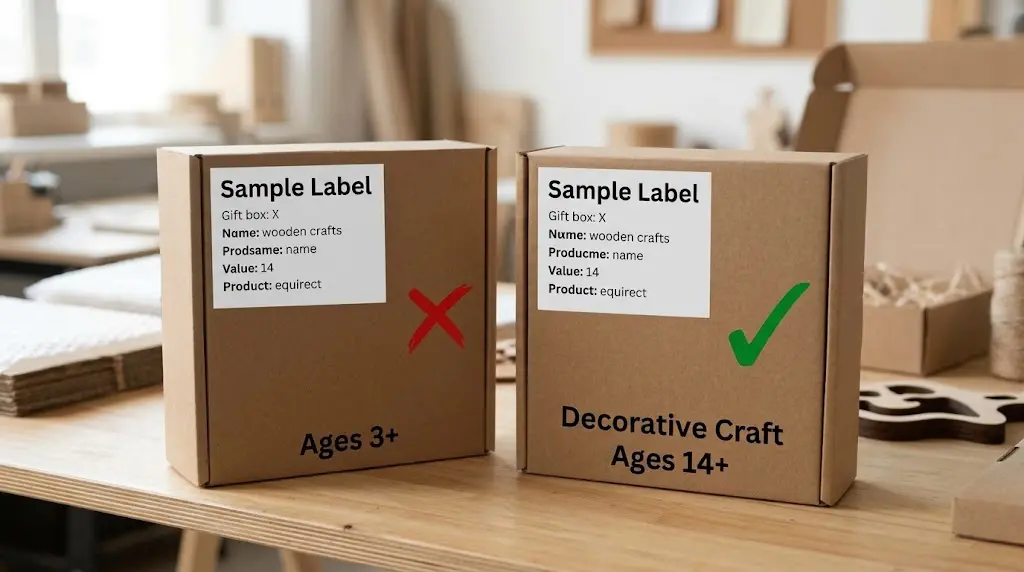
This is where importers most often land in trouble, because the test is not what you intended. A hand-carved wooden animal sold as shelf decoration can still be treated as a toy if a child under fourteen would plausibly play with it — and a small brightly painted figure is exactly that. Intention does not carry the classification; appearance, size, marketing and channel do.
If the article is a toy, coatings must meet the migration limits of the EN71 toy safety standards, small-parts and age-warning rules apply, and it falls inside the CE marking regime. If it is a decorative gift for adults, none of that applies — and marking it CE anyway is not a harmless precaution. CE is a manufacturer’s declaration of conformity with the legislation covering the article; applying it outside that scope is a false declaration, and it invites the question of what else on the pack was not thought through.
The fix is a written designation on the pack that matches the product: a decorative article should say it is a decorative item, not a toy, and carry the age statement that goes with that claim. Our guide to EN71 and toy safety for wooden animal figurines covers how the same carving is treated on both sides of that line, and retail safety labeling for wooden slingshots is a worked example of age grading on a product that looks like a toy but is not sold as one.

What Has to Appear on the Product or Pack
Two scope questions sit behind this list: whether the article contacts food or drink, which puts coasters in a different regulatory space from a hanging ornament, and which freight term applies, since that decides who answers at the border — see our guide to incoterms for wooden decor imports. Once scope is settled the on-pack elements follow. Which are legally required, which channel-required and which merely good practice differs by market — that distinction belongs to the importer, not the factory. We produce all of them accurately and get sign-off before print.
- Product identification and batch reference. Design name or number, size or format where a range has several, and a batch or lot code that lets a production run be identified later — which is also what makes a quality claim resolvable rather than arguable.
- Responsible economic operator. A name and postal address inside the EU for the party answerable for the article, normally the importer — the element most often missing on direct-shipped goods.
- Warnings and age statement. Where the article is a toy, or where it looks like one, the designation and the age grading must be explicit.
- Material and finish. Species and coating type, increasingly requested for retailers’ due-diligence files even where no rule compels them.
- Origin. Where declared it must be accurate, and some markets and retail contracts require it — treat it as a claim to verify, not a decorative line.
- Barcode and channel codes. GTIN for retail, plus marketplace identifiers where the channel demands them — see our guide to Amazon FBA supplier requirements for wooden decor.
Language follows the destination member state. A pack designed for Ireland is not automatically correct for Belgium, and one artwork trying to serve several markets usually ends up legible in none. For multi-state ranges the workable approach is a common printed box plus a market-specific label — how the tiers in our guide to ornament retail packaging are usually configured.
ISPM 15 and the Wood Packaging Material
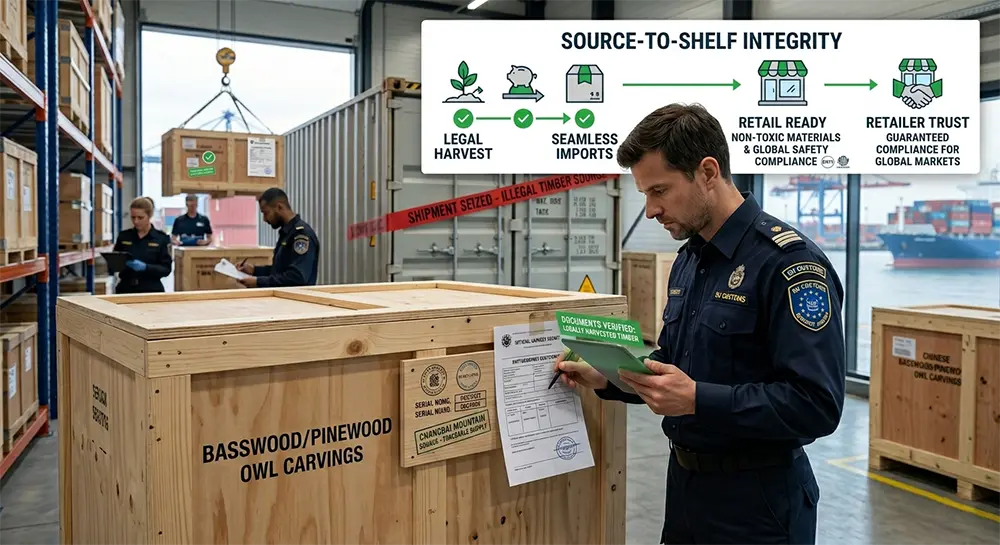
Routinely misunderstood, because the rule attaches to the packing rather than the product. Wood packaging material — pallets, crates, drums, dunnage and bracing made from raw wood — must be heat treated or fumigated and bear the IPPC mark showing it. The purpose is stopping pest movement between countries; it has nothing to do with the gift inside.
Our retail and export packing is corrugated fibreboard — processed material, not the regulated raw wood — so the cartons are not the issue. The risk sits one level down: a consolidation on raw-wood pallets, a crate built for an oversized order, or timber bracing a freight party adds without anyone noticing. Unmarked material can get the consignment held, re-treated or refused at entry, and the delay lands in the delivery window rather than on an invoice. Ask your forwarder in writing what the load is packed on. The standard is administered under the International Plant Protection Convention. Our carton specification and drop-test regime are described in our guides to B2B export packaging for wood carvings and the ISTA protocol we test to.
Packaging Waste and National Registration
Separately from product rules, several member states require registration and fee payment for packaging placed on their market, and some require recycling marking. Germany’s packaging registration system and France’s producer-responsibility marking most often catch importers by surprise: the obligation follows the packaging, not the product, and is enforced through the seller’s ability to list.
Two points decide who carries it. The duty generally falls on whoever first places the packaged goods on that national market — usually the importer, though a brand shipping direct to consumers across borders can find itself in that seat. And marketplaces increasingly ask for a registration number as a condition of listing, turning a back-office obligation into a sales blocker. Confirm the position per market and channel before the first order, not after the first suspension. Minimisation and recyclability are worth designing for at the same time: a smaller mono-material box is cheaper to freight and easier to justify in a retailer’s sustainability questionnaire.

Labeling Wooden Gifts: Elements at a Glance
| Element | Applies when | Who supplies it |
|---|---|---|
| Toy / decorative designation | Always — it sets which regime applies | Importer decides; we print and place |
| Age grading and warnings | Toy scope, or an article that reads as child-appealing | Importer decides; we supply coating test data |
| EU economic operator name and address | Articles inside a harmonisation regime | Importer — we cannot supply it |
| Batch or lot code | Traceability and claims handling | Us, against the order number |
| Species and finish information | Retailer due-diligence requests | Us, from the production record |
| Barcode / channel identifier | Retail and marketplace channels | Buyer supplies the number; we print and verify scannability |
| ISPM 15 treatment mark | Raw-wood pallets, crates and dunnage only | The party supplying the wood packaging material |
| Packaging registration / recycling mark | Per member state and per channel | Whoever first places the packaged goods on that market |
Best For / Not For: Labeling Depth by Channel
| Channel | What to invest in | What is wasted effort |
|---|---|---|
| Independent gift retail | A clean hang tag and correct designation; the shopkeeper explains the rest | Full printed colour boxes at a 500-piece minimum on a first trial order |
| Chain or supermarket | Their artwork specification, barcode placement and compliance file, met exactly | Assuming one EU-wide artwork satisfies every member state they trade in |
| Marketplace seller | Channel identifiers, packaging registration numbers, and a pack that survives parcel networks | Premium retail print the platform’s fulfilment will overbox anyway |
| Direct-to-consumer, cross-border | Confirming who the importer of record actually is, since it may be you | Leaving the economic-operator question to the courier |
What We Check Before a Labeled Order Ships
- Artwork signed off by the importer of record in writing before print, including designation and any age statement — we do not decide scope on a buyer’s behalf.
- Designation matched to the product, so a decorative article carries no toy wording and a toy-scope article is not shipped without it.
- Coating documentation for the paint actually used, including EN71 routes where the article is child-facing, on top of our ISO 9001 and BSCI standing.
- Barcode placement and scannability verified against the channel specification, batch coding tied to the order number.
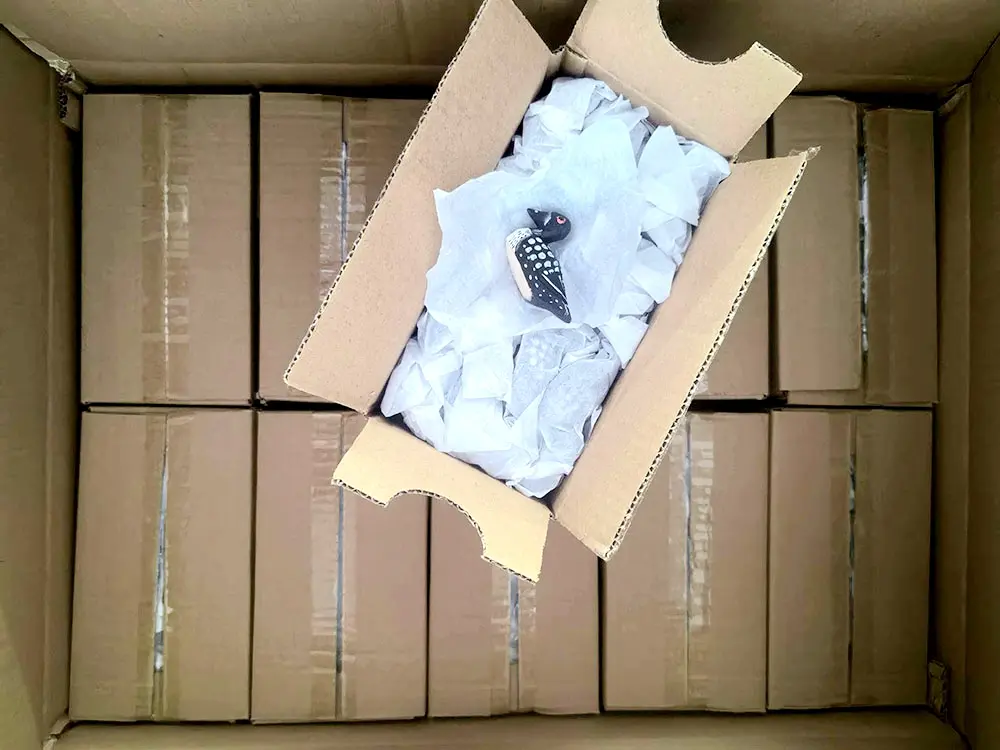
- Carton specification and shipping marks confirmed — white paper wrap per piece, 6 to 12 per three-ply inner box at 21 × 11 × 14 cm, 240 to 480 per five-ply master carton at 58 × 44 × 31 cm, 8.0 to 15.0 kg gross, rated to ISTA 3A — and the pallet question put to the forwarder in writing.
- Photographs and video of finished, labeled goods sent before balance payment, under our T/T terms of 30% deposit and 70% before shipment, so the buyer approves the printed pack and not a proof.
On provenance, keep the claim matched to the material. We hold FSC chain-of-custody certification, but certified basswood is not currently available to us, so our carvings are not marketed as FSC-certified wood; timber felling and transport permits are available for traceability. A provenance claim on a label should survive the same scrutiny as everything else on the pack. Sequencing is covered in our guide to the wood OEM timeline from sample to first order.
End to End: One Range Into Three Member States
A wholesale gift brand wants a carved wooden animal range into Germany, France and Ireland, sold through independent retailers and one online channel.
Scope first. The range is settled as decorative articles for adults, with designation and an age statement written into the artwork. Two designs sit near the line — small, brightly painted, child-appealing — so they are held back pending a classification decision.
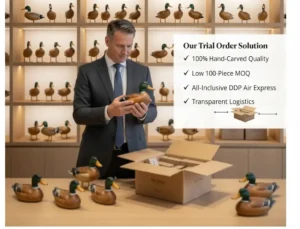
Trial and artwork. 100 pieces at a USD 500 minimum order value, air express DDP, 20–30 days. The importer signs the artwork, supplies the EU name and address, and confirms packaging registration per market. A common box plus a market-specific label beats three separate printings.
Production, print and loading. The order moves to 300 pieces at a USD 3,000 minimum order value, sea freight, 60–90 days to port. Batch coding ties to the order number, barcode placement is checked against the online channel’s specification, and the forwarder confirms in writing what the load sits on — corrugated cartons on marked, treated pallets.
Before balance. Photographs and video of the finished, labeled goods reach the buyer ahead of the 70% balance, so an artwork error is caught while it can still be fixed. Range options are in our custom product manufacturing and wholesale wooden crafts guides.
Taking a wooden gift range into the EU? Send us the artwork brief and destination markets and we will produce label artwork, batch coding, carton marks and coating documentation to your importer’s specification.
Frequently Asked Questions
Q: Does a decorative wooden gift need CE marking?
Only if it falls inside an EU harmonisation regime requiring it — for wooden articles usually the toy scope. A decorative gift for adults does not carry CE, and marking it anyway is a false declaration rather than a precaution. If the piece is small, brightly painted and child-appealing, get the classification decided in writing first.
Q: Does ISPM 15 apply to my cartons?
Not to corrugated fibreboard cartons, which are processed material. It applies to wood packaging material — raw-wood pallets, crates, drums and dunnage — which must be heat treated or fumigated and bear the IPPC mark. Ask your forwarder in writing what the load sits on, since unmarked material can get a consignment held or re-treated.
Q: Which language must the label be in?
The language of the destination member state. A pack designed for one market is not automatically correct for the next, and one artwork serving several usually ends up legible in none. For multi-market ranges use a common box plus a market-specific label.
Q: Who registers for packaging producer responsibility?
Generally whoever first places the packaged goods on that national market — usually the importer, though a brand shipping direct to consumers across borders can hold that position. Marketplaces increasingly require a registration number to list, so settle it per market and channel before the first order, not after a suspension.
Q: Who is responsible if the label turns out to be wrong?
The importer of record carries the obligation, which is why we ask for written artwork sign-off before print and supply the underlying data — species, coating documentation, batch coding, carton specification — rather than deciding scope for a buyer. We are a manufacturer, not a legal adviser; classification belongs to the importer or a notified body.
Sources
ISPM 15 for wood packaging material is administered under the International Plant Protection Convention. Toy safety requirements, including the EN71 standards and the scope question for child-appealing articles, are published by the European Commission. Our carton specification and ISTA 3A rating, minimums, order values, lead times, payment terms, species list and certifications are our own published first-party terms. No directive number, national scheme detail or penalty figure is reproduced here: this guide sequences the questions, and each requirement’s current text must be confirmed with the importer of record, a notified body or customs counsel. We are a manufacturer, not a legal adviser.