Skip to content
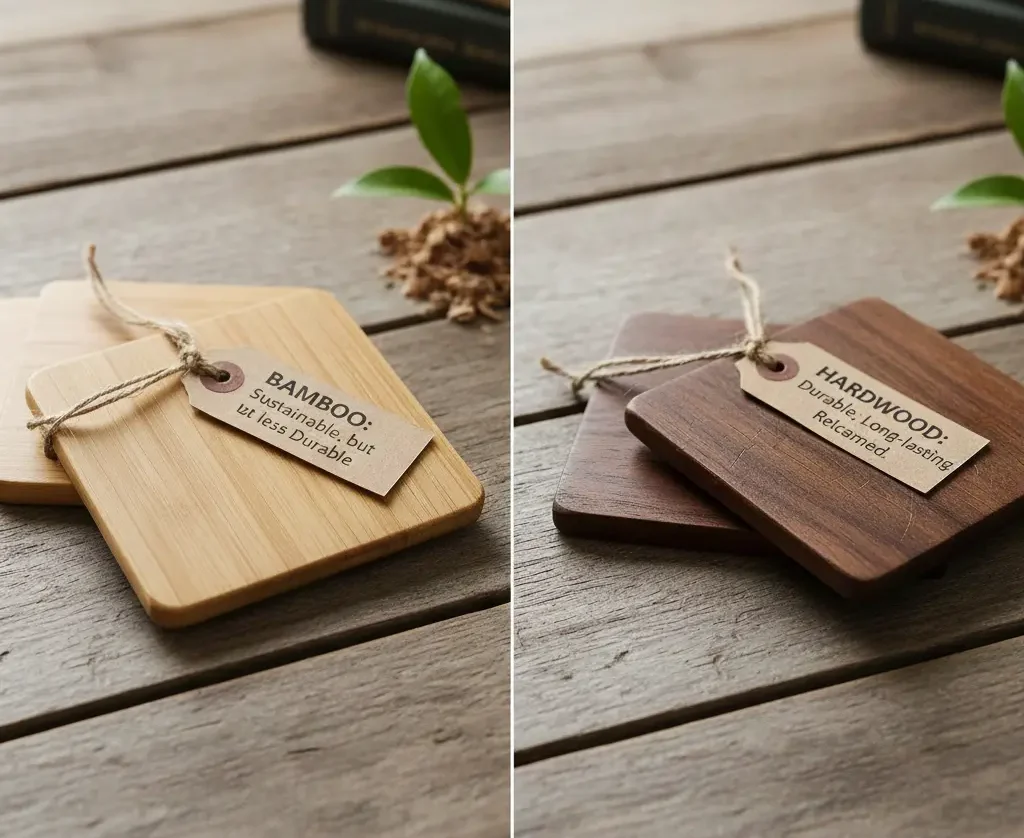
Cork, wood and slate are the three coaster materials a programme is usually specified in, and buyers tend to choose between them on price and feel. Neither decides whether the coaster survives eighteen months on a bar top. Condensation, heat, washing, stacking and the table underneath decide that — and the three materials answer very differently.
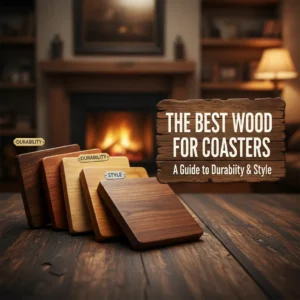
One disclosure first: we manufacture wooden coasters and do not produce cork or slate, so the wood side is written from production knowledge while the other two are described from general material behaviour. Treat the cork and slate sections as a checklist to test against samples from whoever actually supplies them. For choosing between wood species rather than material families, see our guide to the best wood for coasters.
Key Takeaways
- Specify the job before the material. A hotel bar coaster, a corporate gift and a retail gift set are three products that happen to share a shape.
- Cork is light, quiet and forgiving on surfaces; its weakness is the edge, which crumbles and stains once the surface skin is broken.
- Wood is the most workable — carved, engraved, printed, refinished — but it must be finished correctly and not sold into a wet application without the right coating.
- Slate is the most durable surface and the heaviest, and it fails by chipping rather than wearing. Its weight is a freight line, not just a handling quality.
- Moisture governs wood. We hold it at 8–12% before finishing, and a coaster that starts wet will cup on a warm bar top.
- Do not compare hardness figures from different sources. Public values for cork and slate vary widely by origin and density; ask each supplier for batch test data on the article you are buying.
In This Guide
- What a Coaster Actually Has to Do
- Cork: Where It Wins and Where It Fails
- Wood: Species, Finish and the Condensation Question
- Slate: Durability, Weight and the Chip Risk
- Coaster Materials Side by Side
- Best For / Not For: Material by Application
- What We Check on a Wooden Coaster Order
- End to End: A Branded Coaster Programme
- Frequently Asked Questions
What a Coaster Actually Has to Do
Six requirements, in the order they cause problems:
- Take condensation without degrading. A cold glass leaves a ring of water and the coaster sits in it for an hour — the hardest test any of the three faces.
- Not transfer that water to the table. A coaster that soaks through protects nothing and can mark a lacquered surface worse than the glass would.
- Tolerate heat. A hot mug is a different load from a cold glass, and some finishes blush, soften or lift under it.
- Survive cleaning. In hospitality it is wiped with detergent many times a day; in retail it is handled by every customer who picks it up.
- Stack flat. Warped coasters do not stack, and a stack that rocks is a stack a bar discards.
- Carry branding legibly for its service life. A logo that wears off in three months is worse than none, because it reads as neglect rather than restraint.
Where a coaster may contact a drink or food directly rather than only supporting a vessel, food-contact rules apply to material and finish. United States buyers can start from the FDA food contact substances guidance and confirm the position for their own market.
Cork: Where It Wins and Where It Fails
Cork is harvested bark, and its cellular structure gives it the properties buyers like: light, compressible and recovering, quiet when a glass is set down, and it does not scratch a polished table. It resists surface water uptake, which is why it has been the default bar coaster for decades.
Its weaknesses sit at the edge and in the branding. Cork crumbles where it is cut, so an edge knocked against a bar rail loses material rather than denting. It absorbs colour — wine, coffee, citrus — and a stain is in the material rather than on it, so it cannot be wiped out. Branding options are narrower than they look: printing sits on a textured, yielding surface where fine type loses definition, and laser marking chars rather than engraving cleanly.
Ask a cork supplier for density and binder. Agglomerated cork is granulate held in a binder, and both decide whether the surface holds a print and survives a wet bar. The answers vary more between suppliers than the word cork suggests.
Wood: Species, Finish and the Condensation Question
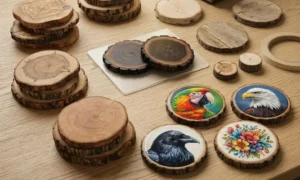
Wood is the most workable of the three, which is why it carries the widest range of finishes and branding options. It can be carved in relief, engraved, laser-marked, screen-printed, painted, stained or left bare; round, square, shaped or bark-edged; and a damaged piece can be sanded and refinished rather than replaced. That workability is also why specification matters more — the same shape in two species with two finishes behaves differently on a wet bar.
On species: we produce in basswood, pinewood, rubber wood and birch. Basswood is pale, fine-grained and soft enough to carve detail into — our published figure is around 410 lbf on the Janka scale — which makes it the choice for engraved and relief work. Pine carries visible figure and reads as rustic, suiting a bar or farmhouse gift set. Birch and rubber wood are denser and plainer, taking a printed logo and repeated wiping better than a soft open-grained alternative. Hardness comparisons between species are in our guide to the best wood for coasters, and the bamboo question in our article on bamboo versus hardwood coasters.
Two things decide whether a wooden coaster survives condensation. The first is starting moisture: we hold wood at 8–12% before finishing, per our published wood moisture content standard, because a coaster that starts wet cups once one face is repeatedly soaked and the other stays dry. The second is how far the finish wraps. A film finish sealed on the face only leaves edge and end grain open, and end grain wicks water into the body of the piece. Sealing all six faces, or specifying a construction with little exposed end grain, is the difference between a coaster that lasts a season and one that lasts a year.
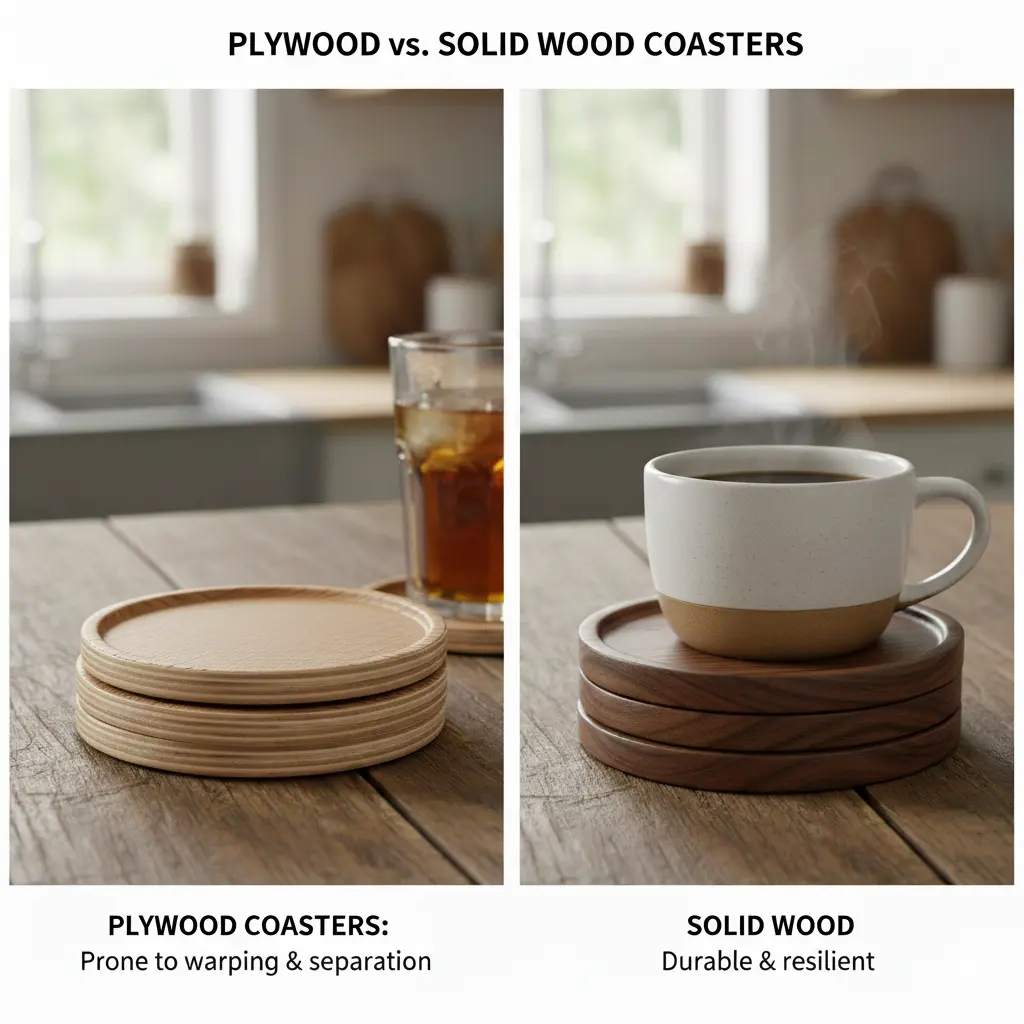
Solid wood and plywood are not interchangeable either. A solid piece moves across the grain with humidity; a plywood core resists that and stays flatter, at the cost of an exposed edge that must be finished rather than shown.

Slate: Durability, Weight and the Chip Risk
Slate splits along a cleavage, which is why it can be produced as a thin flat tile with a naturally textured surface. It is effectively impervious to water, unaffected by heat from a mug, and does not stain from wine or coffee as cork or unfinished wood does. Its surface takes an engraved or printed mark that outlasts branding on any organic material.
Three costs come with that. It is heavy — several times the mass of a cork or wood coaster of the same footprint — which is a freight line, a fixture load question, and a hard edge on a glass table if dropped. It fails by chipping rather than wearing, so a knock on a tile floor takes a flake off the corner irreparably. Being rigid, it needs a foot or backing to stop it scratching the surface it protects, which is an added component. And it cannot be produced in the shapes and carved relief wood allows, so it suits a flat tile rather than a sculptural design.
Coaster Materials Side by Side
The three materials against the six requirements above. Read the failure mode row first: it decides service life, and the three fail in different ways.
| Requirement | Cork | Wood | Slate |
|---|---|---|---|
| Standing water | Resists uptake, but stains into the material | Depends entirely on finish and end-grain sealing | Impervious; the strongest of the three |
| Heat from a mug | Tolerant, may scorch on repeated contact | Finish-dependent; some films blush or soften | Unaffected |
| Failure mode | Edge crumbling, staining, surface lift | Cupping, finish wear, edge denting | Chipping on impact; not repairable |
| Repairable | No | Yes — sand and refinish | No |
| Branding range | Narrow; textured surface limits fine detail | Widest — carve, engrave, print, paint, stain | Engraved or printed flat mark; very durable |
| Weight and freight | Lightest | Light to moderate by species | Heaviest; a real freight and fixture line |
| Protects the table | Best — soft and non-marking | Good, with a smooth finished foot | Needs a foot or backing, or it will scratch |
| Shape freedom | Die-cut flat shapes | Flat, shaped, relief-carved, bark-edged | Flat tile only |
Best For / Not For: Material by Application
| Application | Strong fit | Wrong choice |
|---|---|---|
| High-turnover bar or café | Slate, or a fully sealed wood tile; both survive detergent wiping | Unfinished or edge-open wood, and cork where wine is poured |
| Hotel and restaurant programme | Wood with a carved or engraved mark — see our hotel and restaurant coaster programmes | Printed cork, where the logo fades unevenly across a table run |
| Corporate gift | Wood — engraving depth and gift packaging carry the brand | Slate, whose weight raises postage on a mailed gift set |
| Retail gift set | Wood or cork in a boxed set; both are light enough to gift-wrap | Slate in a self-serve fixture, where a dropped piece chips |
| Outdoor or events | Cork or slate — neither moves with weather the way wood does | Solid wood left outdoors, whatever the finish |
What We Check on a Wooden Coaster Order
This applies to the wood option only; a buyer specifying cork or slate should ask that supplier the equivalent questions.
- Species matched to the use. Basswood for engraved and relief detail, birch or rubber wood for a dense wiping surface, pine where figure is wanted.
- Moisture held at 8–12% before finishing, which stops a coaster cupping once one face is repeatedly wetted.
- Finish wrap confirmed — all faces and edges sealed, end grain specified rather than left open, and the finish tested against a wet glass and a hot mug before the run.
- Flatness and thickness tolerance held across the batch, so a set stacks and does not rock.
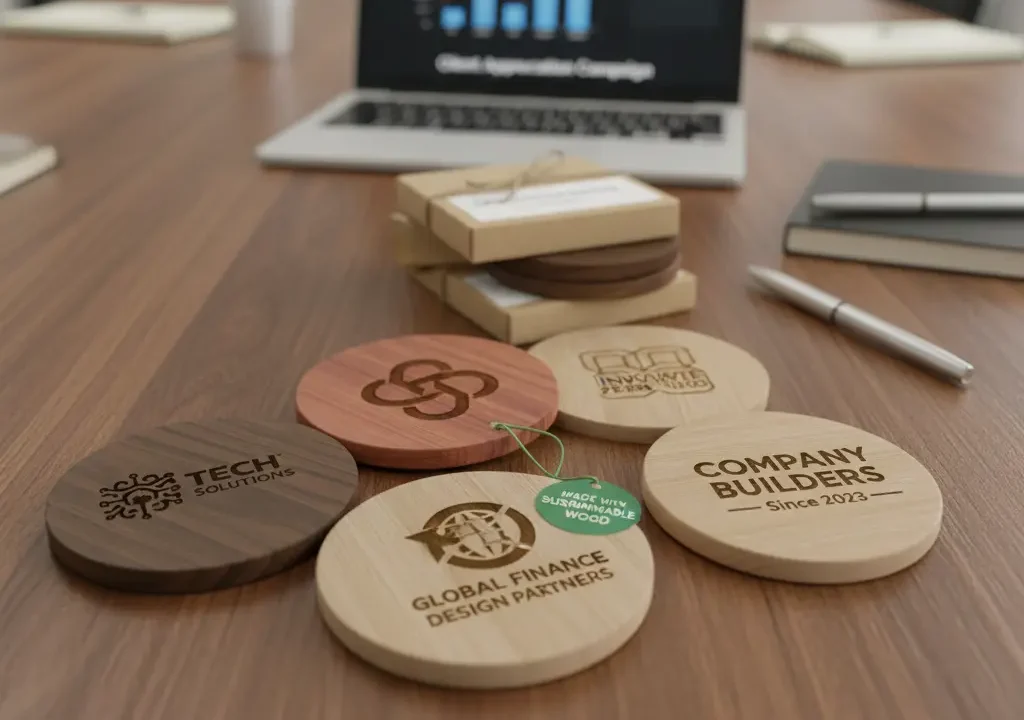
- Branding method verified on the actual material — engraving depth, print adhesion and legibility at the smallest type size in the artwork.
- Export packing confirmed — white paper wrap, 6 to 12 per three-ply inner box at 21 × 11 × 14 cm, 240 to 480 per five-ply master carton at 58 × 44 × 31 cm, 8.0 to 15.0 kg gross, rated to ISTA 3A, with photographs and video of finished goods before the 70% balance falls due. Packing detail is in our guide to B2B export packaging; small-parcel shipping in our guide to shipping wooden coasters.
End to End: A Branded Coaster Programme
A brewery group wants branded coasters for twelve taprooms plus a retail gift set, and is choosing between cork and wood.
Define the job. Taproom coasters face condensation, beer, detergent wiping and a high loss rate; the retail set faces handling, gift packaging and a price point. One material choice for both is usually a compromise on one of them.
Test before committing. A trial order of 100 pieces at a USD 500 minimum order value, air express DDP in 20–30 days, gives enough to put into actual service. Coasters are the cheapest hospitality item to test properly and the one most often specified from a photograph — which is how a finish that blushes under a hot mug gets ordered in volume.
Freeze the specification. Species, dimensions and thickness tolerance, edge treatment, finish system and wrap, branding method and depth, and the artwork at its smallest type size are written down against a retained sample. Cost drivers and minimums are in our guide to custom logo coasters, MOQ and cost factors.
Scale. The reorder moves to 300 pieces at a USD 3,000 minimum order value, sea freight, 60–90 days to port, with custom printed boxes for the retail set at the 500-piece minimum. Payment runs T/T at 30% deposit and 70% before shipment. Corporate positioning is covered in our guide to wooden coasters for sustainable corporate branding, and the full range in our wholesale wooden coasters guide.
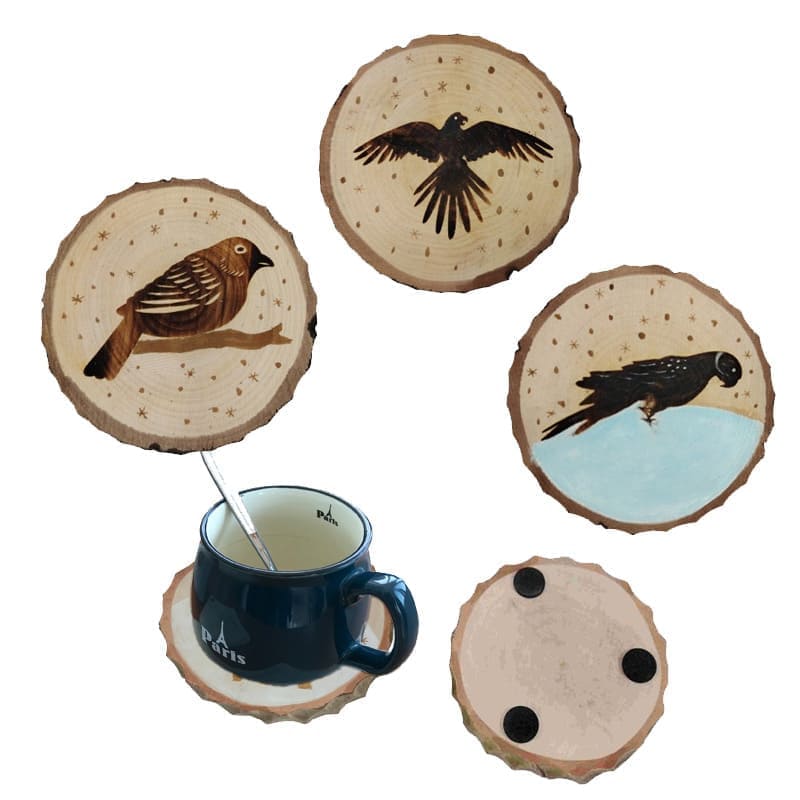
If you are specifying a wooden coaster programme and want species, finish wrap and branding method tested against your actual service conditions — with trial quantities and carton counts worked out — send us your artwork and use case and we will build the specification with you.
Frequently Asked Questions
Q: Which coaster material lasts longest in a bar?
Slate lasts longest against water, heat and detergent and fails only on impact — a drop chips it irreparably. A fully sealed wooden coaster with all faces and edges finished is close behind, and can be sanded and refinished. Cork lasts shortest where wine and coffee are poured, because staining goes into the material.
Q: Do wooden coasters warp from condensation?
They can, and two things decide it. Starting moisture must be controlled — we hold wood at 8–12% before finishing — and the finish must wrap all faces and edges, not only the top. A coaster sealed on one face only cups, because one side swells repeatedly and the other does not.
Q: Which material takes a logo best?
Wood is widest: carved relief, engraved, laser-marked, screen-printed, painted or stained, on flat, shaped or bark-edged forms. Slate takes a durable engraved or printed flat mark, but only on a tile. Cork is narrowest, its textured surface limiting fine type and small logos.
Q: What is the minimum order for custom coasters?
A trial order runs at 100 pieces with a USD 500 minimum order value on in-stock designs, air express DDP in 20–30 days. Wholesale and custom run at 300 pieces with a USD 3,000 minimum order value, sea freight, 60–90 days to port. Custom printed boxes require 500 pieces; payment is T/T 30% deposit and 70% before shipment.
Q: Are wooden coasters food-contact safe?
Where a coaster only supports a vessel, food-contact rules generally do not apply; where it may touch a drink or food directly, material and finish both fall inside them. Ask for coating documentation for the finish actually used and confirm the requirement for your market.
Sources
Food contact substance requirements are published by the United States Food and Drug Administration, and forest provenance frameworks by the FAO forestry division. Our species list, basswood hardness figure, moisture standard, carving capability, minimums, order values, lead times, payment terms, carton specification and ISTA 3A rating are our own published first-party terms. No hardness, density or absorption figure is quoted for cork or slate: published values vary widely by origin, binder and cleavage, so a figure from one source should not be compared with a supplier’s sample — ask for batch test data on the article you are buying. No unit price is stated, and we manufacture wooden coasters only.