Skip to content


Payment terms are usually discussed last, after price, sample and lead time, which is backwards. Terms decide who carries risk while a handcrafted order is being made, and they change what a price means: a quotation on Net 30 and the same quotation on 30% deposit are not the same price, because somebody is financing the run.
This guide sets out the instruments a buyer meets when sourcing wooden products, what each does, and where the risk sits. It is written for importers, wholesalers and private-label brands placing their first few orders. Our own published terms are stated plainly below, including where we do not offer a structure a buyer is asking for.
Key Takeaways
- Net 30 is not a payment method, it is a credit line. A supplier offering it is financing your inventory and will price that financing and risk into the quotation, itemised or not.
- A letter of credit substitutes a bank’s credit for the buyer’s and pays against compliant documents — not against goods you would accept. An LC does not replace inspection.
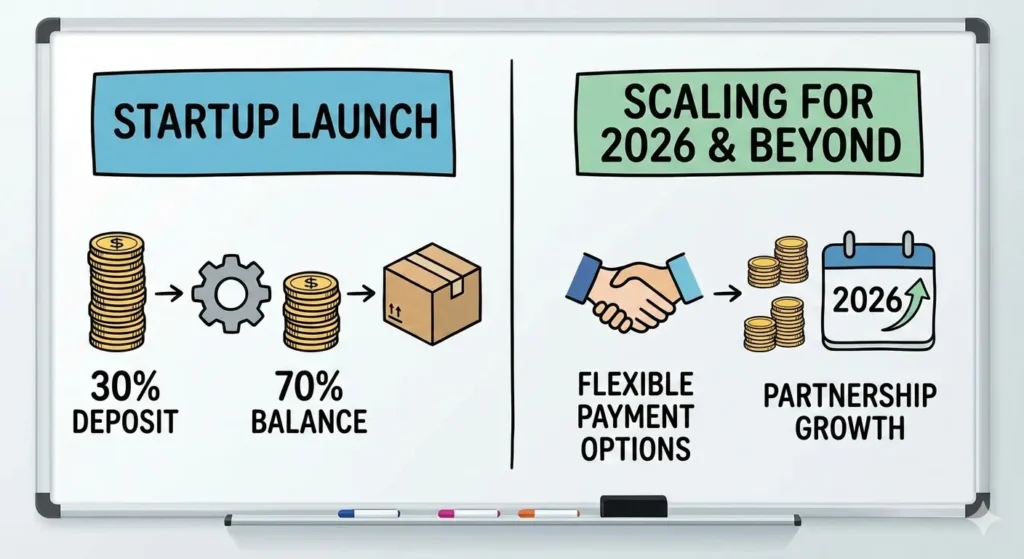
- Our published terms are T/T at 30% deposit and 70% balance before shipment, with photographs and video of the finished goods supplied before the balance falls due.
- Buyer protection on a handcrafted order comes from evidence rather than a bank instrument: a retained master sample, a written acceptance rule, pre-shipment inspection, and a small first order.
- The incoterm and the payment term interact: together they decide who pays which leg, who holds the goods, and which documents must exist for anyone to be paid.
- Get fee figures from your own bank. Issuing, advising, confirming and discrepancy charges vary by bank and corridor, and any percentage in a general article is already out of date.
In This Guide
- The Five Instruments You Will Meet
- Net 30: What Is Actually Being Offered
- Letter of Credit: What It Covers and What It Does Not
- Why Deposit and Balance Is the Default in Handcrafted Goods
- Payment Terms Compared
- Best For / Not For: Terms by Buyer Situation
- Our Published Terms and What Backs Them
- End to End: Terms Across a First and Second Order
- Frequently Asked Questions
The Five Instruments You Will Meet
Every structure in cross-border trade varies on one question: who holds the goods and who holds the money while the other performs.
- Advance or telegraphic transfer (T/T). A bank transfer, usually split — a deposit to start production, a balance before shipment. Fast, cheap and the most common structure here.
- Open account (Net 30, Net 60). Goods ship, an invoice follows, payment is due days later. The buyer holds goods and money through the credit period; the supplier holds the risk.
- Documentary collection (D/P, D/A). Banks pass documents against payment or acceptance of a draft. Cheaper than a credit, but the bank guarantees nothing — a courier with procedures.
- Letter of credit (LC). An irrevocable undertaking by the buyer’s bank to pay against a defined set of compliant documents, sometimes confirmed by a second bank. The bank’s credit replaces the buyer’s.
- Escrow and platform-held funds. A third party holds the money and releases it against agreed milestones — useful where neither side will move first, and common on marketplace channels.
Net 30: What Is Actually Being Offered
Net 30 feels like a payment method and is in fact a loan. When a supplier ships before being paid it has financed your inventory for thirty days out of its own working capital and taken the risk that you do not pay at all. Both are priced, whether or not the quotation shows a line for them.
This is why Net 30 on a first order is rare in handcrafted manufacturing, and why a supplier offering it freely to an unknown buyer is either experienced at collecting or about to learn. What earns it is a track record: settled orders, trade references, larger committed volume, or credit insurance taken out on the buyer. Size matters too — a supplier can carry thirty days on a container it expects to repeat, and cannot on a hundred-piece trial it may never see again.
There is a second-order effect worth understanding. A supplier expecting to be asked for credit quotes differently from one expecting payment before shipment, and the difference is not always visible as a line item. If Net 30 matters to your cash flow, ask for it as a stated alternative quotation rather than assuming it is free. The levers are in our guide to MOQ negotiation for wooden gifts.
Letter of Credit: What It Covers and What It Does Not
An LC solves the trust problem properly and is the instrument most often misunderstood. The buyer’s bank issues an irrevocable undertaking to pay a stated sum against a stated set of documents — typically a commercial invoice, packing list and bill of lading, often with an inspection certificate or certificate of origin. Where the seller needs assurance about the issuing bank, a second bank confirms the credit.
The protection is real: the seller cannot draw money without producing documents proving the goods shipped as described. What it does not mean is that the goods are acceptable. A bank examines documents on their face, not the container behind them, so a compliant document set can accompany a shipment you would reject and the bank will still pay. This is the most important thing to understand before specifying an LC: a letter of credit is a payment mechanism, not a quality mechanism.
An LC costs money and rigidity. On money: issuing, advising and confirmation fees, amendment fees each time terms change, and discrepancy fees when a document does not comply — and discrepancies are common, because documents must match the credit wording exactly. Get current figures from your own bank. On rigidity: an LC fixes the shipment window, the document set and the description of the goods, and handcrafted production varies more than moulded production, so every amendment costs a fee and takes days. That is why an LC suits a large, well-specified single shipment and works badly against a small custom order still being refined. The rules governing credits are maintained by the International Chamber of Commerce.
Why Deposit and Balance Is the Default in Handcrafted Goods
Most orders in this category settle by T/T at 30% deposit and 70% before shipment, for structural rather than habitual reasons. A handcrafted run buys material and commits labour weeks before anything ships, so a deposit funds the start. Order values are usually too small for an LC’s fixed fees to make sense, and the schedule moves more than a moulded run’s — exactly what an LC handles worst.
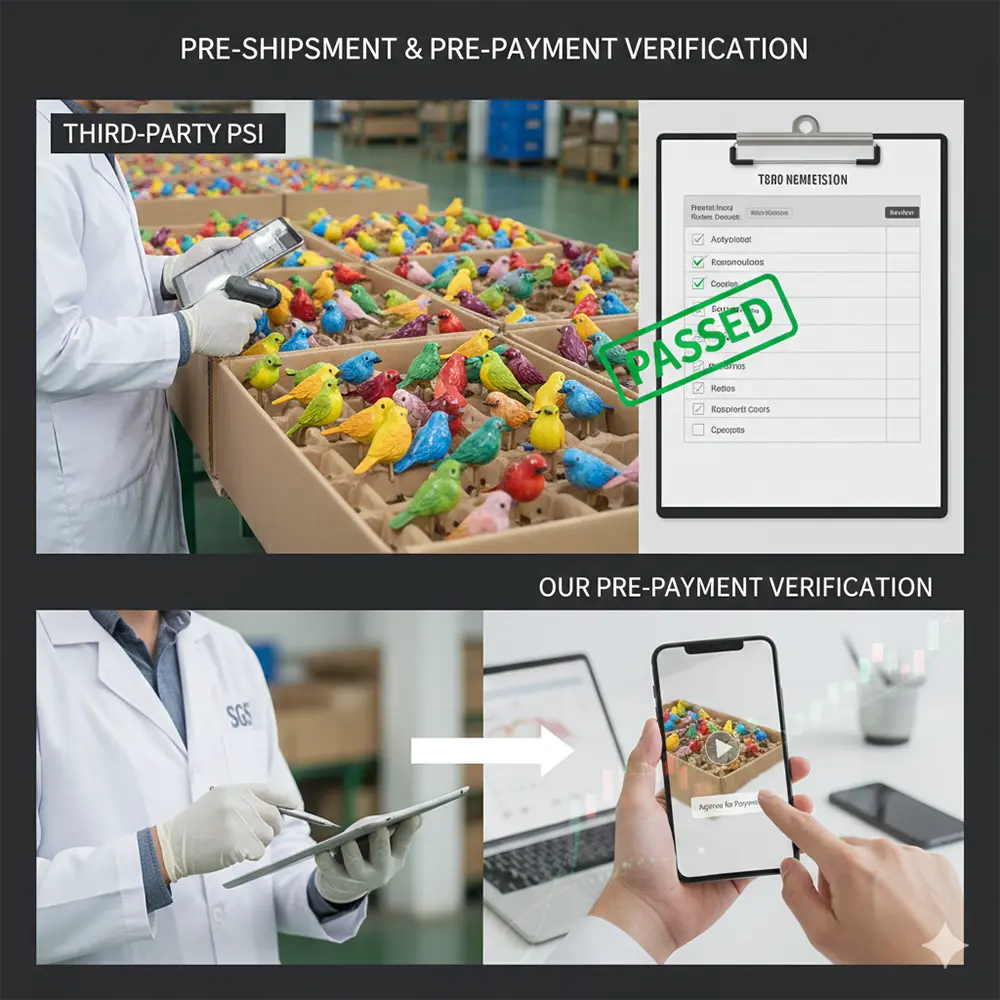
The buyer’s protection here does not come from a bank. It comes from four things, and a buyer should insist on all four rather than asking for an LC instead: a retained master sample both sides hold, so there is a physical reference rather than a memory; a written acceptance rule in the purchase order stating the tolerance and what happens outside it; evidence before the balance falls due — under our terms, photographs and video of finished goods precede the 70%, which is where a buyer’s leverage lives; and a third-party pre-shipment inspection where the order justifies it. Sampling and the retained reference are set out in our guides to golden sample approval and refundable samples for wholesalers, and acceptance rules in our guide to AQL inspection levels for wooden crafts. The commercial structure these terms sit inside is set out in our custom product manufacturing guide.
Payment Terms Compared
| Structure | Risk on buyer | Risk on supplier | Cost and friction |
|---|---|---|---|
| 100% advance | Highest — pays before anything exists | None | Lowest; a transfer fee |
| T/T 30% / 70% before shipment | Deposit at risk; balance paid against evidence | Production funded up to the deposit | Low; two transfers |
| Documentary collection | Moderate; documents control the goods | Moderate; no bank undertaking to pay | Moderate; bank handling charges |
| Letter of credit | Low on payment, unchanged on quality | Low once documents comply | Highest; fees plus amendment rigidity |
| Net 30 open account | Lowest — pays after receipt | Highest — funds the run and the credit | Low in fees, priced into the quote |
Best For / Not For: Terms by Buyer Situation
| Buyer situation | Structure that fits | Structure that does not |
|---|---|---|
| First order with a new supplier | Trial tier on T/T, with evidence before balance and a retained sample | An LC, whose fees exceed the value it protects at that size |
| Repeat buyer, growing volume | T/T now, with Net 30 raised as an alternative quotation once history exists | Assuming credit terms arrive automatically with the second order |
| Large single shipment, fixed specification | An irrevocable LC, confirmed if the issuing bank is unfamiliar | Open account on a shipment too large for the supplier to absorb |
| Custom design still being refined | T/T with milestone evidence, so amendments stay cheap | An LC, where every revision is an amendment fee and a delay |
| Marketplace or platform channel | Escrow or platform-held funds released on milestones | Full advance before the platform’s own release conditions are known |
Our Published Terms and What Backs Them
- Standard terms. T/T at 30% deposit and 70% balance before shipment. The deposit funds material and the start of carving; the balance falls due only after evidence is supplied.
- Evidence before balance. Photographs and video of finished goods are provided before the balance is payable, so the buyer sees the actual order rather than a specification.
- Trial tier. 100 pieces with a USD 500 minimum order value on in-stock designs, air express DDP, 20–30 days — sized so a first order needs no bank instrument to feel safe.
- Wholesale and custom. 300 pieces with a USD 3,000 minimum order value, sea freight, 60–90 days to port; custom printed boxes require 500 pieces.
- What we do not publish. Net 30 and LC terms are not standing offers: both depend on the relationship, order value and corridor, and are negotiated per project rather than quoted from a sheet. A supplier presenting open-account terms as standard to a first-time buyer should be asked what is priced into the number.
Two further points belong in a terms conversation. The incoterm and the payment term must be read together, since the incoterm decides who arranges and pays each leg and so which documents exist to be presented — see our guide to incoterms for wooden decor imports. And supplier capability should be verified separately from terms, because favourable terms from an unverified supplier are not a bargain; our wood carving factory audit checklist covers what to ask. Sequencing of sample, specification and production is in our sample-to-first-order timeline, and disputes in our guide to quality claims and defect resolution.
End to End: Terms Across a First and Second Order
A European importer is placing a first order for a carved decor line and expects to repeat it twice a year.
First order. A trial at 100 pieces with a USD 500 minimum order value, air express DDP, 20–30 days, settled T/T. The buyer receives photographs and video before the balance, and both sides retain an approved sample. No LC is opened: at this value the fees would exceed the risk covered.
Second order. The design is frozen against the retained sample and moves to 300 pieces with a USD 3,000 minimum order value, sea freight, 60–90 days to port. Terms are unchanged, but a pre-shipment inspection is added because the order value now justifies it.
Raising terms. After three settled orders the importer asks for Net 30 as an alternative quotation and receives one. The two numbers differ, and the cash-flow benefit is compared against the price difference rather than treated as free. Where the buyer’s bank will insure the receivable the conversation is easier, because the supplier’s risk becomes transferable.
The one time an LC fits. A later single shipment of a fixed design at container volume, specification unchanged and no amendments expected, is quoted against an irrevocable credit. Nothing will be revised mid-run, so the rigidity costs nothing, and the undertaking covers a sum large enough for the fees to make sense.

If you want a quotation you can plan cash flow against — with terms, incoterm, lead time and the evidence supplied before balance stated up front — send us your design references and target quantity and we will build it with you.
Frequently Asked Questions
Q: What payment terms do you offer?
Our published standard is T/T at 30% deposit and 70% balance before shipment, with photographs and video of the finished goods supplied before the balance falls due. Net 30 and letter-of-credit terms are not standing offers — they are negotiated per project against the relationship, the order value and the corridor.
Q: Why will a supplier not offer Net 30 on a first order?
Because Net 30 is credit, not a payment method. The supplier funds production then waits thirty days after delivery, carrying the financing cost and the non-payment risk with no trading history to price against. It becomes available after settled orders, references, larger volume, or credit insurance on the receivable.
Q: Does a letter of credit protect me if the goods are wrong?
No. A bank pays against compliant documents examined on their face, not against the goods in the container. A document set can comply perfectly and still accompany a shipment you would reject. Quality protection comes from a retained sample, a written acceptance rule and pre-shipment inspection — not the credit.
Q: When is an LC worth its cost?
On a large single shipment with a fixed specification that will not be revised, where the sum is big enough for issuing, advising and confirming fees to be proportionate. On a small or still-developing custom order the fees and rigidity usually outweigh the protection.
Q: How do I reduce risk without using a letter of credit?
Four things, in order of value: start small on the trial tier; hold a retained master sample both sides can measure against; put the tolerance and acceptance rule in the purchase order in writing; and require evidence — photographs, video or a third-party inspection — before the balance is payable. The last is where a buyer’s leverage lives.
Sources
The rules and standard bank practices governing documentary credits are maintained by the International Chamber of Commerce, which also publishes the Incoterms rules determining cost and risk at each leg. Our published terms, minimums and order values, lead times, evidence supplied before balance payment and carton specifications are our own first-party terms. No interest rate, bank fee, confirming charge, discrepancy fee or discount percentage is quoted here: those are set by your bank and the supplier’s, vary by institution and corridor, and must be obtained as current quotations. We are a manufacturer, not a trade finance adviser.