Skip to content


Key Takeaways
- A gift shop year runs as 4 display windows, spring, summer, autumn and winter, and each reset swaps about a third of the facing pieces while the other two thirds stay on the floor.
- Reset order is fixed and short: count out, photograph, clean, count in, in that order at every 1 of the 4 resets; the photo step is the one teams skip, and it is the only record of what the window actually held.
- Reach height changes the rule set: a piece that sits within a child’s reach gets re-graded against toy safety rules at every 1 of the 4 resets, not once at first listing.
- Storage is a specification rather than a corner: wrapped per piece, 6 to 12 pieces per inner box, moisture held at 8 to 12 percent so a stored season returns saleable.
- Counts travel with photographs: 1 count sheet and 1 photo set per fixture per reset, filed under the window name, so the next reset starts from evidence instead of memory.
- Order maths follows the reset calendar: proof quantities on the 100-piece trial tier before a window opens, then season volume on the 300-piece tier landed 60 to 90 days to port ahead of it.
A gift shop display lives or dies in the week between seasons, not in the season itself. The pieces that sell a window are chosen months ahead, but the shelf a customer actually meets is assembled in a day or two of counting, moving, wrapping and storing, usually by the same two people who run the till. This guide walks that transition as a repeatable operation: the 4 windows of the year, what stays and what stores, the order of work on reset day, the count and photo discipline that makes the next reset cheaper, and the order maths that keeps each window stocked without burying cash in slow movers.
It is deliberately narrow. The fixture template and shelf hierarchy are covered in our gift shop planogram basics guide, single-season resets such as the spring changeover have their own walkthrough, and the inventory and markdown side of season end sits in a separate turnover article. Here the subject is only the seam: the moment one window closes and the next one opens, and everything a shop must do in that seam to keep both seasons saleable.
In this guide
- Why the Transition Week Decides the Year
- Gift Shop Display: The Year in 4 Windows
- What Stays and What Stores
- Reset Day: The Order of Work
- Count and Photo Discipline per Reset
- Window by Window: What Swaps
- Re-Grading at Reset: Reach Height Changes the Rule
- What We Supply Into Display Programmes
- Which Format Fits Which Window
- What We Check Before a Reset Ships
- End to End: One Shop, Four Resets
- FAQ
Why the Transition Week Decides the Year
Most display losses are transition losses. A piece that chips in a storage bin, a tag that fades under a summer window, a winter set that returns with a broken ear: none failed on the sales floor, they failed in the seam. Shops that treat the reset as a project with an order of work and a record lose fewer pieces than shops that treat it as tidying, and the difference shows a year later as a back room of saleable stock instead of a markdown crate.
The seam also decides what the next window can promise. If the autumn reset discovers that half the spring stock is unsaleable, the spring order a year later gets cut on false evidence. Clean counts and photographs at each reset are what let a buyer separate a weak product from a weak window, which is why the discipline in this guide is mostly paperwork: 1 count sheet, 1 photo set, 1 storage list, per fixture, per reset.
Gift Shop Display: The Year in 4 Windows
Four windows cover most gift shops: spring from late February, summer from late May, autumn from September, winter from early November. Each has a dominant motif, colour temperature and price point, and the reset is the handover of those three things. Spring hands painted pieces and basket stuffers to summer; summer hands coastal and garden themes to autumn; autumn hands harvest and lodge themes to winter; winter hands the heavy range back to storage.
The handover is not a full swap. Roughly a third of facing pieces change, a third move position within the shop, and a third never leave their fixture at all. Keeping the staying third visible and undisturbed is what makes a reset finishable in a day: the team only touches what must move. Boutiques that run a rustic or lodge line year round find the staying third is even larger, because the material story does not change with the season, as our rustic decor merchandising walkthrough describes for that format.

What Stays and What Stores
The stay-or-store decision is made per piece against 3 questions: does the motif belong to the coming window, does the piece photograph well in the coming window’s light, and will it survive another 3 months on the floor without handling damage? A piece that fails the first stores; a piece that fails the second moves to a lower-light fixture; a piece that fails the third stores regardless, because a faded facing piece costs more than an empty hook.
Storage conditions are part of the decision, not an afterthought. Wrapped per piece in white paper, 6 to 12 pieces per inner box, stacked in a dry room with moisture held at 8 to 12 percent in the wood: the same numbers we hold at the factory, and the reason a stored season returns to the floor without rework. Shops in humid climates should check the storage room against our wood moisture content standard before committing a winter range to the back room.

Reset Day: The Order of Work
Reset day runs in a fixed order, and the order matters more than the speed. Count out first: every piece leaving a fixture is counted onto the sheet before it moves, so the sheet describes the window that just closed. Photograph second: one wide shot per fixture plus one close shot per shelf, taken before cleaning, because dust and gaps are evidence too. Clean third, with the fixture empty. Count in last: every piece placed is counted onto the new window’s sheet as it lands, and the sheets reconcile against the storage list at day’s end.
Two rules keep the day honest. Nothing enters a storage box without appearing on the storage list, and nothing returns to the floor next season without being counted in again; the list and the count sheet are the same document viewed from two ends. Teams that skip the photograph step save ten minutes and lose the only artefact that explains, six months later, why a fixture underperformed.
Count and Photo Discipline per Reset
The record per reset is deliberately small: 1 count sheet and 1 photo set per fixture, 1 storage list for the whole shop, and 1 failure line for anything chipped, faded or failed on the way out. Four artefacts filed under the window name reconstruct any decision the reset made; anything more becomes a project nobody finishes, anything less becomes opinion.
| Artefact | Contents | Filed as |
|---|---|---|
| Count sheet | Piece count out and in per fixture, with damage marks | Window name plus fixture code |
| Photo set | 1 wide shot plus 1 close shot per shelf, pre-clean | Window name plus fixture code |
| Storage list | Box numbers, piece counts, room and shelf position | Season name, one row per box |
| Failure note | Anything chipped, faded or failed on the way out | One line on the count sheet |
Window by Window: What Swaps
The swap pattern repeats every year with different product names: what changes is the motif, colour temperature and price point leading the fixture; what stays is the fixture, the staying third, and the record discipline. The table is the shape of a typical year for a shop carrying a carved and painted wooden range.
| Window | Swaps in | Swaps out to storage | Stays on the floor |
|---|---|---|---|
| Spring | Painted bunnies, eggs, basket stuffers | Winter sets, lodge pieces | Natural-finish animals, year-round ornaments |
| Summer | Coastal birds, garden and picnic themes | Spring painted stock | Natural-finish animals, tabletop decor |
| Autumn | Harvest, lodge and raptor themes | Summer coastal stock | Rustic line, tabletop decor |
| Winter | Nativity, ornaments, gift sets | Autumn harvest stock | Rustic line, gift sets that read all year |

Re-Grading at Reset: Reach Height Changes the Rule
A reset moves pieces between heights, and height changes the rule set. A carved animal on a top shelf is decor; the same animal on a low bin table is within a child’s reach, and anything within reach that a shop presents as suitable for children falls under toy safety expectations rather than decor expectations. European toy safety legislation and its EN 71 standards are the reference point we grade against, published by the European Commission’s toy safety sector page, and the small-part, edge and cord checks it implies are cheap to run at reset time and expensive to run after a complaint.
The practical rule is one line per reset: any piece that lands within a child’s reach gets its grading line re-read before it is faced, and decor-graded pieces go above reach or carry a decorative-use line on the tag. Reset day is the natural moment because the piece is already in hand and the count sheet is open.
What We Supply Into Display Programmes
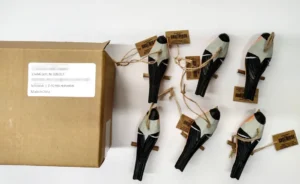
- We supply: carved and painted wooden pieces in 4 species, basswood, pinewood, rubber wood and birch, in 3D carving from 5 to 40 cm and 2D pieces to 80 cm, so a window can be built from one material story.
- We supply: season sets designed as display units, kitted per fixture with a shared tag card, so a reset swaps a box rather than assembling pieces one by one.
- We supply: export packing built for storage as well as transit: white-paper wrap per piece, 6 to 12 pieces per 3-ply inner box, 240 to 480 pieces per 5-ply master, tested to ISTA 3A.
- We do not supply: electronics, hinges, magnets or springs inside display pieces, and no weatherproofing or outdoor guarantee for interior decor ranges.
Season sets and window kits are quoted from the same specification library as our other programmes, and the range overview sits in wholesale wooden crafts for buyers assembling a first order across several windows at once.
Which Format Fits Which Window
Format choice is a transition decision as much as a sales decision. Hanging ornaments suit windows with vertical space and low handling risk; tabletop carvings suit bins and counters but collect handling damage; kitted gift sets suit winter because they leave the floor in the box they arrived in; flat 2D pieces suit spring baskets because they survive bulk handling. The cheapest upgrade most shops can make is one format family per fixture, so the reset crew handles a single packing logic per shelf: mixed-format fixtures are where chips happen, because the wrap that protects a hanging ornament does not protect a standing carving.
What We Check Before a Reset Ships
- Moisture at 8 to 12 percent recorded per batch before wrapping, so pieces arrive at the storage room in the same band they must keep.
- Edge and point inspection on the sampling plan, with any piece destined for low fixtures flagged for the reach-height re-grade at the shop.
- Finish and tag consistency across a season set, printed identically on piece and box so a reset crew can re-tag from stock without opening every box.
- Claims limited to what we hold: CE, UKCA, RoHS, EN71 where the piece is marketed as a toy, BSCI and ISO 9001.
Every figure above is first-party and checkable against an inspection report or a certificate we hold; the window calendar and the reset order are programme design, not statistics. The company and its specification library sit at ewoodarts.com.
End to End: One Shop, Four Resets
A museum shop with two fixtures per season wants a repeatable year: proof the spring range, carry it through summer with a partial swap, then commit to winter volume once the counts from autumn are in.
Proof first. The spring range arrives on the trial tier at 100 pieces and a USD 500 minimum order value, air express DDP in 20 to 30 days, so the first reset tests real handling before real money. Count sheets and photo sets from that window decide which pieces earn a place in the summer staying third.
Commit on evidence. The winter range is ordered after the autumn reset reconciles, on the wholesale tier at 300 pieces and a USD 3,000 minimum order value, sea freight at 60 to 90 days to port, timed so the master cartons land before the November window opens. Payment runs T/T with a 30 percent deposit and 70 percent before shipment against photos and video of the packed order.
Close the loop. The winter storage list becomes next spring’s count-in sheet, and the four artefacts per reset accumulate into a year of evidence: which motifs sold, which formats survived, which fixtures need a different staying third. Buyers applying the same discipline to a first range can start from our wholesale and retail programme overview.
Plan next season’s resets with a range built for them
Season sets, window kits and per-piece grading records, quoted from one specification library.
FAQ
How many display windows should a small gift shop run per year?
Four covers most shops: spring, summer, autumn and winter. A shop with a strong local season can run five by splitting that peak, but each extra window adds a full reset with its counts and photographs.
What proportion of facing pieces should change at each reset?
About a third swaps in, a third moves position, a third stays put. Swapping more than half turns a reset into a re-merchandising project that will not finish in a day, and it erases the staying range regulars recognise.
Do stored wooden pieces need special conditions between seasons?
Dry, stable conditions: wrapped per piece, boxed in small inner counts, kept where the wood holds 8 to 12 percent moisture. Damp storage shows up next season as checks and open joints, not as damage on the day of storing.
When must a decor piece be re-graded as a toy?
Whenever it moves within a child’s reach and is presented as suitable for children: toy safety expectations then apply, so the grading line and tag are re-read at the reset rather than left as first-listed decor grading.
How far ahead should winter display stock be ordered?
Allow the sea tier’s 60 to 90 days to port plus inland time, so a November window is ordered by late summer. Trial-tier proof quantities can still fly in 20 to 30 days if a range is confirmed late.