Skip to content

Wooden family puzzles sit in an odd corner of the toy aisle: they are bought by adults, played with by several age groups at once, and judged on how well they survive repeated family use rather than on a single opening. For a toy retailer or educational supplier, that makes them one of the few wooden categories where build quality, age grading and print artwork all have to be specified separately, and where the supplier conversation is about construction and compliance rather than about trend reports. This guide covers how the category is structured, which standards govern it, how customisation is quoted, and what to verify before placing a wholesale order through our wooden family puzzle production line.
Jilin Ever Creation – the company behind the Ewood Arts brand – carves and finishes basswood puzzle boards and pieces in Jilin Province, using timber sourced from the Changbai Mountains and documentation issued under domestic logging regulations. Everything below reflects how we build and quote the category for overseas buyers.
Key Takeaways
- 100 pieces or a USD 500 minimum order value is all a trial run of wooden family puzzles requires before a retailer tests the range.
- 3 age tiers carry the category – 2-4, 5-7 and 8+ – and each one triggers different small-parts and labelling rules.
- Basswood kiln-dried to 8-12% moisture is what keeps puzzle boards from warping across a container crossing.
- EN71, ASTM F963 and ISO 8124 are the three standard sets a toy buyer should see referenced in the supplier file.
- Custom colour boxes start at 500 pieces, so artwork amortises across the whole seasonal drop instead of one SKU.
- 20-30 days by air, 60-90 days by sea to port, which sets the real deadline for gift-season puzzle orders.
In This Guide
- How the Wooden Family Puzzle Category Is Organised
- Developmental Value: What Buyers Actually Sell
- Age Grading, Small Parts and Labelling
- Material and Build Decisions
- Safety and Compliance Documentation
- Customisation: Photo, Theme and Private Label
- MOQ, Lead Time and Landed Cost
- Supplier Evaluation Checklist
- Frequently Asked Questions
How the Wooden Family Puzzle Category Is Organised
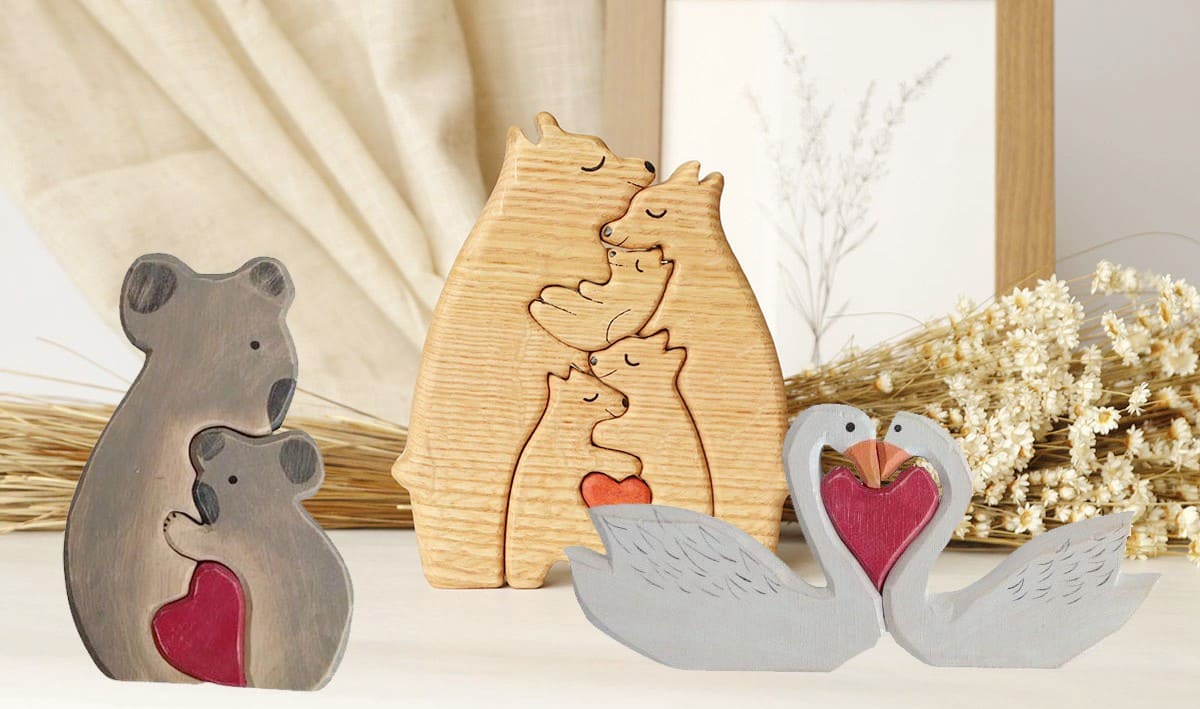
Retail ranges rarely work as a single SKU. Puzzle programmes divide along three independent axes, and mixing across them is what makes an endcap read as a collection rather than as leftover stock.
By piece count and playing time
Simple peg-and-shape boards resolve in a few minutes; multi-layer scenic puzzles and personalised photo puzzles hold a table for an evening. The first format suits checkout impulse and gift-with-purchase; the second justifies a higher ticket and a place on the main run rather than in a dump bin.
By theme
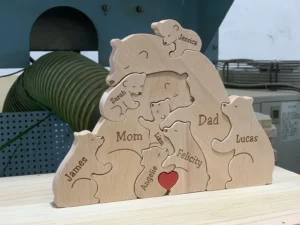
Family-portrait and pet-portrait puzzles are the fastest-growing briefs we receive, because the artwork is supplied by the customer and the product becomes unreturnable in the best possible retail sense. Nature, animal, transport and number/alphabet themes are the steady replenishment lines. A buyer planning a range normally carries one personalised hero, two or three themed core SKUs, and one entry-level board that anchors the shelf price.
By construction
Developmental Value: What Buyers Actually Sell
Retailers do not sell a puzzle; they sell an outcome they can describe on the shelf talker. Four outcomes cover almost every wooden family puzzle listing, and each maps to an age band rather than to a marketing claim.
- Hand-eye coordination and grasp control: picking up and seating a chunky piece is the visible skill in the 2-4 band.
- Spatial reasoning: rotation and fit judgement, which is what the 5-7 band is tested on.
- Number, letter and vocabulary work: printed themes carry the educational content, and curriculum alignment is a real brief from school-supply buyers.
- Shared attention: the family format exists because an adult sits down for ten minutes with the child, which is the argument toy buyers use against screen time.
Write these into the listing copy as capability, not as improvement rates. A retailer who claims a specific cognitive gain needs a study behind the number, and most buyers cannot produce one. That is precisely why our own spec sheets describe construction, tolerances and finish rather than outcomes.

Age Grading, Small Parts and Labelling
Age grading is the decision that constrains everything else in this category. It fixes the minimum piece size, the warning labels, the packaging copy and often the paint system, and it is set by the market the goods are entering rather than by the design.
- Under 3 years: no small parts at all, oversized pieces, and a durable printed finish that survives washing; chunky peg boards are the safe format.
- Ages 3-6: small-parts testing still applies to anything that fits the standard test cylinder, so piece geometry and the warning label are checked together.
- Ages 8 and up: fine jigsaw pieces and photo prints become viable, allowing thinner board stock and tighter cut tolerances.
Labelling follows the grading decision: the applicable standard reference, the manufacturer or importer responsible for the goods, the age warning, and country-of-origin marking on both the colour box and the master carton. Our wooden puzzle age-grading and safety breakdown covers how grading changes the piece geometry we cut.
Material and Build Decisions
Basswood is the default for carved and layered puzzles: it cuts cleanly, takes print and paint without bleeding, and stays light enough that a large board is comfortable to handle. Birch ply is used where a buyer wants a harder face for fine jigsaw cuts. Either way, board stock is kiln-dried to 8-12% moisture before cutting; a puzzle that leaves the factory at a higher moisture content will cup during the container crossing, and cupped boards do not survive a returns policy.
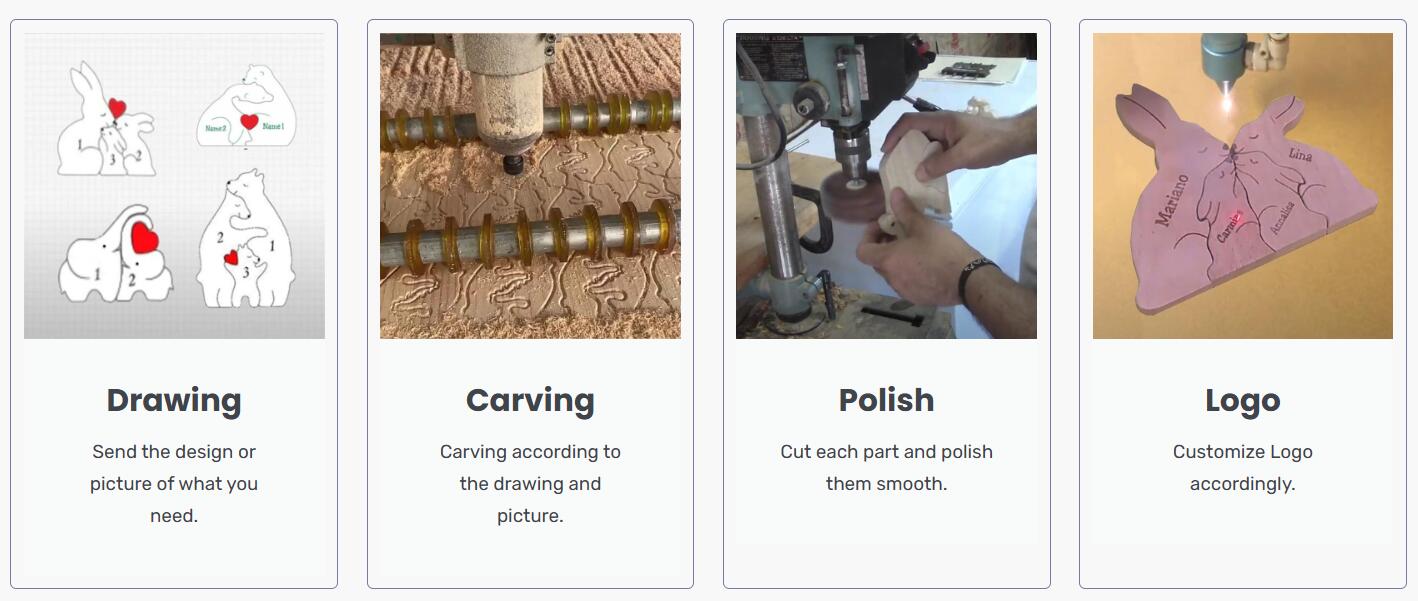
Finish choice drives cost more than artwork does. A two-colour pad-printed surface is cheap and fast; a full-colour printed face with matte varnish requires litho or digital printing on board and a longer drying schedule; hand-painted details are bench work and quoted accordingly. Edge treatment – deburring and a light sanding pass on every piece – is the step buyers most often forget to specify and then audit for.
Safety and Compliance Documentation
Three standard sets appear in almost every wholesale enquiry for this category: EN71 in the European market, ASTM F963 in the United States, and ISO 8124 as the international reference. A buyer should expect the supplier to name the specific parts, not just the standard family – EN71-1 mechanical properties, EN71-2 flammability and EN71-3 migration of certain elements being the relevant trio for wooden puzzles.
On the chemical side, US requirements cap lead in paint and surface coatings, and phthalate limits apply to any coated or plasticised component. The Consumer Product Safety Commission toy safety business guidance is the reference we hand to North American buyers so they can check the requirement list themselves instead of taking our word for it.
What we can evidence in-house is the compliance framework the goods are produced under: BSCI social-compliance audits, an ISO 9001 quality management system, and CE, UKCA, RoHS and EN71 conformity for the finished product. Each production run keeps its paint batch records and inspection notes alongside the timber documentation, and every export batch travels with official timber felling and transport permits, so a buyer’s own compliance team has a file to audit rather than a promise. Where a retailer needs product-level certification under a scheme we do not hold, we say so at sampling stage instead of at shipment.
Customisation: Photo, Theme and Private Label
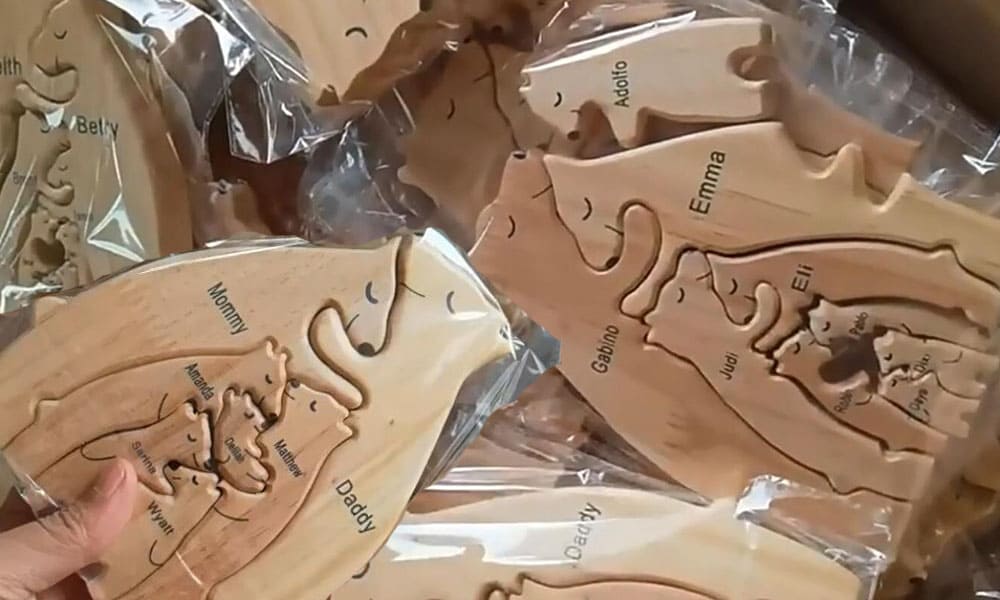
Personalised puzzles are a artwork-forward product: the customer supplies the photograph or illustration, and the supplier’s job is colour management, print registration and piece layout that still solves after cutting. Two questions decide whether a factory can really run this line – can they produce a printed proof on the actual board stock, and who owns the artwork files between orders.
Private-label branding works at three levels: printed colour box artwork, in-puzzle branding (a logo piece or a hidden mark on the reverse), and the insert card carrying the retailer’s own age guidance and warranty contact. Custom colour box tooling is where the 500-piece threshold sits, which is why buyers normally bundle a personalised line and its packaging into one order rather than placing them weeks apart. Our EN71 approach to wooden learning toys explains which finish systems we use when the target age band is young.
Sampling runs 7-14 days from an approved artwork file, and AQL 2.5 inspection against that signed sample governs the production run. Once the sample is approved, artwork changes are a new cost line, not a favour.
MOQ, Lead Time and Landed Cost
- Trial orders: 100 pieces, or a USD 500 minimum order value, drawn from in-stock designs and normally shipped by air express on DDP terms in roughly 20-30 days.
- Wholesale and customised orders: 300 pieces, or a USD 3,000 minimum order value, which is the point where sea freight at 60-90 days to port becomes the economic choice.
- Custom printed colour boxes: 500 pieces per tooling run, shared across sizes within one order where the artwork allows it.
Freight mode is the variable most buyers underestimate. A 300-piece puzzle order that arrives six weeks late is not a delayed shipment but a missed gift window, which is why seasonal programmes are booked against the sea-freight calendar and the air lane is reserved for replenishment. Working back from the in-market date, add the 7-14 day sampling window and the production run to whatever the freight quote promises.
Supplier Evaluation Checklist
Nine checks separate a real wooden puzzle manufacturer from a trading account with a catalogue.
- Board stock and moisture control: ask which species, which ply, and what kiln-drying range the factory holds.
- Cut tolerance evidence: request a solved sample rather than a photograph.
- Print system: pad print, litho or digital on board, and who colour-matches the proof.
- Finish chemistry: which certified coatings are available for the target age band.
- Standards named by part: EN71-1/-2/-3, ASTM F963, ISO 8124 – a supplier who cannot name parts is reselling.
- Audit and system certificates: BSCI and ISO 9001 for the facility, CE, UKCA, RoHS and EN71 conformity for the goods.
- Timber documentation: felling and transport permits for the export batch.
- Inspection protocol: AQL level, and against what reference sample.
- Commercial structure: MOQ, minimum order value, sampling timeline and freight options in writing.

Wholesale buyers starting a range usually begin with the mixed trial order rather than a single hero SKU; our wholesale wooden family puzzles programme is built around that, and specification questions can go straight to the team.
Start a Wooden Family Puzzle Range With the Factory Direct
Basswood and birch puzzle boards, custom artwork and printed colour boxes, produced under BSCI-audited and ISO 9001-controlled conditions. Trial orders from 100 pieces or a USD 500 minimum order value.
Frequently Asked Questions
What is the minimum order for wooden family puzzles?
A trial order starts at 100 pieces or a USD 500 minimum order value, which can be split across designs and age bands. Wholesale and customised programmes begin at 300 pieces or a USD 3,000 minimum order value.
Can we put our own family photograph into the puzzle?
Yes, that is the personalised line. You supply the artwork at print resolution, we produce a printed proof on the actual board stock, and piece layout is set so the image still solves cleanly. Personalised puzzles are quoted as custom work rather than from stock.
Which safety standards apply to wooden puzzles?
EN71 parts 1, 2 and 3 in Europe, ASTM F963 in the United States, and ISO 8124 as the international reference. Age grading decides the small-parts requirements, and the warning label on the colour box has to match that grading.
How long does a custom puzzle order take?
Sampling runs 7-14 days from an approved artwork file. After the sample is approved, allow 20-30 days by air express or 60-90 days by sea to port for delivery, so a seasonal order is planned backwards from the in-market date.
Do you supply the retail packaging as well?
Yes. Custom printed colour boxes run from 500 pieces per tooling set, and the same run can cover several puzzle sizes if the artwork is built to share a design. Barcode application and outer-carton shipping marks are handled in-house.
Final Thoughts
A wooden family puzzle programme succeeds or fails on three specification decisions: the age band the pieces are cut for, the moisture content of the board that ships, and whether the finish system matches the certification the target market expects. Everything else in this category – artwork, format mix, packaging – is commercial rather than technical.
Buyers who lock those three down before quoting avoid the two failure modes that actually cost money: a range that cannot be labelled for the shelf it was built for, and a delivery that arrives after its season. Start with a mixed trial order, hold the approved sample as the production reference, and let the compliance file – not the sales deck – decide the supplier.