Skip to content
Hand-carved wooden animal figurines have moved well beyond the souvenir shelf. Today, specialty retailers, museum gift shops, interior stylists, and e-commerce brands stock them as core home decor SKUs — and the sourcing math is straightforward. A 12cm basswood owl that costs $2.80 at factory gate retails for $18–$24 in a European gift shop, delivering margin ratios that few other handcrafted categories can match. But wholesale wooden animal carvings is a broad market: product ranges span from 5cm impulse-buy keychains to 40cm statement sculptures, wood species vary in workability and price, and quality differences between suppliers are dramatic. This guide walks buyers through every decision point — categories, materials, sizing, quality benchmarks, OEM options, and order logistics — so you can build a profitable animal carving line with confidence.
Product Categories: What Sells in Wholesale Wooden Animal Carvings
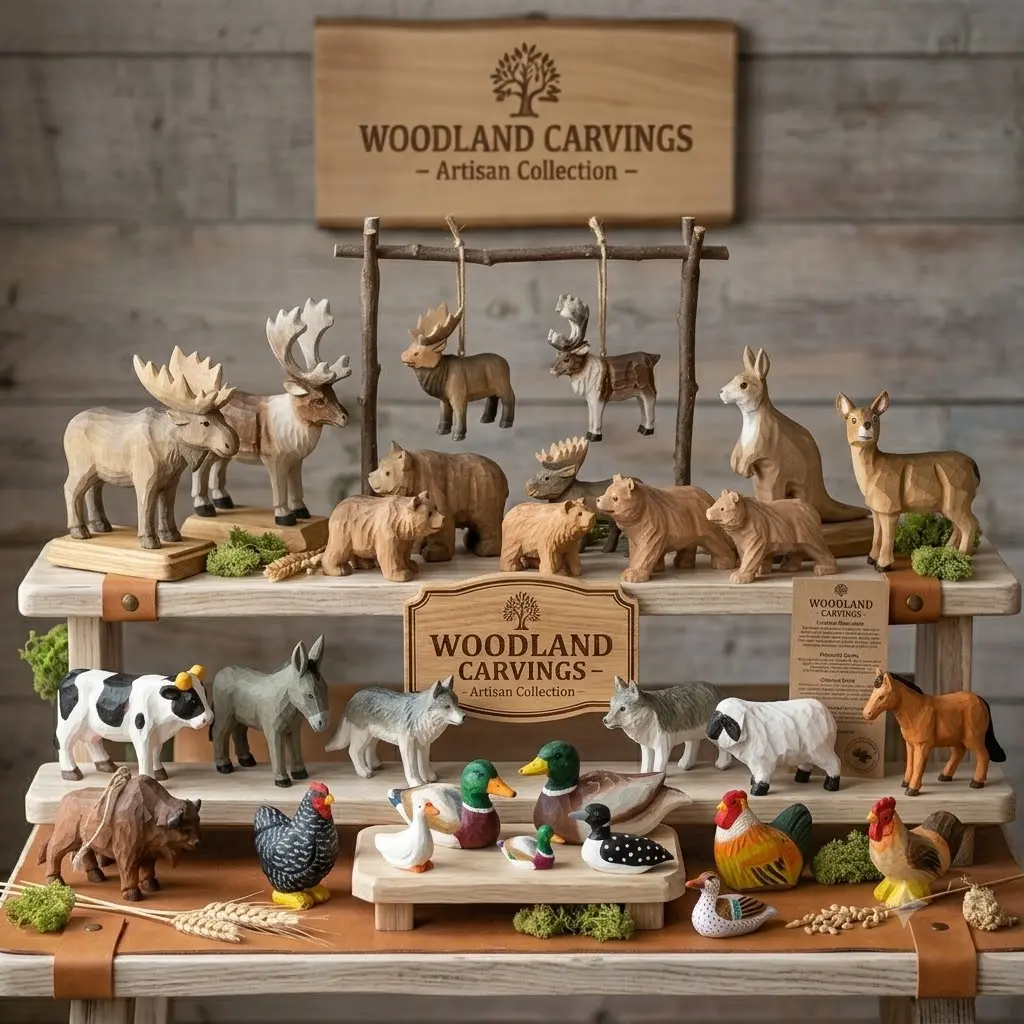
The wholesale market for wooden animal figurines breaks into five commercially distinct categories. Understanding which category fits your retail format is the first step to building a coherent product line.
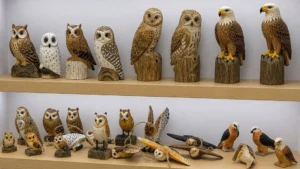
Wildlife figurines are the volume core. Owls, eagles, ducks, and forest animals (foxes, deer, bears) dominate European and North American gift shops. At our factory, garden songbirds alone account for over 40 species — from robin redbreasts to kingfishers — each hand-painted with species-accurate plumage. Waterfowl decoys follow traditional Scandinavian and American carving aesthetics, appealing to the heritage decor segment. Raptors — particularly owls and eagles — command premium pricing because of their sculptural presence; a 25cm hand-carved bald eagle typically retails above $60 in specialist stores.
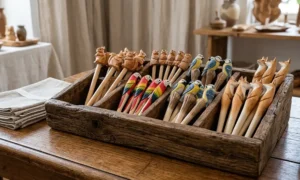
Fantasy and whimsical animals — chunky cartoon-style owls, painted elephants with decorative saddles, penguin families — target the impulse and children’s gift segment. These pieces run 5–15cm, carry bright colour finishes, and price at $1.50–$4.00 wholesale. They are high-turn items for checkout counters and market stalls.
Naturalistic sculptures represent the premium tier. Carved from a single block of basswood with meticulous anatomical detail — think museum-quality herons, lifelike foxes mid-stride, or a peregrine falcon in diving posture — these pieces target interior designers and high-end home decor retailers. Sizes range from 15cm to 40cm, and the hand-finishing process (sanding, priming, multi-layer acrylic painting, clear-coat sealing) can take a single artisan 3–5 working days per piece.
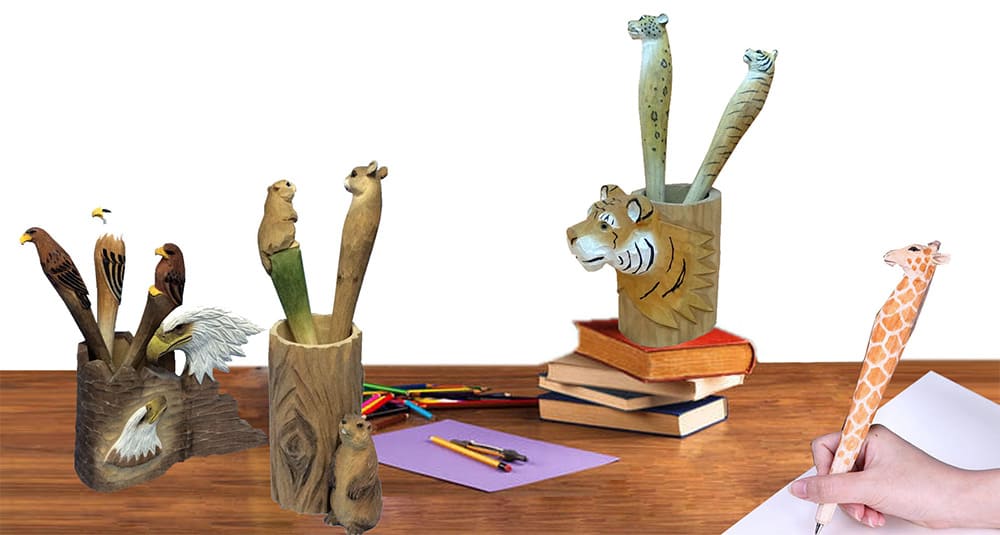
Functional animal decor merges aesthetics with utility: wooden animal wall hooks, bookends shaped as elephants or moose, and animal-form napkin rings. These items solve a practical problem for retailers — they give customers a reason to buy beyond pure decoration — and they consistently outperform pure figurines in average order value.
Seasonal animal ornaments tie into holiday retail calendars. Christmas trees adorned with carved finials, Easter bunnies, Halloween bats, and Day of the Dead sugar skulls all leverage the same carving skillset with seasonal paint palettes. Retailers planning Q4 inventory should note that seasonal animal production slots fill by August — the same window as wholesale wooden Christmas ornament orders, since both lines share factory capacity during peak season.
Wood Selection: Basswood, Pine, Rubber Wood & Birch Compared
The wood species your supplier uses determines carving detail, weight, durability, and cost. Most wholesale wooden animal carvings on the global market are made from four species, each with distinct trade-offs.
Basswood (Tilia) is the industry default for good reason. Its fine, even grain holds intricate detail without splintering — essential when carving feather textures on a bird or whiskers on a fox. It is lightweight (a 15cm owl weighs roughly 120g), which keeps shipping costs low, and it accepts paint and stain uniformly. The Changbaishan forests in Jilin Province, where our factory has operated since 2004, supply basswood with particularly tight grain patterns due to the slow growth cycle in that climate. Basswood is the strategic choice for exporters prioritizing detail fidelity and weight efficiency.
Pine is harder and more resinous than basswood, making it suitable for outdoor or garden pieces that must withstand moisture and temperature swings. The visible grain pattern gives pine carvings a rustic aesthetic that appeals to the cabin-lodge decor segment. However, pine’s resin content can interfere with paint adhesion if the wood is not properly kiln-dried — always verify that your supplier kiln-dries pine to 8–12% moisture content before carving.
Rubber wood is a plantation hardwood increasingly used for mid-range figurines. It is denser than basswood (adding roughly 20% to item weight) but significantly cheaper. Rubber wood takes paint well and is often marketed as “sustainable” since it comes from replanted rubber tree estates. For buyers building ESG-aligned product lines, rubber wood is worth considering — just confirm that your supplier can provide official timber felling and transport permits as traceability documentation.
Birch offers a pale, clean appearance with subtle grain that works beautifully for natural-finish or white-washed pieces. It is harder than basswood, so it holds edges well, but it is more prone to tear-out during fine detail work. Birch is best reserved for pieces where a light-colour wood is aesthetically preferred — Scandinavian-style animal decor, for instance, where the pale wood tone is part of the design language.
Sizing Guide: From 5cm Impulse Buys to 40cm Statement Pieces
Retail buyers new to wooden animal carvings often over-order large sizes, not realizing that a well-stocked display needs size variation to create visual rhythm. Here is how the size tiers break down for 3D carved animal figurines.
Miniature (5–8cm): Keychains, tree ornaments, and counter impulse items. Wholesale unit cost $0.50–$1.50. These are volume drivers — a countertop display box of 50 mixed miniature animals can generate $250–$400 in retail revenue with minimal floor space.
Small (8–15cm): The shelf-workhorse range. Fits standard gift shop shelving, pairs well in groupings (a family of three ducks, for example), and hits the $8–$18 retail sweet spot that triggers impulse purchases without triggering “is this worth it?” hesitation.
Medium (15–25cm): The premium shelf tier. These pieces have enough presence to serve as standalone display items. An 18cm hand-painted eagle at $24–$35 retail is a strong margin item for home decor shops and museum stores.

Large (25–40cm): Statement sculptures for interior designers and specialty retailers. These pieces require more display space and command $40–$120+ at retail. They are best sold as hero pieces — the centrepiece that draws customers into a display, where they then purchase smaller items alongside.
For flat relief carvings and 2D pieces (wall hangings, plaques), the maximum dimension extends to 80cm. These serve a different retail function — wall decor rather than shelf decor — and are typically stocked by galleries, frame shops, and interior design studios.

Quality Markers: What to Inspect Before Placing a Bulk Order
Hand-carved wooden animals look similar in product photos but can differ enormously in person. Four quality markers separate export-grade carvings from craft-market amateur work.
Anti-cracking treatment. The single most important structural factor. Wood must be kiln-dried to 8–12% moisture content and treated with an anti-cracking solution before carving. Skipping this step saves the factory a few dollars per piece but guarantees that carvings will split during international shipping or in climate-controlled retail environments. Ask your supplier to document their kiln-drying protocol — any reputable factory will provide this.
Surface finish. Run your finger along the carving. Export-grade pieces should feel smooth with no rough spots, splinters, or tool marks. The base should be flat and stable — the figurine must stand without wobbling. For painted pieces, check that the paint layer is even, with no bleeding across colour boundaries and no unpainted gaps in recessed areas.
Detail fidelity. Compare the piece to the reference photo or approved sample. Hand carving naturally introduces slight variation — this is the artisanal character that justifies the price premium over CNC-made copies. But the overall proportions, pose, and key features (beak shape on birds, eye placement, ear position on mammals) should match the reference within acceptable tolerance. If you are ordering from a new supplier, request a pre-production sample and measure critical dimensions with calipers.
Paint and coating safety. For the EU market, all paints and coatings must comply with EN71-1/-2/-3 (toy safety standards, which apply to any decorative item that could reasonably be handled by children). For the UK market, UKCA marking is required. Our factory holds current EN71 and UKCA certifications, and we use exclusively eco-friendly, non-toxic acrylic paints. Always request test reports before placing orders — verifying EN71 compliance before import is far cheaper than dealing with a customs rejection.
OEM & Custom Options: From Reference Photo to Finished Product
Most buyers eventually move beyond catalogue pieces into custom designs — and for good reason. A proprietary animal design that no other retailer carries becomes a brand differentiator and a full-margin product. Here is how the OEM process works for wooden animal carvings.
Step 1 — Design input. The buyer provides multi-angle reference photos, target dimensions, wood species preference, and paint/finish requirements. Hand-drawn sketches work but photographs are significantly more reliable for communicating proportions and surface texture.
Step 2 — Prototype carving. A senior artisan carves the prototype by hand. This stage takes 7–15 days depending on complexity. The prototype is photographed from all angles and sent to the buyer for approval before any production commitment.
Step 3 — Approval and adjustment. The buyer reviews the prototype and requests modifications if needed. Common adjustments include proportion tweaks (a longer tail, a wider stance), paint colour changes, or base modifications. One round of revisions is included in the prototype cost; additional rounds are quoted separately.
Step 4 — Production. Once the golden sample is approved, production begins. Lead time depends on order quantity: 20–30 days for trial orders (100–300 pieces), 60–90 days for full custom orders (500+ pieces). Throughout production, the golden sample remains on the factory floor as the quality reference — every piece is compared against it during final inspection.
Custom packaging is available from 500 pieces onward: colour boxes with your branding, insert cards, barcodes, and retail-ready window boxes. For buyers who need end-to-end custom wood manufacturing, the same OEM workflow applies across all wooden product categories — not just animal carvings.

Ordering & Logistics: MOQ, Pricing Tiers, and Shipping
Sourcing wholesale wooden animal carvings from a direct factory offers cost advantages that trading companies cannot match — but it requires understanding the order structure.
MOQ structure. Trial orders start at 100 pieces with a $500 minimum per order. This tier ships via air express DDP (door-to-door with customs clearance included), making it ideal for testing a new product line before committing to a full container. Wholesale orders of 300+ pieces qualify for sea freight at the lowest per-unit cost. Custom packaging MOQ is 500 pieces per SKU.
Pricing tiers. Unit price decreases with volume. A 12cm hand-painted owl might cost $3.20 at 100 pieces, $2.80 at 300 pieces, and $2.40 at 1,000 pieces. Pricing is quoted in USD and based on EXW, FOB, or DDP terms depending on buyer preference. The factory supports EXW, FOB, CFR, CIF, DDU, and DDP — with DDP delivery available to commercial addresses and Amazon FBA centres in the US, Europe, and Australia.
Packaging standards. Each piece is individually wrapped in white paper, then packed 6–12 pieces per inner box (21×11×14cm, 3-ply corrugated). Inner boxes are packed 240–480 pieces per master carton (58×44×31cm, 5-ply reinforced corrugated, ISTA 3A drop-test certified). Master carton gross weight ranges from 8.0–15.0kg. This packaging system has been validated through ISTA drop-test protocols to ensure that breakage rates stay below 0.5% during international transit.
Payment terms. Standard terms are T/T: 30% deposit upon order confirmation, 70% balance before shipment. Before the balance is collected, the factory provides production photos and videos for buyer approval. Small trial orders and samples can be paid via the online payment gateway for convenience.
Why Basswood Dominates the Global Wood Craft Export Market
A question buyers ask frequently: why is basswood so dominant in wooden animal carvings? The answer lies in the intersection of workability, weight, and cost. Basswood’s Janka hardness rating of 420 lbf makes it soft enough for intricate hand carving yet stable enough to hold fine details over decades. Its pale cream colour provides a neutral canvas for any paint system. And its low density (roughly 400kg/m³ kiln-dried) means that a container load of finished carvings weighs significantly less than the same volume in harder woods — directly reducing per-unit freight costs. For importers managing margin across ocean freight, basswood’s weight advantage alone can account for 5–8% of landed cost savings compared to birch or maple.
Frequently Asked Questions
What is the minimum order quantity for wholesale wooden animal carvings?
Trial orders start at 100 pieces with a $500 minimum. This is designed for retailers testing a new product line before committing to larger volumes.
Can I order custom-designed animal carvings?
Yes. Provide multi-angle reference photos, target size, wood preference, and finish requirements. The factory produces a hand-carved prototype within 7–15 days for your approval before starting production.
What certifications do the carvings carry?
The factory holds BSCI social compliance audit reports, ISO 9001 quality management certification, and EN71-1/-2/-3 and UKCA compliance for painted wooden items. Timber traceability is documented through official felling and transport permits.
How long does production take?
Trial orders (100–300 pieces) take 20–30 days. Custom orders of 500+ pieces take 60–90 days depending on complexity and quantity. In-stock items ship within 7–15 days.
What wood species are available?
Basswood (most popular for detail and weight), pine (best for outdoor/garden pieces), rubber wood (cost-effective plantation hardwood), and birch (ideal for light-tone natural finishes).
Start Your Wholesale Wooden Animal Carvings Order
Whether you are launching a new animal figurine line or expanding an existing home decor collection, the key to profitable sourcing is a factory that combines genuine hand-carving craftsmanship with export-grade quality systems. With 20+ years of basswood carving expertise, BSCI and ISO 9001 compliance, and a test-to-scale ordering model that starts at just 100 pieces, Ever Creation is built for retailers who want artisan quality at import scale. Browse our wholesale wooden animal carving catalogue or send your custom design for a prototype quote today.
Ready to source hand-carved wooden animals?
Get a prototype quote within 24 hours. MOQ from 100 pieces, DDP shipping to US/EU/Australia.
Explore the Collection →