Skip to content

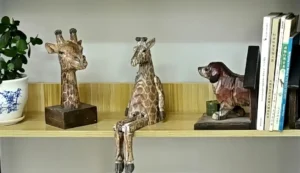
A wooden bookends artisan line is one of the few decor categories that has to work as engineering before it works as decoration. A shelf piece can be light and purely visual; a bookend has to hold a row of books upright, which means mass, a base geometry and a foot that slides under the stack — and most artisan ranges fail on exactly those three points because they were designed as sculptures first.
One thing to state at the top rather than bury. Bookends are a line we make, functional base included — mass, return angle, foot and anti-slip pad. They are custom work rather than a stocked SKU, so that base is specified and sampled with you instead of picked off a shelf. The carved element is solid basswood, pinewood, rubber wood or birch, hand-carved and hand-painted to the same standards as our ornament ranges.
Key Takeaways
- A bookend is a structure, not a figurine. Mass, a 90-degree return and a thin foot do the work; the carving is what sells it.
- Solid hardwood mass is the honest way to add weight. A hollow carved body will slide, and adding a metal plate changes the piece into an assembly.
- Bookends are sold in pairs and priced per pair. Anything specified as a single unit confuses the buyer at the shelf.
- Graduated sizing turns one design into a range: a small pair for paperbacks, a taller pair for hardbacks and art books.
- The artisan value is the variation. Hand-carved pairs will never be identical, and that has to be presented as the point rather than apologised for.
- Specify the base before you specify the carving. The figure can be adapted; the geometry that holds the books cannot.
In This Guide
- Why an Artisan Bookend Line Behaves Differently
- What Actually Makes a Bookend Work
- Formats and Sizing in a Wooden Bookends Artisan Line
- Bookend Formats Compared
- Styling the Line on a Shelf
- Sourcing It: Our Honest Position
- Best For / Not For
- What We Check on a Custom Carved Order
- End to End: Adding a Bookend Line
- Frequently Asked Questions
Why an Artisan Bookend Line Behaves Differently
Mass-produced bookends compete on price and are usually stamped metal or moulded resin with a weight added. An artisan wooden line competes on the object itself, and it draws a different customer: someone buying for a specific room, a specific shelf, or as a gift with a subject attached to it — a birding household, a coastal home, a reader with a favourite animal.
That changes how the line has to be ranged. It is not a single SKU in three colours but a subject family at two or three sizes, where the subject carries the reason to buy and the size carries the function. Retailers who treat it as a colour variant usually end up with a repetitive shelf, because the strength of carved work is that each subject reads as its own piece.
What Actually Makes a Bookend Work
- Mass against the push. A row of hardbacks leans with real force. The bookend has to resist it through weight and friction at the shelf, and solid timber is the honest way to get that weight. A hollow carved body will slide outward, which is the single most common failure in decorative bookends.
- A 90-degree return. The upright face has to be genuinely square to the base. If the carved figure leans back or the return is rounded, the books lose their stopping surface and the pair spreads.
- A foot that goes under the stack. The best bookends let the weight of the books themselves press down on a thin horizontal foot, which is what actually holds the piece in place. Without that, all the resistance has to come from friction at the base.
- A base that will not mark or slip. Felt or a recessed pad protects the shelf and adds grip. This is a small component and it is worth specifying explicitly, because it is the detail a customer notices first on a good piece.
- Stability with the load applied. Height alone does not help; a tall light piece tips. The mass has to sit low, which is why the heaviest part of a working bookend belongs at the base rather than in the figure.

Formats and Sizing in a Wooden Bookends Artisan Line
One carved subject can become a whole line by changing scale and base, which is far cheaper than developing new subjects. Our three-dimensional carving runs from 5 cm to 40 cm, so a single bird or animal design can be produced at a small shelf size, a mid size for a standard bookcase and a statement size for a wide run of hardbacks. Flat work goes to 80 cm where a panel or back-plate format is wanted.
The practical way to structure a range is by the books it holds rather than by the size of the carving. A paperback pair needs less mass and a shorter return; an art-book pair needs a taller face and considerably more weight. Presenting the line that way lets a customer self-select, and it gives a retailer a natural good-better-best ladder across one design family. The graduated approach to sizing a carved shelf group is the same one used in our guide to wooden animal figurines retail display.
Bookend Formats Compared
| Format | Where the mass comes from | Carving potential | Best for |
|---|---|---|---|
| Solid carved figure on an integral base | The timber itself | Full three-dimensional relief | Gift and artisan retail, subject-led ranges |
| Carved figure on a separate L-base | A heavier base block | Figure carved in the round, base plain | Heavier book loads, taller uprights |
| Bookend with a hidden weight plate | An inserted metal plate | High, since the body can be lighter | Light carving at high mass — becomes an assembly |
| Flat panel or back-plate format | Shelf load pressing on the foot | Relief carving to 80 cm flat work | Wide shelves, statement art-book runs |
Styling the Line on a Shelf
A wooden bookends artisan line is merchandised differently from a figurine line because it is displayed in use. The strongest presentation is on real books at the correct span, which lets a customer see the return height against a book row and judge whether it will hold their own shelf. Displaying a pair loose on a flat table removes the only evidence that matters.
Group by subject and show the size ladder together, so the customer sees the family rather than three unrelated objects. Mixing in other carved pieces on the same shelf builds the range without diluting it, which is the approach worked through in our guide to rustic wooden decor merchandising, and the shelf-level mechanics of grouping and facing sit in our guide to gift shop planogram basics.

Sourcing It: Our Honest Position
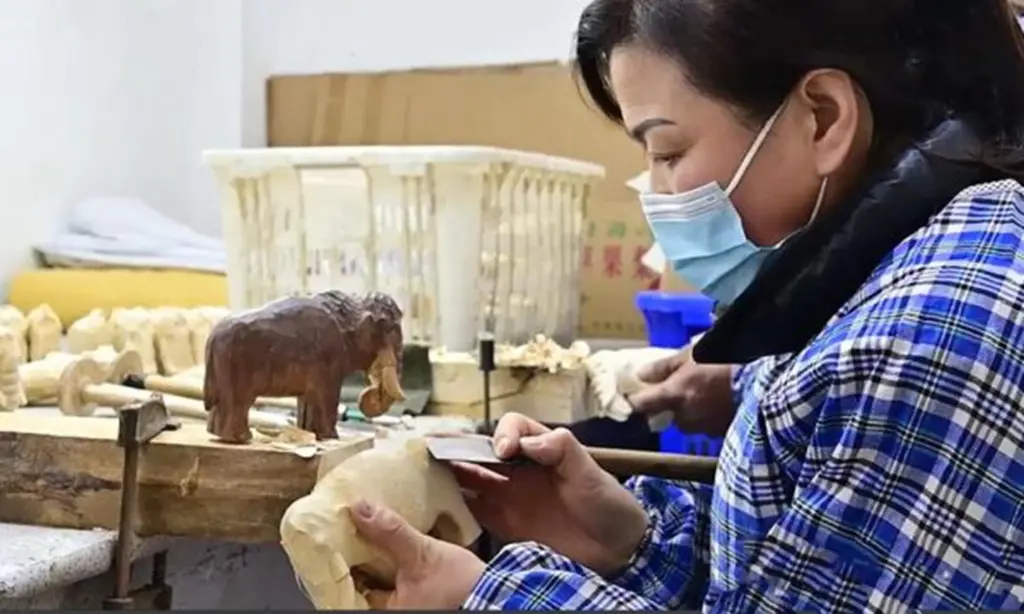
We are a hand-carved solid-wood manufacturer; a bookend is custom work for us, not a standing production line. Our carving covers hand-carved animal and plant ornament work in basswood, pinewood, rubber wood and birch, every piece carved and painted by hand, three-dimensional work from 5 cm to 40 cm and flat work to 80 cm. A bookend falls inside that capability as a custom project: the carved figure is squarely what we do, and so is the base it sits on — but its mass, the return angle and the foot are engineering decisions that have to be specified with you and tested before a run is committed.
To start a custom project we need clear multi-angle reference photographs, the target size, the wood species and the painting or coating requirement. Any inserted weight, felt pad or bonded base turns the piece into an assembly, and that changes the cost structure and the lead time, so it should be settled at sample stage rather than discovered in production. Where a design needs new tooling or a jig, that cost is worked through in our guide to tooling and mould costs for custom wooden products, and the wider custom route is described in custom product manufacturing. Our factory and carving capability are set out on our wood carving factory page.
Best For / Not For
| A carved wooden bookend line suits | It does not suit |
|---|---|
| Gift and artisan retail where the subject carries the purchase | Price-led promotional ranges competing with stamped metal |
| Subject-led families — birds, coastal, farmyard, woodland | Very heavy reference or library loads needing engineered mass |
| Boutiques and lifestyle stores building a shelf story | Fast-turnaround seasonal stock, since custom bases need sampling |
| Corporate and wedding gifting where a pair reads as a keepsake | Buyers needing an in-stock item on the trial tier without sampling |
What We Check on a Custom Carved Order
- Moisture before finishing. Timber is dried to 8–12% so a carved piece does not move or crack once it reaches a heated room — the standard is set out in our guide to wood moisture content.
- Anti-cracking log treatment. This is the step that decides whether a solid piece survives cross-border transport and long-term display across different humidity ranges.
- Squareness of the return. On a bookend this is a functional check, not a cosmetic one — the upright face is measured against the base before finishing.
- Finish against a retained sample. A pair is seen together, so drift between the two pieces is visible on a shelf. Artisanal variance in grain and posture is the point; variance in finish is not.
- Claims limited to what we hold. ISO 9001, BSCI, CE, UKCA, RoHS and EN71 where the article applies. Our facility holds an FSC chain-of-custody certificate, but certified basswood is not currently available to us, so our carvings are not marketed as FSC-certified wood; we supply official timber felling and transport permits, and the certification position is described against the FSC business standards rather than claimed loosely.
End to End: Adding a Bookend Line
A lifestyle retailer wants a coastal bird bookend pair to sit beside an existing figurine range, and sends a mood image with no dimensions.
Settle the base before the bird. The first decision is not the subject — it is the return height, the foot depth and where the mass sits. The retailer is asked what the pair has to hold: paperbacks, hardbacks or art books. That answer fixes the geometry, and only then is the carving designed into it.
Sample against a real book load. A prototype is made and tested on an actual shelf with an actual row of books, checking for slide, tip and shelf marking. This is also where the need for a felt foot or an inserted weight becomes obvious, and where adding either is still cheap.
Order to the terms that fit a new line. Because a bookend is a custom format rather than an in-stock item, it belongs on the wholesale and custom tier at 300 pieces with a USD 3,000 minimum order value, sea freight, 60–90 days to port, rather than the trial tier of 100 pieces at a USD 500 minimum order value which is limited to in-stock designs and ships air express DDP in 20–30 days. Payment is T/T at 30% deposit and 70% before shipment, with photographs and video of finished goods supplied first. Pieces are wrapped in white paper and packed 6–12 to a 3-ply inner box, 240–480 to a 5-ply master carton rated to ISTA 3A, with custom colour boxes from 500 pieces. A pair-based product needs its packaging specified as a pair, which is the kind of detail covered in our guide to ornament retail packaging.

If you want a carved wooden bookend line built around a subject that already sells for you, send us your reference photographs, target size and the book load the pair has to hold. We will tell you honestly what we can carve, what has to be specified as a custom base, and what it will cost to sample.
Frequently Asked Questions
Q: Do you manufacture wooden bookends?
Yes. A wooden bookend is custom work for us: we make the carved figure in solid basswood, pinewood, rubber wood or birch, and we make the functional base with it — mass, return angle, foot geometry and anti-slip pad. Because it is built to order, the base is specified with you and sampled before tooling rather than chosen from a stock line.
Q: Why do decorative wooden bookends slide outward?
Because they were designed as sculptures and lack mass low down, or because the base has no foot for the books to press on. Without a foot, all resistance comes from friction at the shelf, and a row of hardbacks beats friction. The fix is mass placed low, a genuinely square return, and a thin foot the book stack sits on.
Q: Should a bookend line be sold as pairs or singles?
As pairs. A single bookend only works at the end of a run against a wall or a fixed panel, and a customer buying one will be disappointed at the shelf. Pricing and packaging should both be specified per pair, which also means the two pieces are finished and judged as a set rather than matched afterwards.
Q: What wood species works best for a bookend?
It depends on whether the mass comes from the timber or from an insert. We work in basswood, pinewood, rubber wood and birch. Basswood is the default for fine carved detail because it cuts cleanly, while a denser species does more of the holding work through its own weight. Species choice should follow the base design, not the other way round.
Q: Can hand-carved pairs be identical?
Not exactly, and that is the reason to buy them. Grain, posture and hand-painted detail will vary between the two pieces of a pair. What has to be consistent is the functional geometry and the finish standard, both judged against a retained sample. Presenting the variation as the point rather than a defect is what makes an artisan line hold its price.
Sources
Authority: FSC business standards
Related: Wooden animal figurines retail display · Rustic wooden decor merchandising · Wood carving factory