Skip to content
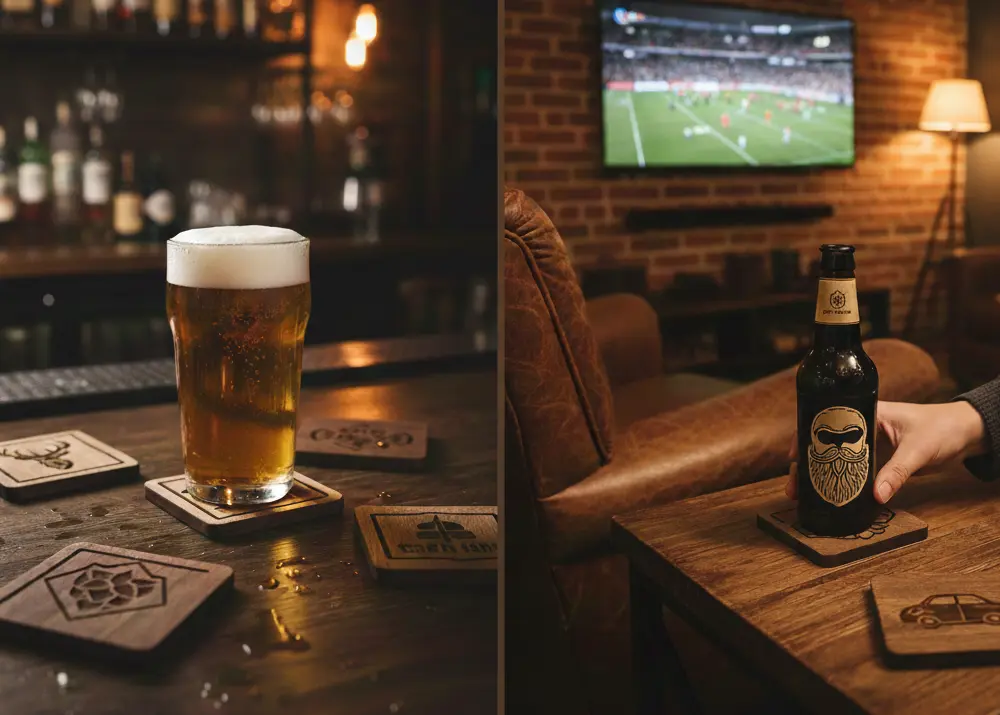
Beer is the harshest job a coaster ever gets. A chilled mug or stein sweats continuously for the length of a slow drink, the base ring is far wider than a wine glass foot, and in a taproom the same coaster is handled by hundreds of people in a week. Wooden coasters take that treatment better than absorbent board, but only when three things are specified correctly: a face large enough for the vessel actually being served, a finish system that keeps moisture out of the board rather than on top of it, and a branding method that survives washing rather than just photographing well.
This guide covers the beer and bar end of our coaster range — sizing for mugs and steins, integrated opener formats, condensation behaviour, brewery and bar branding, and the finish and care decisions that decide whether a coaster lasts a season or a decade. Species comparison, MOQ structure and packing formats live in the wholesale wooden coasters hub, which this page deliberately does not repeat.
Key Takeaways
- Size the face to the vessel, not to the catalogue: beer mugs and steins need a wider footprint than wine or spirits glassware, and an undersized coaster leaves a wet crescent on the table.
- The finish, not the species, decides service life on a bar top. Film-forming coats suit wash-and-reuse programmes; penetrating wax suits retail sets sold with a care card.
- For repeated commercial washing, choose engraved or debossed marks. Surface print is the first thing to fail under abrasive cleaning.
- Our published minimums: 100 pieces against a USD 500 minimum order amount for a trial, 300 pieces against USD 3,000 for wholesale or custom production, 500 pieces for a printed custom colour box.
- Lead time: roughly 20-30 days by air for a stocked trial, 60-90 days to port for a custom sea-freight run, with artwork approval before production opens.
- Timber moves under official felling and transport permits; BSCI, ISO 9001, CE, UKCA and EN71/RoHS documentation ships with the order.
Table of Contents
- Why wood for beer coasters
- Sizing: mugs, steins and base rings
- Integrated bottle opener formats
- Condensation, ring marks and drip
- Branding for breweries, bars and home bars
- Finish and durability on a bar top
- Care and cleaning
- Ordering: minimums and lead time
- Final thoughts
- Frequently asked questions
Why Wood for Beer Coasters
The dominant product in bar service is absorbent pulpboard: cheap, highly thirsty, printed four-colour both sides, and discarded when it saturates or curls. It suits a high-turnover venue that treats coasters as consumables.
Wood takes the opposite position, and that is the point. A sealed hardwood coaster is washed and reused, keeps its shape under a heavy mug, and reads as merchandise rather than waste. For a taproom it becomes part of the retail line — the same piece that sits under a guest’s pint on Saturday is the one they buy at the counter, or that ships inside a gift pack. For a home bar, the difference is simply how long the set lasts. Where a venue genuinely wants a disposable coaster at very high volume, board is the right call; where the coaster is doing brand work after the visit ends, wood is.
Sizing Matters: Mugs, Steins and Base Rings
The failure is geometric rather than material. Every vessel has a base ring, and condensation forms just outside it as a wet circle. If the coaster’s face is not wider than that ring, the water lands on the furniture and dries as a ring mark — the coaster performs no better than no coaster at all.
Beer vessels carry the widest base rings in the category. A standard 4-inch face suits wine goblets, spirits and most tumblers. Half-litre mugs, handled steins and boot glasses generally need a noticeably larger footprint, and square formats can beat a round one of similar nominal size because the corners extend past a wide circular base. Weight matters too: a full litre mug on a thin board, on a polished bar top, will slide and tip. A heavier board with a cork or felt backing solves both problems at once.
The practical method is unglamorous and worth doing: measure the base ring of the heaviest and widest vessel you actually serve, then add margin. Thickness in the 6 mm range with a cork backing is where beer programmes usually settle — enough mass to stay put, thin enough to stack.
Integrated Bottle Opener Formats
A coaster with an opener set into a routed recess is one of the strongest gift SKUs in the range, because it converts a passive accessory into a tool that stays at the bar rather than in a drawer. Two construction styles work: a stainless opener fixed into a recess and covered by a flush cap so the top face stays flat, or a thicker slab with the opener mounted through it and a protective foot on the underside.
Three specification points decide whether it survives. The opener must be mechanically captured, not simply glued, because bottle caps demand real torque. The recess must be sized so the wood around it keeps enough thickness to resist splitting. And the face still has to be flat enough to hold a glass without rocking — a coaster that tips a pint is worse than no coaster. The engraving sits around the opener, so brief the artwork with the cut-out in place rather than assuming the logo can go anywhere.
Condensation, Ring Marks and Drip
A cold mug produces a continuous film of water, not a single drop. On a smooth bar top that film travels outward until it meets the edge of whatever is under the glass. Two design features control it: a slightly raised or bevelled rim that keeps moisture on the face rather than letting it track straight to the table, and a sealed underside, which is the part most cheap coasters skip and the reason they swell from the bottom.
A flat, fully sealed wooden coaster handles beer condensation well provided the face is oversized for the vessel. Where a venue serves very wet glassware or the tables are lacquered and unforgiving, a shallow drip channel around the perimeter is a legitimate specification — but it costs engraving area and adds a machining pass, so it should be chosen deliberately rather than by default.
Branding for Breweries, Bars and Home Bars
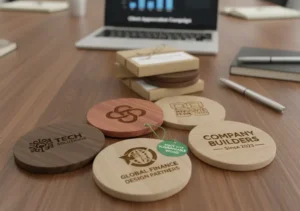
Brewery branding usually wants one of two outcomes: a beer-launch merch reset at low unit cost, or a durable bar programme that stays in service for years. They call for different processes. Laser engraving burns the mark into the substrate, so it cannot wear off, and it reads best on an even-grained board. Deboss presses the mark into the wood and suits darker or oilier species where engraving contrast is weak. Full-colour print carries gradients and multiple brand colours, but sits on the surface and is the first thing a bar wash cycle removes.

A common taproom pattern is a two-spec programme: engraved or debossed coasters for bar service, and a printed version for retail gift sets where the artwork matters more than the wash cycle. Both can run from one production window, which keeps artwork, golden sample and freight consolidated. The wider promotional and corporate logic is covered in our guides to coasters as promotional products and sustainable corporate branding; hospitality set structure and reorder cadence are in the hotel and restaurant coaster programmes guide.
Finish and Durability on a Bar Top
On a bar, the finish is the product. Two families behave differently under beer: film-forming coats (lacquer, polyurethane, epoxy) build a continuous barrier on top of the wood, block moisture effectively, and show wear at the edges first; penetrating finishes (hard waxes, curing oils) feel better, mark less obviously, and need periodic renewal. For a venue that will rinse coasters under a tap nightly, the film-forming family is the correct answer, and every face and edge must be sealed — an unsealed back is where swelling starts.

A simple field test is worth more than a brochure: water should bead on a finished coaster rather than darken it, and the piece should return flat after being wiped wet and left to dry. If you need documented evidence rather than a demonstration, liquid-spot and humidity resistance can be tested against published coating methods such as those maintained by ASTM International — ask your supplier which tests were actually run on your specification, because the standard existing is not the same as your batch being tested. Grain orientation also affects how a coaster copes with moisture; our note on which species and grain behave how explains which boards stay flatter.
Care and Cleaning
Wipe with mild soap and water and dry before stacking. The two habits that destroy wooden coasters are soaking and stacking wet: standing water finds the unsealed edge, and trapped moisture between faces is what causes cupping and mould. No dishwasher, no bleach, no steam.
For bar programmes, rotate stock so pieces dry fully between services, and retire any coaster whose face has begun to look chalky — that is the film wearing through, and the board underneath will swell within a few washes. Retail sets sold with a care card last measurably longer, because the owner knows whether to re-wax. The finish options and their maintenance intervals are compared in our guide to non-toxic and eco-friendly coaster finishes.
Ordering: Minimums, Lead Time and Freight
Our published structure is fixed rather than negotiated per order: 100 pieces against a USD 500 minimum order amount for a trial on in-stock blanks, 300 pieces against USD 3,000 for wholesale or custom production, and 500 pieces once you want a printed custom colour box. Payment is 30% T/T deposit with the 70% balance before shipment, released against photographs and video of the finished goods.
A stocked trial ships by air express in roughly 20-30 days; an engraved or custom production run takes 60-90 days to port by sea. Artwork approval must be complete before production opens, because engraving runs sequentially. Beer programmes are usually timed to a launch or a season, so treat the artwork date — not the ship date — as the deadline. Cartons are marked with gross and net weight and mapped to your delivery addresses; where a chain requires documented transit performance, packing is specified against ISTA transit testing standards. For e-commerce resale of the same SKU, see the marketplace shipping guide.
Final Thoughts
Three decisions carry almost all of the outcome for a beer coaster programme: a face sized against the widest base ring you actually serve, a fully sealed board chosen for repeated washing rather than for photographs, and a branding method that is in the wood rather than on it. Get those right and the coaster stays in service long enough to do brand work. Get any one wrong and a taproom ends up replacing a merch item every few months, which is the most expensive way to buy coasters.
Spec a Beer Coaster Programme in One Pass
Size, species, sealing system and engraved or debossed branding quoted together, with cork backing, care card and cartons marked to your distribution centre. Trials from 100 pieces.
Frequently Asked Questions
What size coaster do beer mugs need?
Larger than the standard 4-inch face. Measure the base ring of the heaviest vessel you serve and add margin, because condensation forms just outside it. Half-litre mugs and handled steins need a wider footprint than the standard 4-inch face, and weight matters as much as diameter: a heavier board with cork backing stops a full mug sliding.
What is the minimum order for wholesale pricing?
100 pieces against a USD 500 minimum order amount for a trial on in-stock blanks, and 300 pieces against USD 3,000 for wholesale or custom production. A printed custom colour box starts at 500 pieces. One design means one shape, species and branding combination, so reducing the number of designs is usually cheaper than chasing a lower minimum.
Are wooden coasters better than pulpboard for bars?
They solve different problems. Pulpboard is absorbent, cheap and disposable, suiting venues that treat coasters as consumables. Sealed wood is washed and reused, keeps its shape under a heavy mug, and doubles as retail merchandise. If the coaster should leave the venue as a purchase, wood pays for its higher unit cost.
Which branding survives bar washing?
Engraving and deboss, because the mark is in the substrate rather than on it. Surface print carries full brand colour and gradients but is the first thing removed by abrasive cleaning and repeated wetting. Many taprooms run a debossed or engraved version for bar service and a printed version for retail gift sets, from the same production window.
How far ahead should I order for a beer launch?
Allow eight to twelve weeks. A stocked trial takes roughly 20-30 days by air; an engraved or custom run takes 60-90 days to port by sea. Artwork must be approved before production opens, so for a launch tied to a fixed date the artwork deadline is the real constraint, not the shipping date.