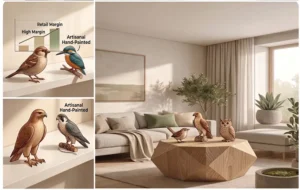
B2B retailers are moving away from mass-produced resin decor as 2026 market trends favor material authenticity and artisanal craftsmanship. Eagle and owl carvings meet this demand by offering symbolic depth—representing leadership for corporate environments and wisdom for the home library. These handcrafted wooden assets help businesses cater to niche segments that value the tactile quality of natural materials over synthetic alternatives.
This overview covers material sourcing from FSC-certified regions, wholesale procurement metrics such as the 300-unit minimum order quantity, and shipping protocols using 32 ECT rated cartons to protect delicate wing structures.
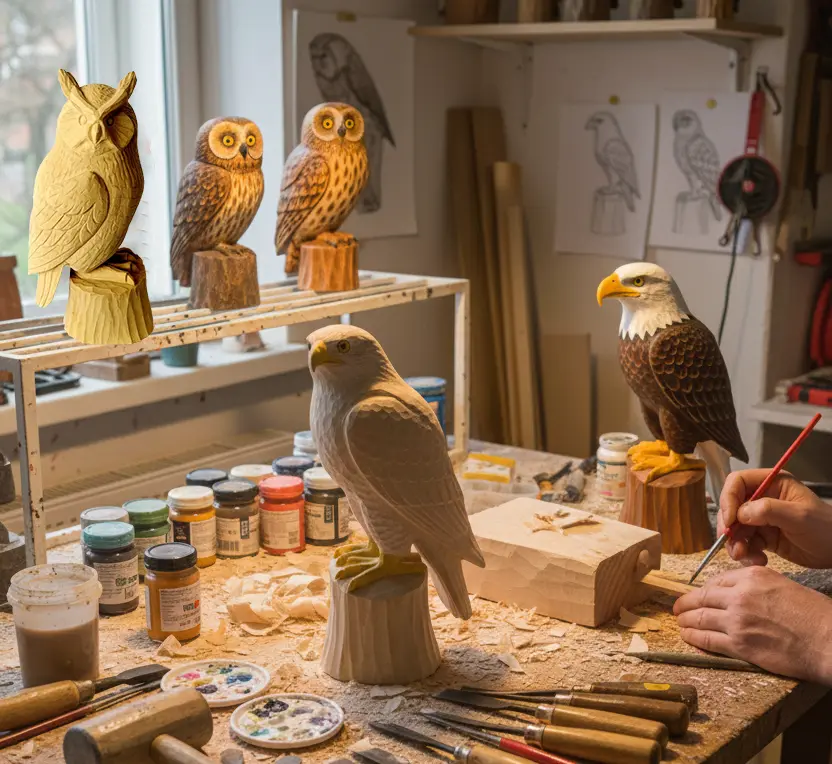
The Symbolism of Eagles & Owls
Eagle and owl carvings serve as powerful icons in the 2026 decor market. Eagles represent leadership and vision, making them popular for corporate gifts, while owls symbolize wisdom and protection, appealing to the home library and wellness segments. These carvings translate abstract values into tangible, handcrafted assets for retail collections.
Cultural Representations in Modern Giftware
Eagle carvings signify authority, freedom, and perspective. These attributes make them primary choices for centerpieces in executive offices and public spaces. In these environments, the bird serves as a visual shorthand for leadership and long-term vision. Meanwhile, owl motifs represent intellectual depth and nocturnal intuition. This symbolism drives consistent sales in boutique bookstore and home office niches where consumers look for decor that reflects a focus on knowledge and protection.
Raptor symbolism provides a connection to nature that aligns with the 2026 consumer preference for organic, artisanal home accents. By choosing wood over synthetic materials, retailers tap into a market that values material authenticity. The symbolic weight of a hand-carved eagle or owl increases the perceived worth of the item, distinguishing it from mass-produced resin alternatives that lack the same tactile and cultural resonance.
Technical Standards for Symbolic Carvings
Manufacturers use premium basswood, often sourced from the Changbai Mountain region, to ensure a smooth grain capable of holding intricate symbolic details. The structural integrity of the wood allows for high-definition work on the feathers and facial features. To maintain quality, production standards require strict humidity control below 12%. This prevents the wood from cracking in delicate wing and talon sections during shipping or display in climate-controlled retail environments.
Dimensions for desktop symbolic carvings typically range from 255mm in height to 125mm in diameter. These specifications ensure the carvings fit standard shelving units and display cases common in modern homes and offices. To achieve the lifelike anatomy required for high-end raptor representations, skilled artisans apply traditional techniques like stop cuts and V-tool detailing. These mechanical processes ensure that the final product meets the aesthetic expectations of collectors who prioritize anatomical accuracy alongside symbolic meaning.
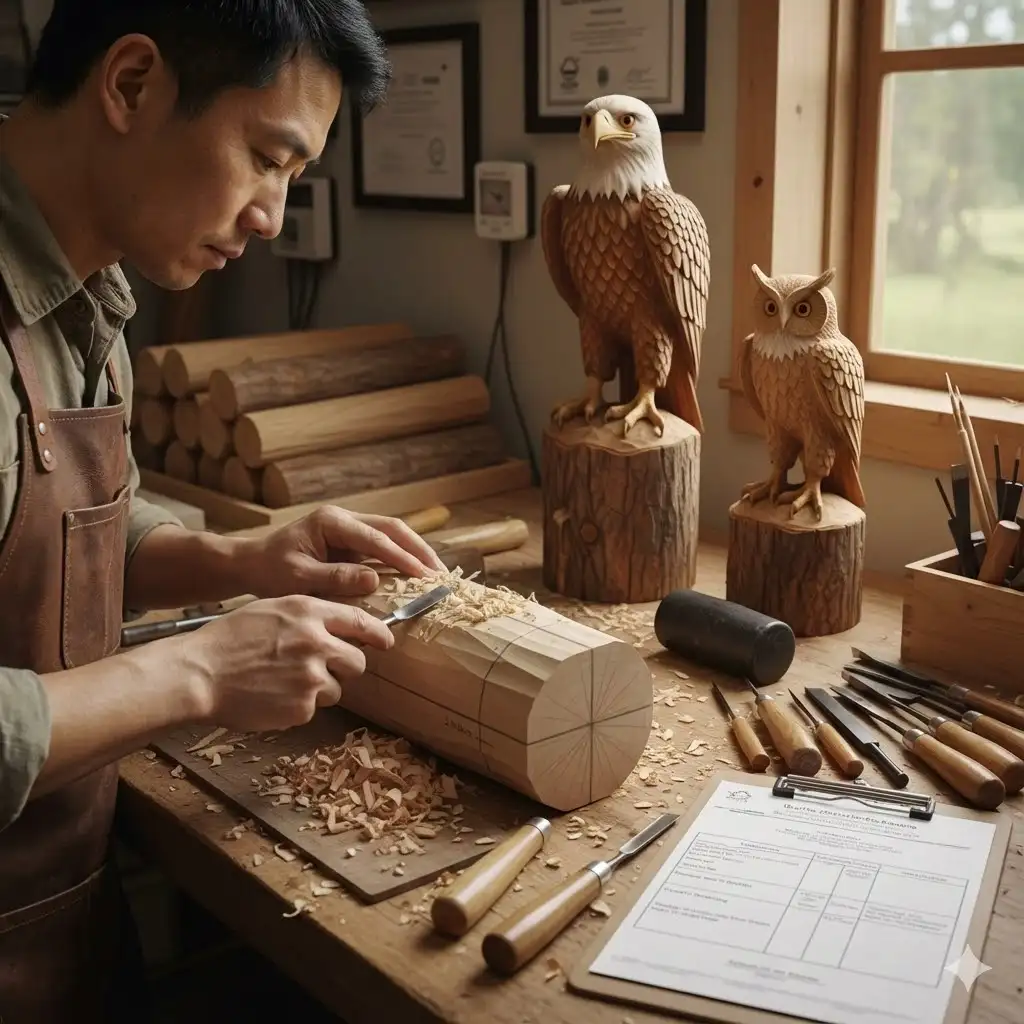
Top Species: Bald Eagle, Barn Owl
Bald Eagles and Barn Owls dominate the carving market due to their iconic features. High-end carvings replicate the eagle’s massive 7-8 ft wingspan for large displays, while the barn owl’s compact 32-40 cm frame allows for intricate facial detailing in smaller collectible formats.
Scaling the Bald Eagle for Statement Pieces
Replicating the Bald Eagle (Haliaeetus leucocephalus) requires a precise understanding of its massive proportions. Artisans scale carvings to match the natural 7-8 ft (213-244 cm) wingspan found in large specimens. Since these birds weigh between 8-13 lb (3.6-5.9 kg), the structural engineering of the carving’s base must support significant mass to maintain stability in dynamic poses. Standard carving templates utilize a 3 ft (91 cm) beak-to-tail body length to ensure anatomical accuracy in modern designs. High-quality basswood provides the necessary density to support expansive features, including large-scale 8 ft nest replicas.
Capturing Barn Owl Anatomy in Small-Scale Designs
Creating realistic Tyto alba figurines depends on maintaining a compact 32-40 cm (12.6-15.8 in) body length. This specific scale allows for desktop-sized models that emphasize the species’ unique heart-shaped facial disk. A body width of 11-13.5 cm (4.3-5.3 in) enables high-fidelity carving of talon placement and facial depth. Wingspan ratios of 100-125 cm (39.4-49.2 in) define the spatial requirements for both perched and flight-pose carvings. The lighter mass of 400-700 g found in live specimens guides artisans to prioritize delicate feather texturing in hand-carved models, ensuring the final piece reflects the bird’s natural elegance.
Scale Your Retail Collection with Hand-Carved Raptor Sculptures
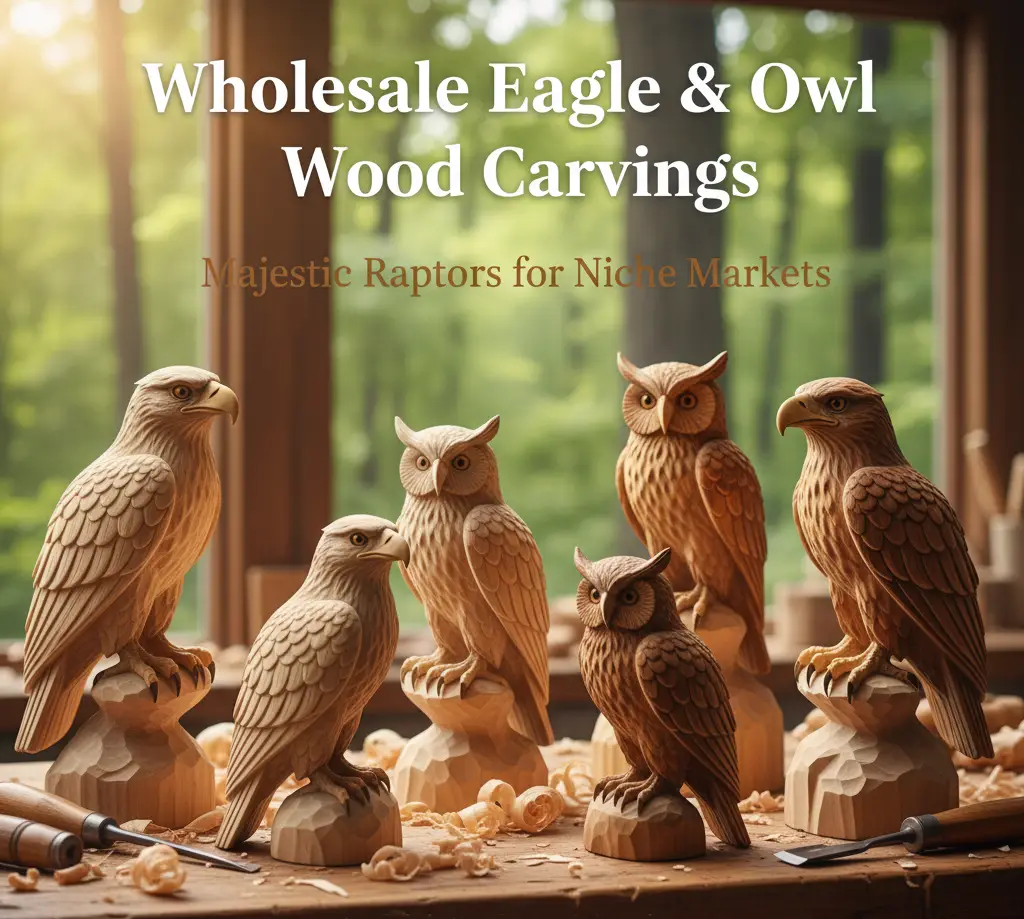
Sizes: From Desktop to Statement
Standard carvings range from 5cm desktop miniatures to life-sized chainsaw sculptures exceeding 30cm. Portable pieces typically measure between 13cm and 21cm in height, while statement carvings utilize logs at least 255mm long to capture life-sized raptor proportions.
Desktop Miniatures and Portable Souvenirs
Small-scale raptor carvings generally span 5cm to 21cm, fitting comfortably on office desks and bookshelves. Specific eagle models frequently adopt 13cm x 9.5cm x 2.5cm dimensions to facilitate efficient shipping and retail display. Indoor sculptures often favor softer woods like alder or basswood, which accommodate the high level of anatomical detail required for viewing at close range.
Life-Sized Sculptures and Large Displays
Commercial statement pieces reach heights of 30cm or more. A life-sized Great Horned Owl carving requires a significant spatial footprint and typically begins with a green wood log measuring at least 255mm in length and 125mm in diameter. Chainsaw carving techniques allow for these larger scales, prioritizing structural stability and outdoor durability for garden or branding installations. These dimensions follow practical carving constraints like log diameter and tool reach rather than formal engineering standards.
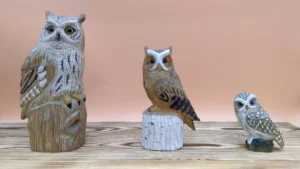
Sourcing for Tourist Locations
Sourcing eagle and owl carvings in 2026 requires aligning product species with local wildlife and ensuring suppliers meet strict environmental certifications. Buyers focus on high-traffic gift shops and nature centers, utilizing OEM services to maintain a 300-unit Minimum Order Quantity for custom, site-specific souvenirs.
Retail Placement and Wildlife Species Alignment
National park gift shops and eco-tourism resorts prioritize handcrafted carvings that represent indigenous birds like the Bald Eagle or Barn Owl. These retail environments demand authenticity, as tourists often look for souvenirs that reflect the specific ecosystem they visited. Retailers increase conversion rates by selecting species documented in local bird-watching guides and regional conservation programs, creating a direct connection between the product and the visitor’s experience.
Nature-themed retail kiosks use hand-carved raptors to anchor their rustic home decor collections. By stocking high-quality eagle and owl sculptures, these outlets attract collectors who value artisanal craftsmanship over mass-produced plastic alternatives. This strategic placement ensures that the carvings serve as premium centerpieces within a broader wildlife-themed inventory.
Technical Procurement Standards and Supply Metrics
Manufacturers utilize FSC-certified basswood and alder to meet 2026 sustainability mandates for the international souvenir industry. Technical dimensions for production often involve alder blocks measuring 255mm long by 125mm in diameter or specialized basswood blocks to ensure structural integrity during the carving process. Adhering to these material standards allows suppliers to maintain the durability required for global shipping and long-term retail display.
Wholesale procurement models require a Minimum Order Quantity (MOQ) of 300 pieces for custom OEM and ODM designs. This volume supports the production of site-specific carvings tailored to individual park requirements. To ensure safety and quality consistency for global distribution networks, products must meet EN71-1/-2/-3 and ISO 9001 standards. These certifications guarantee that the carvings are free from hazardous finishes and meet the mechanical strength requirements for commercial retail environments.
Quality Checklist for Raptors
Professional quality checks for raptor carvings focus on anatomical proportions and material stability. Key criteria include using seasoned basswood, adhering to baseline measurements like 3.8cm for talons, and utilizing specific gouges for feather texture. These steps ensure every eagle or owl sculpture meets durability and aesthetic standards for global retail.
| Carving Feature | Technical Standard | Primary Tooling |
|---|---|---|
| Log Dimensions | 255mm L x 125mm D | Alder or Basswood Block |
| Anatomical Guidelines | 3.8cm and 7cm Marks | Chalk and Vertical Lines |
| Talon Definition | 1.3cm Square Boxes | Stop and Pyramid Cuts |
| Feather Detailing | 3mm Micro Texture | No.9 Gouge / 60° V-Tool |
Material Standards and Structural Foundations
Successful raptor carvings begin with wood blocks measuring approximately 255mm in length and 125mm in diameter. These dimensions provide the necessary volume for stable owl and eagle forms without excessive waste. Using seasoned alder or basswood minimizes the risk of structural failure during the removal of bulk material.
Checking timber humidity levels is a critical step to prevent cracking as the sculpture dries. If using green wood, sharpen tools frequently to manage the moisture-softened grain. A flattened log base provides a sturdy foundation for the carving process, and retaining the natural bark on the base often adds aesthetic value to the finished retail piece.
Establishing anatomical symmetry requires central vertical chalk lines and precise guidelines. Mark these lines at 3.8cm and 7cm from the bottom of the block to serve as reference points for leg placement and body proportions. These measurements ensure the raptor’s weight appears balanced and anatomically correct across different production batches.
Precision Detailing and Technical Specifications
Specific tool selection defines the depth and realism of the plumage. No.9 gouges and 3mm 60° V-tools create distinct feather lines and facial depth around the eyes and beak. Utilizing 3mm micro U-gouges adds authentic belly textures and fine plumage details that distinguish high-quality carvings from mass-produced ornaments.
Carvers must execute 1.3cm square talon boxes using stop cuts and pyramid cuts. This technical approach isolates the feet from the main body, allowing for detailed shaping without compromising the wood’s structural integrity. These precise cuts prevent splintering in the delicate toe areas which are prone to breakage.
Adhering to ISO 9001 and FSC standards verifies both manufacturing consistency and sustainable sourcing for global distribution. While large steel sculptures of eagle owls may use 8mm round bars for durability, wooden counterparts rely on these standardized carving techniques to maintain quality and professional craftsmanship.
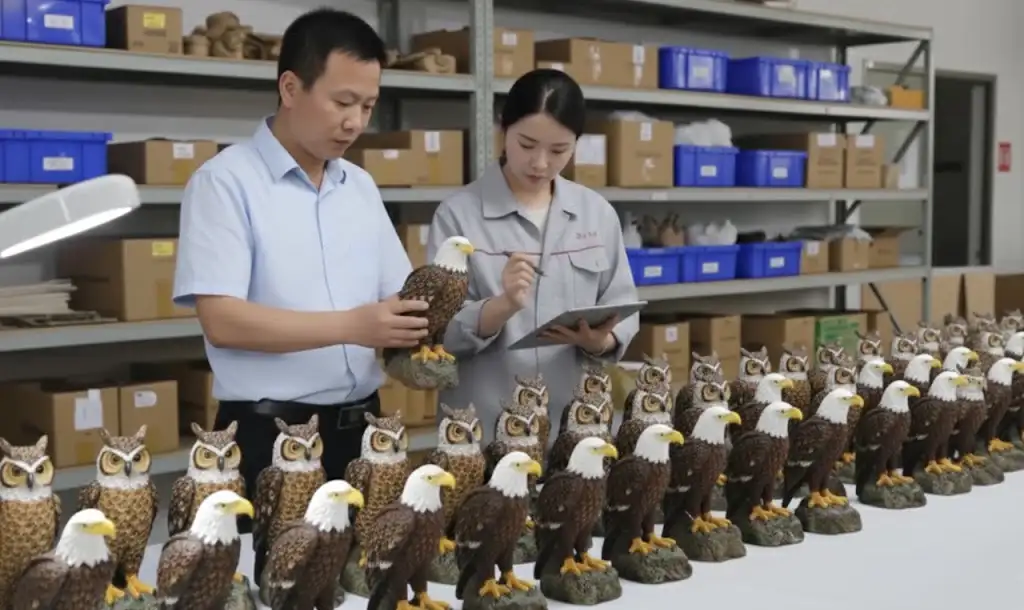
Shipping Fragile Wings
Safe transport for hand-carved raptors requires 32 ECT rated corrugated cartons and a minimum of three inches of shock-absorbing cushioning. By 2026, export standards for these items emphasize moisture-proof 4 mil polyethylene barriers and structural support capable of sustaining five-layer stacking without compromising the delicate wing structures.
Internal Layering and Moisture Barriers
Sealing each carving in 4 mil polyethylene bags maintains optimal humidity levels and prevents the wood from expanding or contracting during transit. This moisture barrier is essential for preserving the structural integrity of the carving as it moves through different climate zones. Technicians surround wing tips and tail feathers with 3 to 4 inches of specialized cushioning to isolate the delicate details from external vibrations. Before adding bulk insulation, an initial layer of soft, lint-free wrapping shields the hand-painted finish from surface abrasion and scuffing.
Outer Carton Integrity and Load Standards
Heavy-duty shipping requires double-walled corrugated boxes with a minimum 32 ECT (Edge Crush Test) rating to prevent the packaging from collapsing under pressure. These containers meet industrial standards for five-layer stacking, ensuring stability within high-volume freight environments. To remove mechanical stress from fragile wing joints, custom foam bracing immobilizes the main body of the bird. This structural arrangement ensures the wings do not bear any weight or impact, transferring the load directly to the reinforced frame of the outer carton.

Final Thoughts
Investing in raptor carvings requires a focus on anatomical accuracy and material stability. Using seasoned basswood and maintaining strict moisture levels prevents the wood from cracking, ensuring each piece lasts as a long-term decor asset. Retailers benefit from selecting species that resonate with local ecosystems, as this alignment creates a stronger connection for customers looking for authentic, handcrafted items.
Reliable sourcing involves meeting international safety standards and utilizing robust packaging to protect delicate features like wing tips. When suppliers combine traditional carving techniques with modern logistical protections, they deliver products that stand out in the premium gift market. These wood carvings provide a tactile alternative to mass-produced goods, meeting the growing demand for sustainable and meaningful home accents.
Frequently Asked Questions
How do you protect fragile wing tips during bulk shipping?
Eagle and owl carvings are delicate, especially the wing tips which can break under impact. We utilize custom foam-fit packaging and reinforced inner frames to support the structure. This ensures that articulated wings remain intact throughout international transit.
What size ranges are available for wholesale avian carvings?
We offer various sizes to suit different market needs. This includes small decorative items from 5 cm, standard 13-inch commercial models. Custom scaling is available for OEM orders that meet our 300-piece minimum.
Are raptor carvings currently trending in US National Park gift shops?
While these items are popular in boutique galleries and home decor segments, they are not high-volume souvenirs within the NPS system. They serve as premium, high-fidelity collectibles rather than mass-market tourist trinkets.