Skip to content
Why Livestock & Game Operations Need Mineral Salt Supplementation
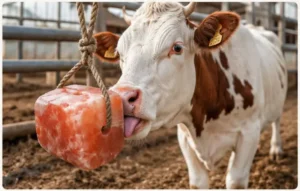
Sodium and chloride form the foundation of animal nutrition planning, yet they remain among the most under-supplemented minerals on farms and ranches across North America and Europe. For operations raising cattle, sheep, goats, or managing game populations such as deer and elk, consistent access to quality salt is not optional—it directly affects feed conversion, milk production, bone development, and overall herd vitality. When buyers source salt licks wholesale, they are investing in a delivery mechanism that animals use instinctively, self-regulating their intake based on physiological need.
Himalayan salt licks offer a particular advantage over commodity white salt blocks because they carry trace minerals—iron, potassium, magnesium, calcium—alongside sodium chloride. These trace elements occur naturally from the ancient evaporite deposits where the salt was formed millions of years ago. The Food and Agriculture Organization has long recognized mineral supplementation as a critical component of livestock productivity, particularly in grazing systems where forage alone cannot meet daily sodium requirements.
The economics matter too. A single salt lick block costs pennies per day of use, yet the downstream effects of mineral deficiency—reduced weight gain, poor coat condition, lowered fertility, pica (the chewing of non-food objects)—carry real financial consequences. For game managers maintaining deer herds or elk populations, supplemental salt licks also serve as attractants that support observation, population monitoring, and habitat management. This is why demand for salt licks wholesale continues to grow across both agricultural and wildlife sectors.
Natural Mined vs. Pressed Salt Licks: Which Suits Your Market?
One of the first decisions a wholesale buyer faces is choosing between natural mined blocks and pressed blocks. Both originate from the same source—the Khewra salt mine in Pakistan, one of the oldest and largest salt deposits on Earth—but the manufacturing process produces physically and functionally different products. Understanding the distinction helps you match inventory to your customer base.
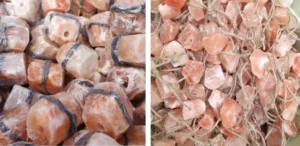
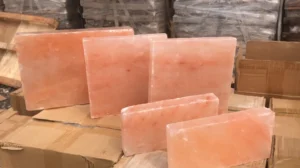
Natural mined blocks are cut directly from salt seams using traditional extraction methods. Each block has an irregular shape and unique color variation, ranging from off-white to deep amber depending on the mineral concentration in that particular seam. Buyers targeting the rustic or natural-product retail segment often prefer these blocks because the visual irregularity signals authenticity. They are popular with game managers placing licks in forest plots and with small-scale livestock owners who want an unprocessed product.
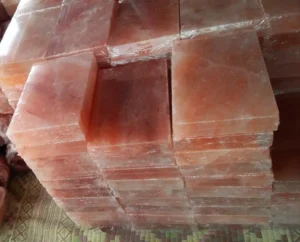
Pressed blocks, by contrast, are manufactured by crushing raw salt crystals, then reforming them under high pressure into uniform shapes. The result is a denser block with consistent dimensions, slower consumption rates, and easier stacking for transport. Pressed blocks tend to perform better in wet outdoor conditions because their higher density resists weathering. For large cattle operations and commercial feed resellers, pressed blocks offer the predictability needed for inventory management.
| Feature | Natural Mined Blocks | Pressed Blocks |
|---|---|---|
| Shape | Irregular, hand-cut | Uniform, machine-formed |
| Density | Moderate | Higher (compressed) |
| Weather Resistance | Moderate — weathers faster outdoors | Better — slower dissolution in rain |
| Color Variation | High — each block unique | Low — consistent appearance |
| Best Market Fit | Game management, boutique retail, small farms | Large cattle operations, commercial resellers, feed stores |
| Consumption Rate | Faster — animals lick at natural surface | Slower — denser surface, longer-lasting |
At ewoodarts, both forms are available for wholesale order, sourced from natural pure salt crystals at Khewra and processed under ISO9001 quality management. The choice between them often comes down to your end customer’s expectations and the environment where the lick will be placed.
Quality Indicators When Sourcing Salt Licks Wholesale
Not all Himalayan salt licks are created equal, and wholesale buyers should evaluate suppliers against measurable quality criteria rather than marketing claims. The first indicator is NaCl purity. Premium-grade Himalayan salt typically contains 95% or higher sodium chloride, with the remaining percentage composed of naturally occurring trace minerals. A supplier who can provide lab analysis or a certificate of analysis (COA) for each batch gives you documentation to back up your own product claims.

Density is the second factor. A denser block lasts longer in the field, which matters for cattle and game animals that may lick intermittently over weeks. Low-density blocks crumble quickly, especially in humid conditions or when placed in exposed locations. You can assess density by comparing the weight of blocks with identical dimensions—heavier blocks at the same volume indicate tighter compaction. Pressed blocks naturally achieve higher density, but well-selected natural mined blocks from competent seams also deliver adequate hardness.
Moisture content deserves attention because salt is hygroscopic. Blocks with high residual moisture will sweat, attract insects, and degrade in packaging during transit. Reputable manufacturers control moisture through proper drying and storage before packing. Color can also serve as a rough authenticity indicator: genuine Himalayan salt from Khewra displays pink, amber, or reddish hues caused by trace iron oxide. Blocks that are uniformly white may have been refined or blended with other salt sources.
For buyers who need to verify provenance, request official mining and transport permits from the Khewra region. Full traceability from mine to shipping container is a hallmark of a reliable supply chain. Our Himalayan salt products wholesale page outlines the documentation available with every order.
Placement & Usage Strategies for Different Animal Types
How and where you place salt licks determines how effectively animals use them. Cattle operations typically position blocks near water sources, shade trees, or loafing areas where animals congregate naturally. A general guideline is one block for every 15 to 25 head of cattle, though this varies with pasture size, forage quality, and ambient temperature. During hot months, sodium intake increases as animals sweat, so checking block consumption rates seasonally helps you adjust placement.
Sheep and goats have different behavioral patterns. These animals are more selective grazers and may avoid salt licks placed in muddy or heavily trafficked areas. Elevating blocks on a wooden platform or placing them in a covered mineral feeder keeps them clean and accessible. For sheep, be mindful that copper-containing mineral supplements can be toxic, so ensure your salt licks are plain Himalayan salt without added copper or other trace minerals formulated for cattle.
For game management—particularly deer and elk populations—salt licks serve a dual purpose. They supplement the mineral intake of free-ranging animals, especially in early spring when fresh forage is still sparse, and they create predictable visitation sites for wildlife observation and population surveys. Place deer licks at the edge of food plots or along established trails. Elk respond well to licks placed near mineral-rich soil areas they already frequent. Penn State Extension offers research-based guidance on mineral supplementation strategies for livestock operations of various scales.
Regardless of species, consistency matters. Animals develop routines around mineral access, and removing or relocating licks disrupts their intake patterns. For detailed guidance on selecting the right salt lick format for your specific animal type, see our salt lick for animals resource page.
Import Compliance: Documentation for EU & US Markets
Importing salt licks into regulated markets requires specific documentation, and the compliance burden falls on the importer of record. The first step is correct tariff classification. Himalayan salt licks fall under HS Code 2501.0019 or 2501.0020, depending on the destination country’s specific nomenclature. Misclassification can trigger duty overpayment or customs delays, so work with your customs broker to confirm the correct code before your first shipment.
For the European Union, salt licks intended for animal consumption must comply with feed safety regulations. Your supplier should be able to provide a CE declaration of conformity, and the product must meet the requirements of Regulation (EC) No 183/2005 on feed hygiene. If you are selling retail-packaged salt licks alongside other products, EN71 safety testing may also apply. For the UK market post-Brexit, UKCA marking replaces CE in certain contexts.
In the United States, salt licks marketed as animal feed supplements fall under FDA jurisdiction. While Himalayan salt licks are generally recognized as safe, importers should be prepared with proper labeling that identifies the product, its intended use, net weight, and the name and address of the responsible party. A BSCI audit report from your manufacturer demonstrates social compliance, which is increasingly required by European retail chains. Major retailers like Landi Switzerland already source from BSCI-audited suppliers, and this expectation continues to spread across the industry.
At ewoodarts, every wholesale salt licks order ships with full documentation: commercial invoice, packing list, bill of lading, certificate of origin, and any product-specific certificates requested at the time of order. For more on how we handle the logistics of international compliance, see our guide on bulk salt shipping in containers.
Bulk Shipping & Moisture Control: Getting Salt Licks to Your Warehouse
Salt is heavy, hygroscopic, and unforgiving of poor packaging. Any buyer sourcing salt licks wholesale needs to understand how the product is packed, how it behaves in a shipping container, and what safeguards protect it during ocean transit. The packaging system used for Himalayan salt licks follows a multi-layer approach designed to prevent moisture ingress, physical damage, and contamination.
Each salt lick is individually encased in vacuum-sealed POF shrink film, creating an impermeable moisture barrier crucial for ocean transit and preventing direct contact between blocks. Blocks are then packed into inner boxes holding 6 to 12 pieces, using 3-ply corrugated cartons. These inner boxes are consolidated into master cartons measuring 58 × 44 × 31 cm, constructed from reinforced 5-ply BC flute corrugated board that passes ISTA 3A drop testing. Each master carton weighs between 8.0 and 15.0 kg depending on block size and quantity.

Container loading follows standard palletization patterns. A 20-foot container typically holds between 18 and 22 metric tons of salt licks depending on block dimensions and pallet configuration. For buyers receiving product at US, European, or Australian commercial warehouses—or at Amazon FBA fulfillment centers—DDP (Delivered Duty Paid) shipping is available, handling all customs clearance and last-mile delivery. Trade terms are flexible: EXW, FOB, CFR, CIF, DDU, and DDP are all supported depending on the buyer’s preference and logistics capability.
Moisture control during transit is critical. Containers should be lined with desiccant bags or kraft paper to absorb condensation that forms during temperature fluctuations at sea. If you are shipping during monsoon season from South Asia or into cold-climate ports, double-check that your packaging specification includes adequate moisture barriers. For buyers interested in retail-ready presentation, custom color boxes, branded labels, and printed shipping marks are available at the 1000-piece custom box threshold.
For additional detail on how we prepare salt products for container shipping, our article on merchandising Himalayan salt for retail covers the transition from bulk packaging to shelf-ready presentation.
How to Start Your Salt Licks Wholesale Order
Placing a wholesale order for Himalayan salt licks follows a straightforward process designed to reduce risk for first-time buyers while scaling efficiently for repeat customers. The minimum order structure is tiered to accommodate operations of different sizes, from regional feed stores testing a new product line to national distributors filling warehouse shelves.
| Order Tier | Minimum Quantity | Minimum Value | Lead Time |
|---|---|---|---|
| Trial Order | 100 pieces | USD 500 | 20–30 days |
| Wholesale Order | 300 pieces | USD 3,000 | 20–30 days |
| Custom Packaging | 1000 pieces | — | 60–90 days |
Stock items ship within 7 to 15 days of order confirmation. Trial and wholesale orders follow a 20- to 30-day production cycle, while custom-branded packaging extends the timeline to 60 to 90 days to accommodate box printing, labeling, and quality checks. Payment follows standard international trade terms: T/T with a 30% deposit at order placement and the remaining 70% due before shipment. This structure protects both parties and is familiar to importers accustomed to working with Asian manufacturers.
Jilin Province Ever Creation Technology Co., Ltd. has operated under the ewoodarts brand since 2004, with more than 20 years of experience sourcing, processing, and exporting Himalayan salt products. The company holds ISO9001 certification, has completed BSCI social compliance audits, and maintains full traceability from the Khewra mine through to the shipping container. Whether you are a feed supply cooperative placing your first order or a distributor scaling to container-load volumes, the process is designed to be transparent and efficient.
Stock the Salt Licks Your Farm and Feed Customers Ask For
To discuss block sizes, quantities, packaging or destination logistics, reach out through the Himalayan salt licks product page.
Request a Quote on Himalayan Salt Licks →Frequently Asked Questions
What minerals do Himalayan salt licks provide for livestock?
They supply sodium chloride, typically at 95% or higher purity, plus naturally occurring trace minerals such as iron, potassium, magnesium and calcium that support bone development, milk production and herd vitality.
Can salt licks be used for both cattle and sheep?
Yes. Both cattle and sheep use them readily. Because sheep are sensitive to copper, choose plain salt licks without copper additives and confirm the mineral profile with your supplier before ordering.
What is the difference between natural mined and pressed salt licks?
Natural mined blocks are cut directly from salt seams, so shapes and color vary. Pressed blocks are crushed salt reformed under pressure, giving uniform dimensions that simplify display and pricing.
What is the minimum order quantity for wholesale salt licks?
Trial orders start at 100 pieces (USD 500 minimum) with 20 to 30 days lead time. Standard wholesale orders start at 300 pieces (USD 3,000 minimum). Custom OEM packaging requires 1000 pieces.
How are salt licks packaged for bulk shipping?
Each block is vacuum-sealed in POF shrink film, then packed 6 to 12 pieces per inner carton and consolidated into ISTA 3A certified 5-ply master cartons for safe container loading.
What certifications should I verify when sourcing salt licks?
Check ISO 9001 and BSCI audit reports, CE marking for EU entry and UKCA for the UK. Ask for mining and transport permits for traceability and a certificate of analysis for NaCl purity.