Skip to content

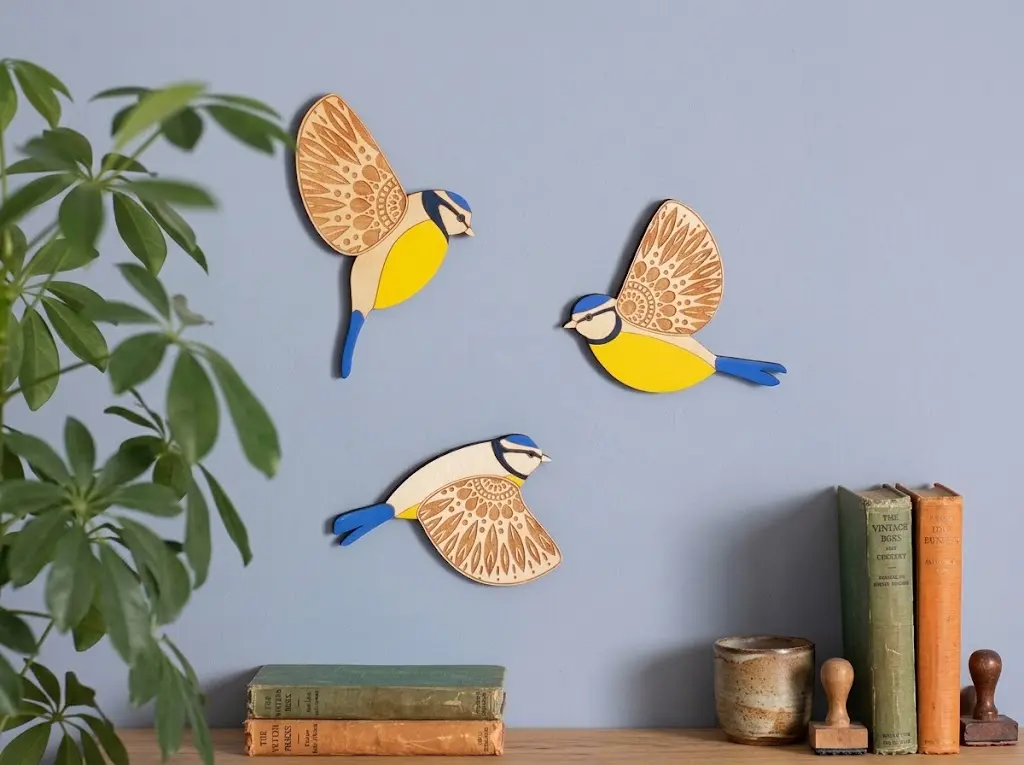
Boutique buyers comparing wooden wall art with resin wall decor are usually answering a sales question with a materials question. Material decides what a piece can be, how it ages and what it costs to buy; sales are decided by price point, wall presence, gift-ability and how the range hangs together on a fixture.
One disclosure first: we are a hand-carved wood manufacturer and do not make resin, so this is written from one side of the comparison. Where resin genuinely wins is stated plainly, and no sales or conversion figure is invented — we do not have your shop’s numbers, and neither does anyone writing a general guide. For figurines rather than wall pieces, see wood versus resin birds.
Key Takeaways
- Material sets the ceiling, not the sale. Carved wood carries a higher price because it is visibly worked; resin carries a lower one because moulding scales. Neither guarantees sell-through on your fixture.
- Resin wins on dimensional stability, moisture tolerance and consistency at volume — real advantages that may decide the question outdoors or in a humid room.
- Carved wood wins on repairability, on the hand-made read that supports a gift purchase, and on plastic-free positioning — a claim retailers are increasingly asked to substantiate.
- Wall art sells on presence per metre of wall, not unit price. A three-piece flying set reads as a scheme; one large panel reads as a statement.
- Weight matters more on a wall than on a shelf. Fixings, plasterboard limits and shipping cost all follow from it.
- Test with a trial order rather than a belief. A hundred pieces across two formats beats any comparison article, including this one.
In This Guide
- What This Comparison Can and Cannot Tell You
- Formats of Wooden Wall Art Boutiques Actually Stock
- Where Resin Genuinely Wins
- Where Carved Wood Genuinely Wins
- Wooden Wall Art vs Resin: Side by Side
- What Drives Sell-Through, and How to Test It
- Best For / Not For: Material by Shop Type
- What We Check on a Wall Art Order
- End to End: Testing Two Wall Formats
- Frequently Asked Questions
What This Comparison Can and Cannot Tell You
Each material permits different things. Carved wood is worked from a solid blank, so it holds undercut detail, can be sanded and refinished, and carries tool evidence a customer reads as labour. Cast resin reproduces a design identically at volume and is limited by what releases from a mould rather than by what a carver can reach. What neither tells you is which sells better in your shop: a conversion rate published for a whole material category describes somebody else’s customers. What follows gives the factors that move the number and a cheap way to measure them yourself.
Formats of Wooden Wall Art Boutiques Actually Stock
Wooden wall art is not one product, and the format changes the buying decision more than the material does.
- Flying bird sets. Three to nine pieces mounted to read as a flock in movement. They cover a wide stretch of wall for a modest price per piece, which is why they are the commonest entry point into the category, and each piece is light enough for simple fixings.
- Single carved panels. One larger relief — an animal, a scene, a botanical subject. Higher price and presence, slower turnover, and usually bought for the buyer’s own home rather than as a gift.
- Animal wall hooks and heads. Functional as well as decorative: a carved head with a peg for coats or keys. These earn their space in a hallway and tend to be picked up as gifts.
- Flat cut and layered work. Two-dimensional silhouettes, cut rather than modelled, sometimes layered for depth. Our flat carving runs to 80 cm against 5 cm to 40 cm for three-dimensional pieces, so one supplier can span an impulse-priced silhouette and a substantial modelled panel.
Hand-carved versus machine-cut matters commercially here: it is the difference between a piece priced as craft and one competing on price alone. See our article on hand-carved versus laser-cut wooden pieces, and for wall-hung formats our guide to styling wooden animal carvings.

Where Resin Genuinely Wins
Stating these plainly is not concession for its own sake: a buyer who understands them can also see where they stop applying.
- Moisture and temperature tolerance. Cured resin does not move with humidity as solid wood does. For a bathroom, a covered porch, a coastal shop or a market with large seasonal humidity swings, that is the honest reason to specify it.
- Consistency at volume. Every piece from a mould is the same. For a chain specifying one fixture across hundreds of stores, identical dimensions and colour remove a variable hand work always carries.
- Cost per piece at high volume. Once a mould exists, marginal cost falls sharply, so a resin design at ten thousand pieces will usually undercut a hand-carved one.
- Repeatable surface texture. Moulds hold detail — weave, fur, scale — crisply and identically, which is hard to match by hand across a large run.
Resin is weak at low volume and at the top of the price range. A mould is a fixed cost that must be earned back, so short runs are expensive, and a customer examining a piece closely can usually tell nothing touched it after the mould. If you sell sixty pieces a year of a design, resin’s economics do not help you.
Where Carved Wood Genuinely Wins
- The hand-made read. Tool marks, grain variation and slight asymmetry let a shop assistant say somebody carved this and be believed. That sentence does real work at the point of sale, particularly on a gift purchase.
- Repairability. A dent in a painted wooden piece can be filled, sanded and refinished. A chip in resin usually cannot be made invisible, so it becomes a return or a markdown.
- Low-volume economics. No mould to amortise, so a design can be run at a hundred pieces, tested and dropped without a fixed cost stranded against it — which is what makes a trial sensible.
- Plastic-free positioning. Wood is renewable and a wooden range can be sold without plastic in it — but the claim must be accurate rather than decorative. Our facility holds FSC chain-of-custody certification with ISO 9001 and BSCI, but certified basswood is not currently available to us, so our carvings are not marketed as FSC-certified wood; timber felling and transport permits are available for traceability. The frameworks behind such claims are described by FSC for businesses and the FAO forestry division.
Wood’s weakness is that it moves. Solid wood expands and contracts with humidity, which is why moisture is controlled before finishing and why a piece for a damp wall is a poor use of it. We hold wood between 8% and 12% before finishing, per our published wood moisture content standard, and treat logs against cracking — but nothing makes solid wood behave like plastic in a bathroom.

Wooden Wall Art vs Resin: Side by Side
| Factor | Hand-carved wood | Cast resin |
|---|---|---|
| Piece-to-piece variation | Present; bounded by a stated tolerance | Effectively none within a mould run |
| Humidity and damp | Moves with moisture; unsuited to bathrooms or outdoor walls | Stable; the better choice where damp is real |
| Fixed tooling cost | None; a design can start at 100 pieces | A mould must be earned back across the run |
| Cost behaviour at volume | Falls with quantity but stays labour-bound | Falls sharply once the mould exists |
| Damage in transit or on the wall | Can be filled, sanded and refinished | A chip is usually visible permanently |
| Price ceiling | Higher; supported by visible labour | Lower at retail unless the design is exceptional |
| Material story | Renewable, plastic-free, traceable permits available | Petrochemical; harder to position in a plastic-free range |
What Drives Sell-Through, and How to Test It
Five factors decide whether wall decor leaves a boutique, and only one is material.
- Wall coverage per price. Customers buy a solution for an empty wall. A three-piece set covering a metre reads as a scheme; one small piece at the same price reads as an accent.
- Installation friction. A piece needing a drill, an anchor and twenty minutes is a different purchase from one that hangs on a nail — where weight and fixing hardware matter more than material density.
- Gift-ability. A gift has to be carryable, packable and unlikely to be wrong: smaller, lighter and boxed beats large and fragile.
- Range coherence. Three unrelated wall pieces sell worse than one recognisable family of them. Cohesion is a merchandising decision; planogram basics are in our guide to gift shop planograms.
- Price architecture. One price point gives a shopper yes-or-no; three gives a choice, which converts better.
The test that settles it is cheap. Run two formats of one subject side by side on the same fixture for six weeks — a three-piece flying set against a single carved panel — and record weeks-to-clear, how often each is lifted off the wall, and whether either sells alongside another line. That produces a number belonging to your customers. Our guide to wooden animal figurines retail display covers the fixture side, and bulk sourcing for home accents covers what to do once you have the answer.

Best For / Not For: Material by Shop Type
| Shop type | Carved wood is the strong choice | Resin is the strong choice |
|---|---|---|
| Independent gift boutique | Low-volume designs, gift purchases, a hand-made story the shop can tell | A high-turnover impulse line where price is the whole argument |
| Coastal or garden retail | Indoor wall pieces in a dry, conditioned space | Anything near damp, salt air or an unheated porch |
| Chain or multi-site retailer | A premium tier with a stated tolerance and a documented acceptance rule | A fixture rolled out to hundreds of sites needing identical dimensions |
| Plastic-free or sustainability-led | Wood throughout, with traceability documents behind the claim | Not the right category — the material undercuts the positioning |
What We Check on a Wall Art Order
- Moisture held at 8–12% before finishing, which stops a wall piece cupping once it hangs in a heated room.
- Log treatment against cracking, since a wall panel is a wide visible surface where a split cannot be explained away.
- Fixing hardware specified and pull-tested against piece weight, with the weight recorded so your fixture and freight quotation rest on the real number.
- Finish approved against a retained physical sample, so grain variation stays inside an agreed range rather than becoming a discussion at delivery.
- Export packing confirmed — white paper wrap per piece, 6 to 12 per three-ply inner box at 21 × 11 × 14 cm, 240 to 480 per five-ply master carton at 58 × 44 × 31 cm, 8.0 to 15.0 kg gross, rated to ISTA 3A. Flat wall pieces are most vulnerable to corner impact, so pack pattern matters more here than for a solid carving.
- Photographs and video of finished goods before balance payment, under our T/T terms of 30% deposit and 70% before shipment.
End to End: Testing Two Wall Formats
A boutique with two shops wants a wall decor line and cannot choose between a flying bird set and a single carved panel.
Frame the test. One subject, two formats, same finish, same fixture position in both shops. The question is which format clears, not which material wins in the abstract — resin is not in the trial, because neither format is being considered in it for a dry indoor wall.
Order the trial. 100 pieces at a USD 500 minimum order value split across the two formats, air express DDP, 20–30 days. Splitting one trial minimum across two designs is what the trial tier is for; neither is committed to volume yet.
Run six weeks. Record weeks-to-clear per format, how often each is lifted off the wall, average basket when it sells, and whether the panel sells only to regulars. Lift-and-replace is the strongest signal available for wall decor, because it happens before price is considered.
Commit the winner. The reorder moves to 300 pieces at a USD 3,000 minimum order value, sea freight, 60–90 days to port, and the losing format is dropped without a mould cost stranded against it. Range options sit in our wood carving and wholesale wooden crafts guides, sequencing in our sample-to-first-order timeline.
If you want to test wall formats before committing volume — with piece weights, fixing hardware, carton quantities and a trial split across two designs — send us your subject and wall dimensions and we will build the test order with you.
Frequently Asked Questions
Q: Does wooden wall art sell better than resin in boutiques?
Nobody can answer that honestly without your sales data. Material sets what a piece can be and what it costs to buy; sell-through is decided by price point, wall coverage, installation friction, gift-ability and range coherence. Test two formats on your own fixture for six weeks.
Q: Will carved wood warp on a wall?
Not if moisture is controlled and the piece hangs in a conditioned room. We hold wood between 8% and 12% before finishing and treat logs against cracking. Solid wood does move with humidity, so a bathroom, an unheated porch or a wall in direct sun is a poor location — and that is where resin earns its place.
Q: Why is resin cheaper at high volume?
Because a mould is a fixed cost and each casting after it adds comparatively little, while hand carving stays labour-bound at every quantity. That is also why resin suits short runs poorly: the mould must be earned back, and a design tested at a hundred pieces cannot carry it.
Q: What is the minimum order to test a wall art design?
A trial order runs at 100 pieces with a USD 500 minimum order value on in-stock designs, air express DDP in 20–30 days, and can be split across two formats. Wholesale and custom run at 300 pieces with a USD 3,000 minimum order value, sea freight, 60–90 days to port.
Q: Can I claim a wooden range is plastic-free?
Only if it is true across the piece and the pack — article, finish, fixing hardware and retail packaging. On provenance, we hold FSC chain-of-custody certification with ISO 9001 and BSCI, but certified basswood is not currently available to us, so our carvings are not marketed as FSC-certified wood; timber felling and transport permits are available.
Sources
Forest certification frameworks are described by FSC for businesses and the FAO forestry division. Our species list, carving size range, moisture standard, hand-carved and hand-painted construction, minimums, order values, lead times, payment terms, carton specification, ISTA 3A rating and certifications are our own published first-party terms. No sales, conversion, sell-through or market-share figure is stated here, and no unit price is quoted for either material: we do not have your shop’s data. We are a wood carving manufacturer and do not produce resin.