Skip to content

Minimum order quantity is the smallest run a factory can produce on agreed terms, and on custom wooden wholesale wooden Christmas ornaments it is set per design and per finish combination, not per order. At Ewoodarts the standard MOQ is 300 units per design. Unit cost then moves with four levers: committed volume, finish complexity, packaging tier, and whether the shape needs custom tooling. Get those four right and the same ornament can be positioned as an entry-price shelf piece or a gift-boxed keepsake without changing the carving.
Key Takeaways
- MOQ binds the design, not the order. A single purchase order can carry several designs; each custom design typically needs its own 300-unit commitment, while repeat runs of an approved design are cheaper to place.
- Finish drives cost faster than material. Plain laser-cut blanks are the low-cost baseline; each added step — printing colours, hand-painting, multi-pass carving — adds labour, not stock.
- Packaging is a retail-price lever. An insert card or gift box costs the factory little but moves the item from bin display to giftable tier at the till.
- Volume steps matter most on freight. Ornaments are light but bulky; landed cost per unit often swings more on cubic-space efficiency than on the ex-works price itself.
- Shoulder-season orders negotiate better. Capacity reserved months ahead of the autumn peak gives buyers room on MOQ flexibility and slot priority.
- Ex-works is not the decision number. Build the landed-cost sheet — unit price, freight share, duties, storage — before comparing two supplier quotes.
In This Guide
- What MOQ Covers on a Christmas Ornament Order
- Why the Holiday Calendar Changes MOQ Logic
- The Unit Cost Stack: What Actually Moves Price
- Finish Choices: Where the Money Goes
- Packaging Tiers That Protect Margin
- Options When a Design Cannot Reach MOQ
- Landed Cost: The Checks Before You Commit
- Order Calendar: Locking Dates Around MOQ
- Frequently Asked Questions
- Best For / Not For: Which Order Structure Fits Which Buyer
- What We Check Before an Ornament Order Ships
What MOQ Covers on a Christmas Ornament Order
An MOQ is not a store policy invented to discourage small buyers. It is the arithmetic of a production run: batches of basswood or plywood blanks have to be cut, sanded, finished, checked and packed together, and each custom design needs its own setup on the finishing line — engraving files locked, paint colours mixed, packing labels generated. Below a certain quantity, that setup is spread over so few units that no sensible price exists: the buyer would pay a per-unit cost higher than the retail shelf can carry.
Three practical consequences follow. First, MOQ applies per design: a red cardinal and a gold cardinal are two designs, each needing its own commitment, even though they ship in one carton. Second, colour variants of the same carving usually count as one design when they run on the same paint line in one session. Third, approved repeat orders of an existing design almost always sit on easier terms than first runs, because setup already happened once. If your assortment plan has eight boutique shapes, plan eight MOQ commitments or consolidate shapes before quoting.

Why the Holiday Calendar Changes MOQ Logic
Ornament factories live in two seasons. Spring and early summer lines run cooler; August through October everything is Christmas. Near peak, two things harden: production slots fill, and suppliers become stricter about committing capacity to orders that are large enough to be worth the line time. That is when a 300-unit design competes with a retailer ordering 3,000. Ask to negotiate MOQ relief in September and the answer is usually no; ask in the planning conversation you were having in March and the same supplier may split a first trial across two colours, hold a slot, or accept a smaller opening quantity backed by a reorder commitment.
Seasonality also changes what the MOQ protects. A late December reorder of an in-stock design is cheap to produce; a February order for a brand-new carved shape with sculpt approval locks engineering attention for months. Same number, different commitment. Treat MOQ discussions as calendar discussions, and you will get further than buyers who treat them as price haggling.
The Unit Cost Stack: What Actually Moves Price
Four factors set the per-unit cost of a wooden ornament, and they do not weigh equally. The table below shows each lever, the direction it pushes cost, and the buyer move that captures savings.
| Cost Lever | Direction | Buyer Move |
|---|---|---|
| Committed volume per design | Cost per unit falls as the run lengthens; setup amortises across more pieces. | Consolidate shapes. Fewer designs at deeper quantities beats many designs at MOQ. |
| Finish complexity | Each added step — colour, hand-paint detail, multi-pass carving — raises labour. | Keep hero designs premium; run entry-price shelves as laser-cut and printed. |
| Tooling for custom shapes | New cut files, jigs or moulds add one-time cost that must be spread over the run. | Start from shared stock shapes; reserve full-custom for your proven top sellers. |
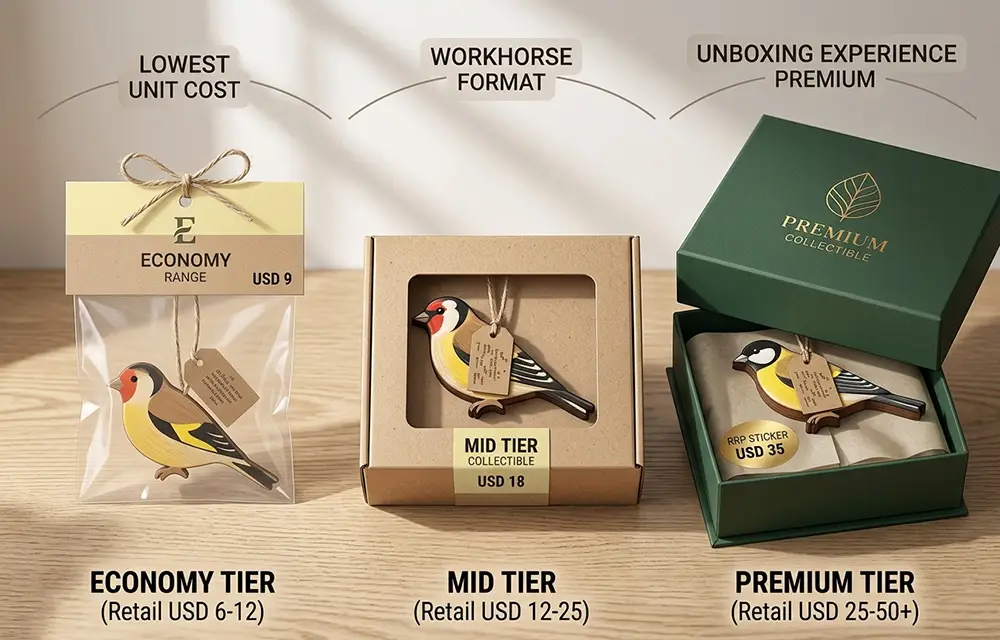
| Packaging tier | Insert cards and boxes raise unit cost slightly but lift retail price disproportionately. | Tier packaging by shelf role: bin, carded, gift-boxed — one carving, three price points. |
Finish Choices: Where the Money Goes
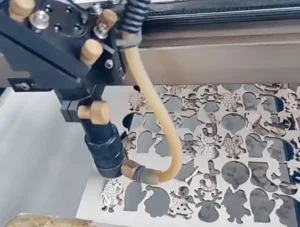
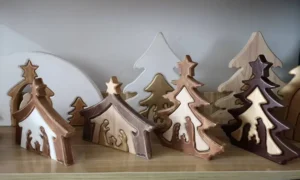
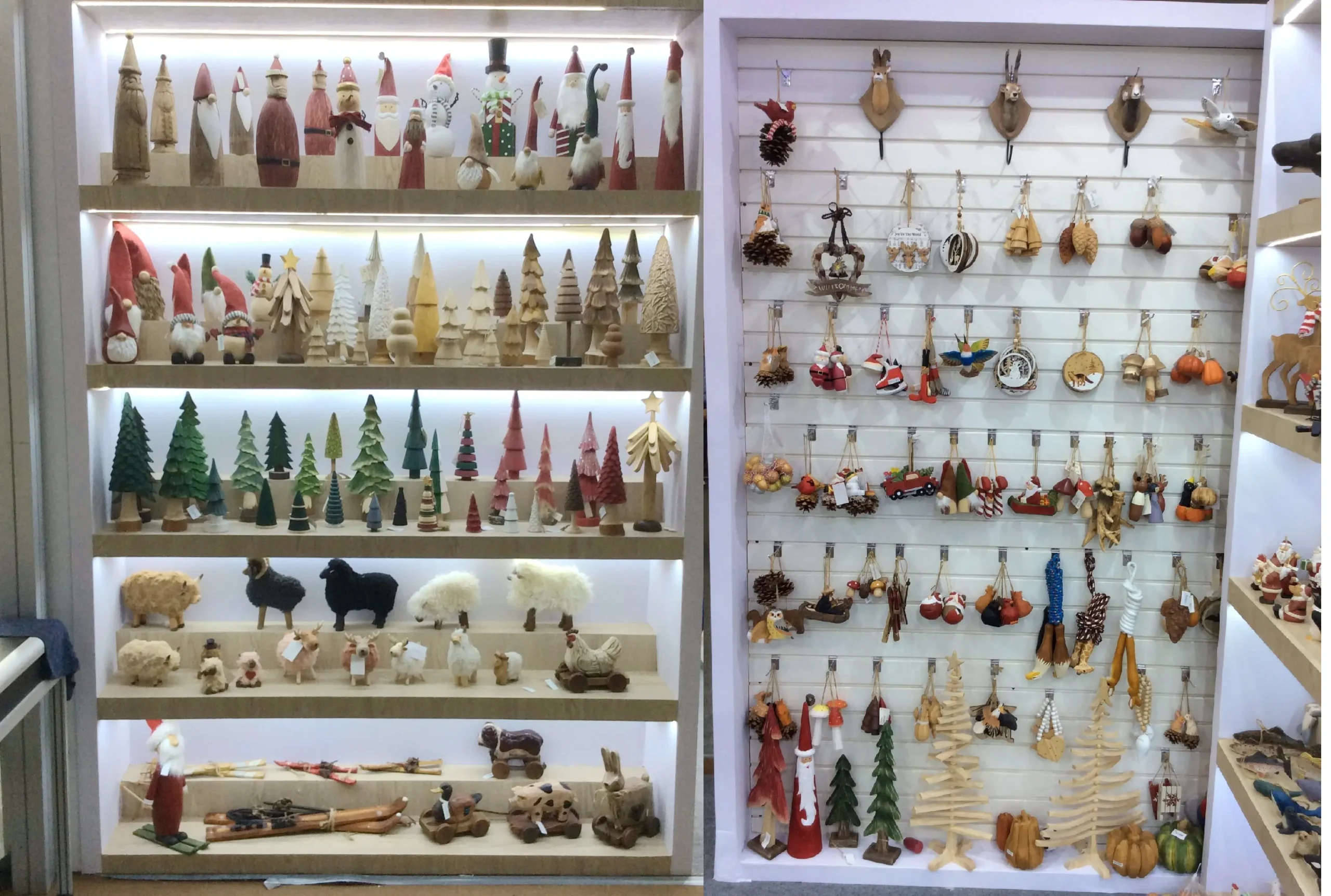
The full cost spectrum from plainest to richest reads: unfinished blanks, laser-cut and sanded shapes, single-colour print, multi-colour print, engraved personalisation, hand-painted detail, hand-carved sculptural pieces. The gap between adjacent steps is mostly labour and quality-control time, not material. The distinction matters most between hand-carved versus laser-cut ornaments, where the hand-carved tier buys shelf presence and gift pricing, while the laser tier buys assortment depth at entry price.
Buyers routinely over-order finish. A gift shop does not need every SKU hand-painted; it needs two or three anchor pieces that justify the window display and a supporting cast of printed designs at accessible price. Ask your supplier to quote the same shape at two finish levels and compare the retail ladder each supports, rather than asking for one price on one specification.

Packaging Tiers That Protect Margin
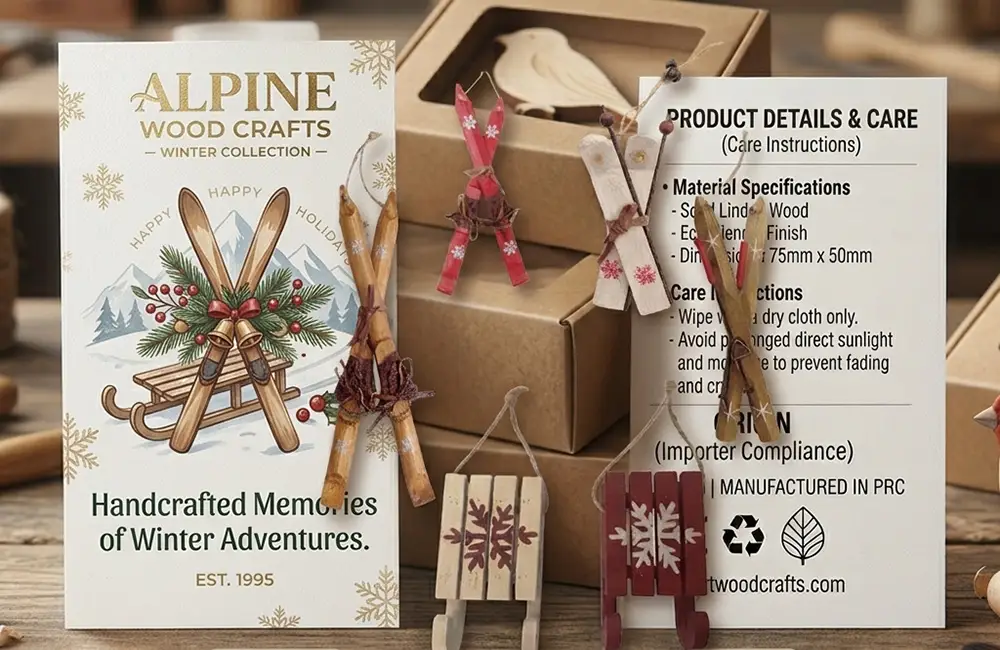
Ornament packaging has three practical tiers. Tier one is the bulk poly bag — lowest unit cost, suits bin displays and craft-fair weight sales. Tier two adds a printed insert card with story, care note or brand mark; it converts the same carving into a shelf-hanging gift item, and the card runs off the shared blank line so MOQ pressure stays on the ornament, not the print. Tier three is a rigid gift box, used for topper sets, catalogue ornament shapes and corporate programs where unboxing is part of the product.
One trap: custom-printed packaging often carries its own MOQ, separate from the ornament MOQ, and print plates can add one-time fees. If you plan seasonal card artwork changes every year, negotiate a stock-card format with a swappable insert panel — it keeps your unit packaging cost near the shared-programme rate while still letting each client year read differently.
Options When a Design Cannot Reach MOQ
Not every boutique can commit 300 units to an unproven shape. Four routes work with the standard policy rather than against it. One: pick from the supplier’s shared catalogue where dozens of buyers combine into the same run, then add your logo engraving — the carve is at scale, your differentiation is at unit level. Two: take one design across the whole store and rotate yearly, deepening each run as you learn the sellers. Three: start with a sample-to-retail ladder — approved samples now, small opening quantity backed by a written reorder commitment. Four: link your opening buy to a programme, for example a client-appreciation gifting pre-order that reaches MOQ before your shop floor order even ships.
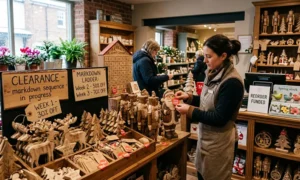
Illustrative scenario: a five-door gift retailer wants eight novel shapes. A workable structure is three shared-catalogue shapes at their standard MOQ, two shapes personalised with the chain name on a shared blank, and the remaining three deferred to a spring re-sample once the first containers show which categories actually turn. Same shelf story, a fraction of the commitment, and no dead stock at clearance.
Landed Cost: The Checks Before You Commit
Compare quotes on landed cost, never ex-works. Ornaments are light but bulky, so ocean freight is charged on volume well before weight becomes relevant; carton dimensions and nesting efficiency are a negotiation point with real money behind them. Add duties at the correct tariff classification for wooden decorative articles — confirm the current heading and rate with your customs broker, since classification depends on construction, use and destination market, not on the word ornament. Add storage and handling: a container of 4,000 ornaments occupies more warehouse cube than the same value of salt lamps or pens.
A useful discipline is to build the same one-page sheet for every supplier quote: unit price at quantity, carton units and cbm, freight share per unit, duty estimate, and your retail price at each packaging tier. Two suppliers that differ by ten percent ex-works can swap positions entirely once freight efficiency is counted.
Order Calendar: Locking Dates Around MOQ
MOQ discussions have a deadline hidden in them: production slots. A custom design that needs sculpt approval, sample rounds and a long run should be locked well before autumn, because the same 300-unit commitment competes with four-digit retail orders once the line fills. Reorders of approved designs usually stay possible into October, but first runs rarely do. Plan new shapes in the spring review, sample in early summer, and treat August as the practical edge for first Christmas deliveries. For the ordering mechanics behind that calendar see our procurement guide for wooden crafts, and for how the corporate segment plans its December drop see the client-appreciation gifting playbook.
Best For / Not For: Which Order Structure Fits Which Buyer
Our published terms are fixed, so the only real decision is which of them your assortment fits into. The table below is the same one our sales team works from; the full shape range is in the wooden Christmas ornament buyers catalog.
| Structure | Best For | Not For | Our Terms |
|---|---|---|---|
| Trial order | First-time buyers testing a category, in-stock shapes, tight pre-season windows | Bespoke shapes or custom colour boxes — those need the wholesale track | 100 pcs MOQ / USD 500 minimum order value · air express, DDP · 20–30 days |
| Wholesale or custom run | Full-catalogue buying, OEM/ODM shapes, buyers optimising landed cost per unit | Anyone needing goods inside 60 days — production alone runs 60–90 days to port | 300 pcs per design MOQ / USD 3,000 minimum order value · sea freight |
| Custom colour box | Brands and chains that need shelf-ready retail packaging under their own artwork | Loose bin or pick-and-fill displays, where the box cost is wasted | 500 pcs MOQ on the printed box, separate from the ornament MOQ |
| Catalogue shape + your logo | Buyers who want differentiation without paying for sculpting and sampling | Brands whose identity depends on a silhouette no catalogue shape can carry | Sits on the lighter personalisation minimums rather than full custom tooling |
Payment runs T/T across all four: 30% deposit at order confirmation, 70% balance before shipment, with photographs and video of the finished goods supplied before the balance is due.
What We Check Before an Ornament Order Ships
Unit cost and MOQ only hold if the goods arrive saleable, so the packing specification is part of the price conversation rather than an afterthought. Our standard export packing is:
- each piece wrapped in white paper before boxing, to stop paint transfer between units;
- 6–12 pcs per three-ply corrugated inner box, 21 × 11 × 14 cm;
- 240–480 pcs per five-ply master carton, 58 × 44 × 31 cm, adjusted to the product’s dimensions;
- average gross weight held between 8.0 and 15.0 kg per carton, which is the figure your freight forwarder should be quoting against;
- carton construction rated to pass an ISTA 3A drop test;
- custom colour boxes, labels and shipping marks available where the buyer’s chain requires them.
Those carton numbers are what make the cubic-space argument in the landed-cost section real: two suppliers ten percent apart ex-works can reverse positions once cube per unit is counted. Buyers who want to verify a factory rather than trust one can work through our wood carving factory audit checklist.
If you are planning a Christmas assortment and want to know what your shapes actually cost at 300, 1,000 and 3,000 units — including packaging tiers and carton efficiency — our team can put that sheet together for you.
Frequently Asked Questions
What is a typical MOQ for wholesale Christmas ornaments?
Common factory minimums run from 100 to 300+ units per design depending on finishing complexity; at Ewoodarts the standard is 300 units per design. Catalogue shapes personalised with your logo can sit on lighter commitments because your order shares a production run.
Can the MOQ be negotiated lower for a first order?
Often, when the structure gives the factory something back: a written reorder commitment, choosing a shared shape over a custom one, or taking one design in two colours of the same run rather than two separate designs. Expect less flexibility as the autumn peak approaches.
What moves ornament unit cost the most?
Finish labour: the steps between a plain laser-cut shape and a hand-painted one. Volume per design comes second, because setup spreads across more units, and packaging tier third — it adds little cost but lifts retail price.
Does a fully custom ornament shape require tooling costs?
New shapes typically need cut files, jigs or sculpt models, which are one-time costs folded into the first run. Starting from an existing shared blank and customising only engraving or paint avoids most of that.
When should retailers place Christmas ornament orders?
First runs of custom designs are usually locked by late summer at the latest; reorders of approved designs can run later, but depend on remaining line capacity. Spring sampling keeps both the calendar and the terms in your favour.
Sources
Delivery terms that decide who carries freight and duty are defined by the ICC Incoterms rules. Tariff classification should always be confirmed for your product construction and destination with U.S. Customs and Border Protection or your licensed broker.