Skip to content
Key Takeaways
- A stump base moves a carved bird out of the decoration aisle and into the artisan craft aisle, which is where a higher shelf price is defensible.
- Stability comes from three build choices: a hand-levelled base, mass kept low, and a glued joint checked on every piece before packing.
- Bird bodies run 8 to 13cm, and six pieces sit in one partitioned 3-ply inner box so nothing shifts in transit.
- Every batch ships with timber harvesting permits and plant quarantine certificates, which is the paperwork an EU due-diligence file asks for.
- Logo engraving needs a vector file, and custom printed colour boxes carry a 500-unit minimum.
- Trial orders start at 100 pieces under a USD 500 minimum order amount on air DDP in 20 to 30 days.
- Wholesale and custom programmes start at 300 pieces under a USD 3,000 minimum, with sea freight at 60 to 90 days to port.
Table of Contents
- Why A Stump Base Sells The Bird
- Stability On A High Traffic Shelf
- How We Verify Timber Legality
- Sizing And Display Guidance For Retail
- Engraving Your Logo On The Base
- Packaging That Stops Detachment
- Office Versus Home Buyer Demand
- Order Terms For Wholesale Buyers
- Frequently Asked Questions
- Final Thoughts On A Bird Stand Line
A wooden bird on a stand is two products bolted together: the carving, which the customer buys with their eyes, and the base, which decides whether the piece survives a season on a busy shelf. Buy the second part badly and the first part stops mattering. An unstable bird tips, falls, chips a beak, and comes back as a return; a base of uncertain origin turns a premium story into a compliance question.
This guide walks through the six decisions a wholesale buyer actually makes on a standing-bird programme: base style, stability engineering, timber paperwork, size and display fit, logo engraving, and the packing sequence that keeps the bird attached from our factory floor to your store. The figures quoted are our own production and packing numbers, so a buyer can cost the row that will ship.
Why A Stump Base Sells The Bird
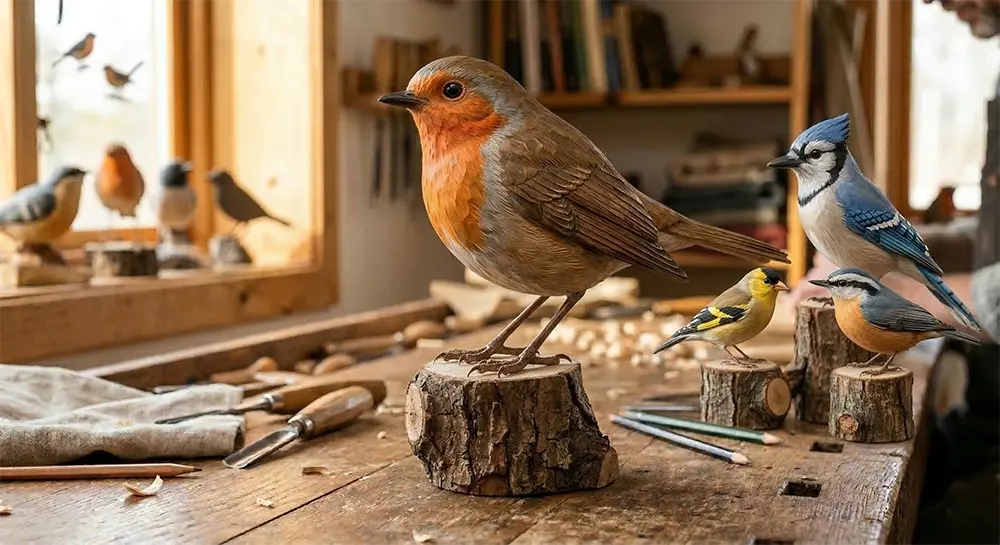
A natural stump does more than hold the carving upright. It changes which aisle the customer files the object under. On a plain block, a painted bird reads as decor, priced against resin and plastic. On an irregular piece of wood with visible grain and tool marks, the same carving reads as an artisan craft, and the buyer of an artisan craft does not comparison-shop on price first. That category shift is the commercial argument for the base, and it is why our wholesale wooden bird line is built on stump foundations rather than milled blocks.
| Attribute | What The Stump Base Does | Buyer Consequence |
|---|---|---|
| Authenticity signal | Unique grain proves the piece is not machine-stamped | Supports a premium shelf price without a discount fight |
| Material connection | Organic texture answers demand for natural interiors | Sits in gift and home ranges instead of toy aisles |
| Brand story | Carries the sourcing narrative on the piece itself | Printed care cards can repeat the permit story |
The texture argument is not decoration for its own sake. Interiors that lean on minimalist wood decor sell on warmth and irregularity, and a real stump delivers both without a mould line. A resin base can imitate the silhouette; it cannot imitate the grain, and shoppers pick the difference up in their hands.
Stability On A High Traffic Shelf
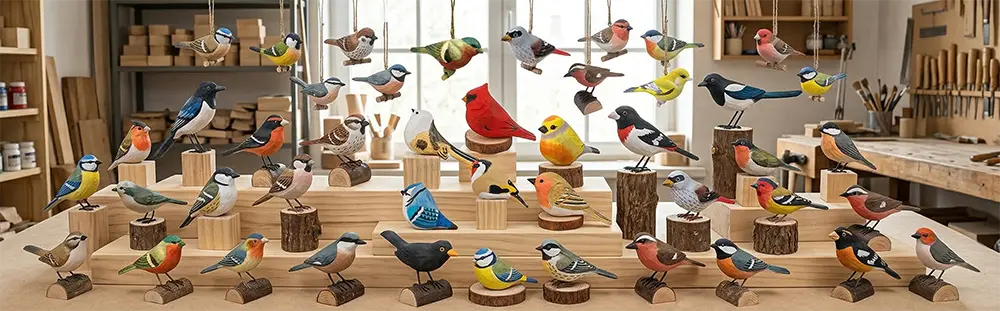
Stability is a build specification, not a hope. Three rules decide whether a standing bird stays upright through a retail season. The base must sit truly flat, because a fraction of a millimetre of twist is enough to start a wobble. Mass belongs low, since the heaviest part of the piece should sit below the carving, not beside it. And once height increases, the joint between bird and stump needs internal reinforcement, because that is the plane where every knock and every hand-off concentrates its force.
We build those rules into production rather than inspecting for them afterwards. Each base is hand-cut from basswood and levelled on a bench so it rests flat before painting. After assembly, every piece goes through a balance check inside our quality control sequence, where the standing bird is set down, nudged and re-set, and rejected if the joint shifts. That protocol is what keeps the failure mode we see at competitor factories, a bird that leans in its second month on the shelf, off our invoices.
The joint itself is the part a buyer cannot see once the piece is painted, so it is worth asking any supplier to describe it in writing. Ours is a pinned, glued connection sized for the body weight above it, tested during the packing drop rather than assumed.

How We Verify Timber Legality
Ethical sourcing is a document set, not an adjective. Four checks carry the weight, and a buyer should ask to see all of them quoted in a supplier’s answer rather than a certificate logo on a homepage. A timber harvesting permit confirms the wood was cut inside a government-approved quota and management plan. A plant quarantine certificate confirms the timber is pest-free and cleared for international movement. Supply-chain traceability ties a batch back to the specific managed forest it came from. And sustainable practice means selective harvesting with water sources and habitat left standing, which is a field decision, not a marketing one.
Jilin Ever Creation works Changbai Mountain basswood under official harvesting permits and quarantine certificates on every batch, and we hand those papers to buyers as part of the shipment file. That matters more each year on the European side: the EU deforestation regulation places due-diligence duties on operators who place timber products on the EU market, and the file it expects is built from exactly these documents. Our own workshop profile sets out where the carving sits and how batches move through it.

Sizing And Display Guidance For Retail
Size drives price, shelf footprint and carton count at the same time, so it is the second decision after base style. Our standing birds are carved at 8 to 13cm body length, and the total height is kept proportionate so the piece reads well on a desk, a mantel or a gondola shelf without towerising past the sightline. The table below is our own packing matrix, which is the one a buyer should cost freight against.
| Body Length | Best Display Position | Inner Box Quantity | Order Tier |
|---|---|---|---|
| 8 to 10cm | Checkout impulse ledge, gift set of three | Six pieces per 3-ply box | Trial and restock orders |
| 11 to 13cm | Desk and shelf hero, single-piece display | Six pieces per 3-ply box | Core wholesale programme |
| Mixed assortment | Themed table with several species together | Partitioned to size within the box | Custom and seasonal builds |
Two merchandising notes from retail customers. First, a standing bird earns its price when it can be picked up, so leave clearance above the shelf edge; a piece that cannot be lifted tends to be read as a display prop. Second, group by species rather than by size, because a cardinal, owl and robin in one cluster gives the shopper a reason to buy three.
Engraving Your Logo On The Base
Laser engraving turns a wholesale item into branded merchandise, and it is the option museum shops and corporate gift buyers ask for most. The technical requirement is simple: send a high-resolution vector file, which we accept as .AI, .SVG or .PSD. A raster logo enlarges into a soft edge under the laser, and a soft edge on a 3cm base is visible from arm length. Our team will advise on placement and size so the mark lands on the flat face of the stump without cutting into the grain that makes the base worth having.
Engraving sits inside our OEM and ODM work, so quantities apply. Custom printed colour boxes start at 500 units, while a 300-piece run under a USD 3,000 minimum covers engraving on the base with plain inner packaging. The step-by-step file handover is on our custom manufacturing process page, and corporate gifting programmes are covered separately on the corporate gifts line.
Packaging That Stops Detachment
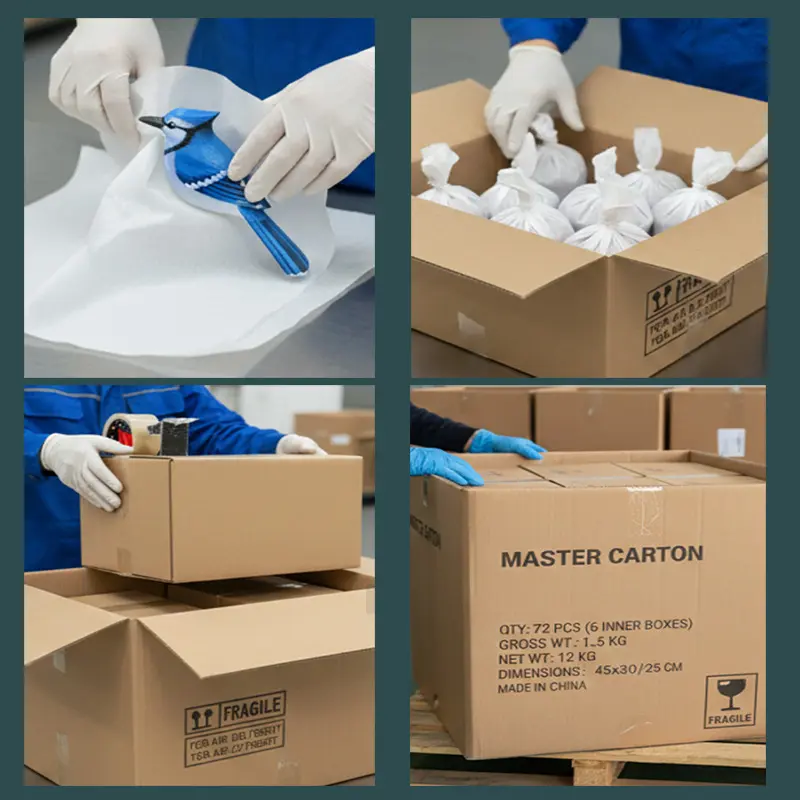
Transit damage in this category has one signature failure: the bird separates from its stand inside the carton and both halves arrive chipped. We treat bird and base as a single unit that must be immobilised, in three layers. Each standing bird is wrapped in protective silk paper first, which guards the hand-painted finish against scuffs. Wrapped pieces then go into a custom-partitioned 3-ply BC flute inner box, six to a box for the 11 to 13cm size, so no piece can shift or strike its neighbour. Those inners are packed into a reinforced 5-ply BC flute export master carton that carries the stacking load.
The full stack passes the ISTA 3A drop test, which is a packing standard rather than a product certification, and it is the difference between a carton that survives a warehouse and one that survives a journey. Timber also has to be dry before it is boxed, or a sealed carton will move moisture into the joint: our blanks are kiln-held to a moisture content of 8 to 12 percent before carving, and again before packing. Our wider guidance on packaging wooden crafts covers the same sequence for other fragile shapes.
Office Versus Home Buyer Demand
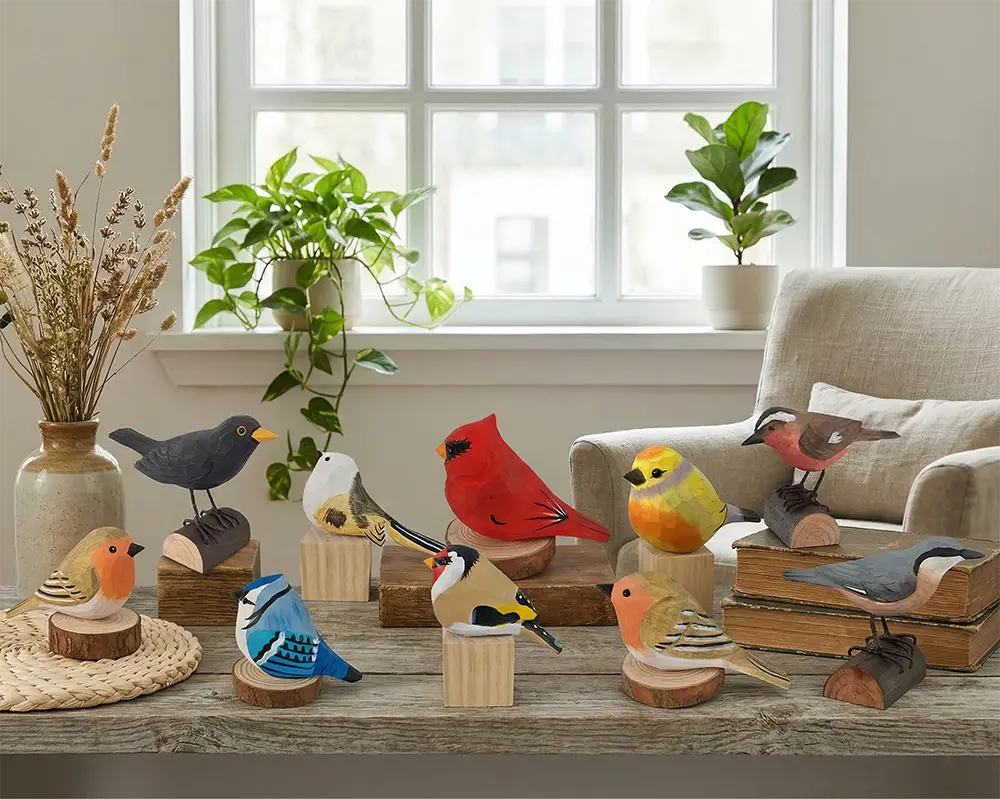
Commercial interiors still order in larger volumes, because an office fit-out buys the same item repeatedly across many desks, and durability plus uniformity outrank character in that purchase. Residential and home-office buying runs the other way: fewer units, more variety, and a shopper who actively wants the variation that a hand-carved piece carries.
For a retailer, that split changes how you build the assortment rather than which segment to chase. A commercial buyer takes a single species in one size, ordered deep. A home customer takes three species in mixed sizes, ordered shallow, and the margin usually sits in that second basket because the set is curated rather than stocked. The wood carvers at our wood carving factory cut both patterns from the same blanks, so a mixed assortment does not have to cost a second tooling charge.
Order Terms For Wholesale Buyers
Terms are fixed and worth quoting before you model a margin. A trial order opens at 100 pieces with a USD 500 minimum order amount, moving by air door-to-door in 20 to 30 days, which is how a first assortment reaches a shelf inside one season. Wholesale and custom programmes start at 300 pieces under a USD 3,000 minimum and travel by sea in 60 to 90 days to port, so a Q4 plan books against the sea figure. Colour-boxed retail packaging adds the 500-unit minimum described above.
Payment splits along the same line: a deposit at order confirmation and the balance before shipment. The full craft family, from these standing birds through wholesale wooden crafts and seasonal bird decor, consolidates into one carton mix, which is where the freight arithmetic starts to work for a smaller buyer.
Stock Standing Birds That Survive The Shelf
Open a 100-piece trial on air DDP, or build a 300-piece programme with levelled bases, engraved logos and ISTA 3A-tested cartons already specified.
Frequently Asked Questions
What size are your wooden songbirds on stands?
Carved bodies measure 8 to 13cm, mounted on a hand-levelled stump base whose height stays proportionate to the bird. That keeps the piece stable on a shelf, a desk or a mantel without towering past the sightline of a display.
What wood is the stand made from and is the finish safe?
Both bird and base are cut from solid Changbai Mountain basswood, and the colour comes from water-based paint documented against EN71. The finish carries no solvent residue that would taint a shelf or a gift box.
Can our company logo be engraved on the base?
Yes. Send a vector file as .AI, .SVG or .PSD and we laser-engrave the mark onto the flat face of the stump. Custom printed colour boxes carry a 500-unit minimum, while base engraving joins a 300-piece programme.
How are standing birds packed for international shipping?
Each piece is wrapped in silk paper, seated in a partitioned 3-ply inner box holding six, and those inners go into a reinforced 5-ply export master carton. The stack is built to pass the ISTA 3A drop test before it leaves the factory.
What is the minimum order quantity for wholesale?
A trial order from in-stock carvings starts at 100 pieces of one design under a USD 500 minimum, arriving on air DDP in 20 to 30 days. Wholesale and custom OEM runs start at 300 pieces under a USD 3,000 minimum by sea.
Final Thoughts On A Bird Stand Line
Cheap decor wins on the invoice and loses on the returns ledger. A standing bird that carries a levelled base, a documented joint, legal timber papers and an ISTA-tested carton justifies its price at retail and arrives sellable, which is the margin that actually reaches a buyer.
Test that before committing to a container. A 100-piece trial shows the balance of the base, the grain of the stump and the packing sequence in one shipment. Our wholesale team can arrange samples and quote logo engraving through the contact page, and the seasonal side of the same craft family is covered in the Christmas bird decor guide.