Skip to content

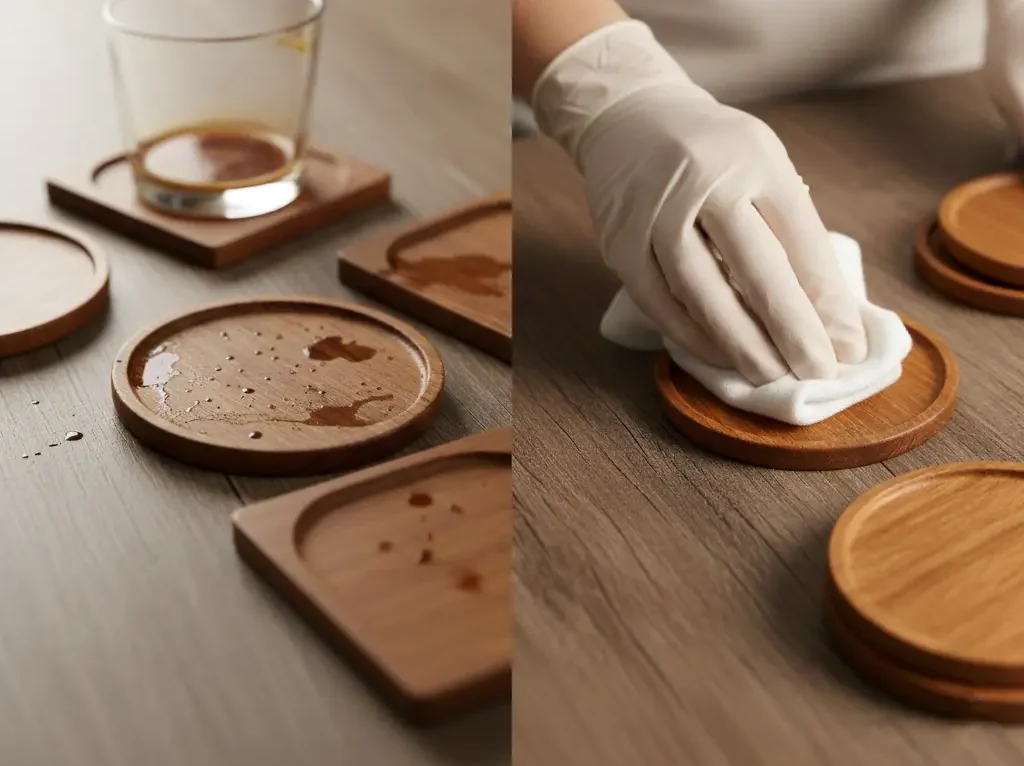
Almost every conversation about absorbent coaster technology reaches the same word, and treats it as a property that can be dialed up. It cannot. A coaster manages water in one of two ways — it absorbs the ring or it sheds it — and each has a different failure mode, service life, and answer to what happens to that water afterwards.
This guide works through absorbent coaster technology honestly, including where solid wood sits and where it does not. One disclosure, because it shapes the article: we manufacture solid wood coasters and do not produce stone, ceramic or diatomaceous-earth slabs. Those materials are described from general behaviour so a buyer can specify correctly, and any composite format is identified as needing a component we do not make. For the wider material comparison see our guide to coaster materials: cork versus wood versus slate.
Key Takeaways
- A coaster either absorbs the condensation ring or sheds it. There is no third behaviour, and “absorbent” is not a quality level added to a sealed surface.
- Absorbing solves the ring and creates a wet object. Whatever took the water has to release it, or it stays damp, stains and eventually fails.
- Sealed wood sheds rather than absorbs — a legitimate design, not a deficiency, provided the seal wraps every face and edge, since an open edge wicks water into the body.
- End grain is the weak point in any wooden coaster: it wicks far faster than face grain, and it is where finish failure shows first.
- A wooden top on an absorbent slab is a composite of two materials. The wood is within our capability; the slab is not and must be sourced separately.
- Ask a supplier for the mechanism, not the adjective. “Absorbent” is a claim; a stated material, finish and drying behaviour is a specification.
In This Guide
- Absorbent Coaster Technology: What the Word Means
- Absorb or Shed: Two Strategies, Two Failure Modes
- How Each Material Handles a Condensation Ring
- Wooden Tops and Stone Slabs: The Composite Format
- Water Behaviour by Material and Finish
- What We Check on a Wooden Coaster Order
- End to End: Specifying for a Wet Environment
- Frequently Asked Questions
Absorbent Coaster Technology: What the Word Means
Absorbency is a function of open pore structure: a material absorbs when it has connected voids drawing liquid in by capillary action. How much it holds, how fast it takes water up and how readily it releases it are three separate properties collapsed into one word.
That collapse is where specifications go wrong. A material taking water up fast may release it slowly and stay damp between uses. One holding a great deal may stain permanently from anything coloured. One drying quickly may be brittle at the handled edge. Asking whether a coaster is absorbent produces a yes; asking what it absorbs, how fast, how much, how it releases and what it looks like afterwards produces a specification.
Absorb or Shed: Two Strategies, Two Failure Modes
Shedding is what a sealed surface does. Water beads on the finish until it evaporates or is wiped, so nothing enters the material, stains or swells. The failure mode is finish failure: once a film is worn through, scratched or missing on an edge, water reaches the substrate and the piece starts to move. That is why the seal must wrap all six faces, not only the top.
Absorbing is what an open-pore material does. Water is drawn in, the ring disappears, and the material holds it until it evaporates — so no puddle forms and nothing transfers to the table. Three failure modes follow: staining from coloured liquids, which is in the material and cannot be wiped off; saturation, where a coaster that never dries between uses stays damp and can develop odour or surface growth; and edge degradation, where repeated wetting breaks down the structure that made it absorbent. Neither strategy is wrong; the right one depends on how wet the environment is and how often the piece is cleaned.

How Each Material Handles a Condensation Ring
Five materials cover most absorbent coaster technology on the market. Only the third is ours; the others are described from general behaviour so a buyer can compare honestly rather than take our word for it.
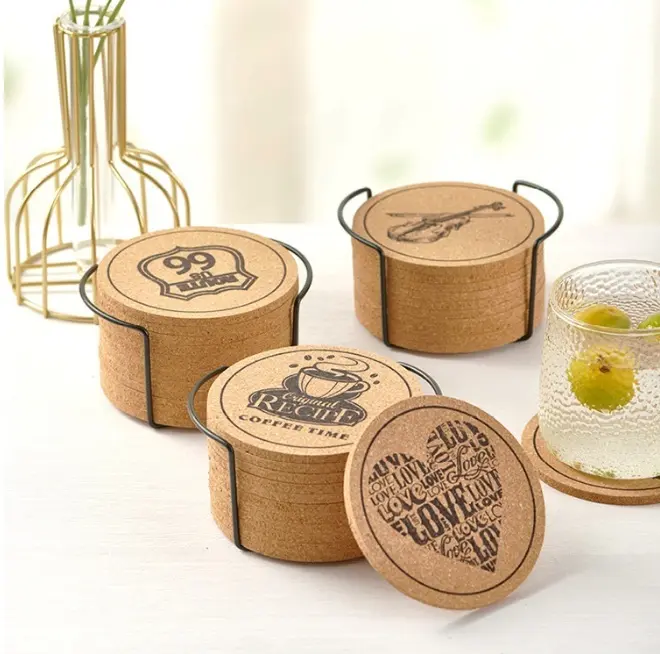
- Cork. Naturally absorbent at the surface because of its cellular structure, and forgiving on a polished table. Its weakness is that a stain goes into the material rather than sitting on it, and the cut edge crumbles once the surface skin breaks.
- Unsealed or oiled wood. Absorbs: it takes up water, darkens while wet and dries back, a movement cycle that eventually cups the piece. An oil finish slows this without stopping it. Chosen for feel rather than for a wet bar.
- Sealed solid wood — what we produce. Sheds. A film finish wraps the piece, water beads and evaporates, nothing enters the substrate. Performance depends on the seal reaching every face and edge. We produce in basswood, pinewood, rubber wood and birch, hold wood at 8–12% moisture before finishing per our published moisture standard, and every piece is carved and finished by hand. Species selection is in our guide to the best wood for coasters.
- Stone, slate and ceramic. Effectively non-absorbent, so water pools and must be wiped or left to evaporate. They do not stain and are unaffected by heat, but a pooling ring defeats part of the purpose.
- Sintered diatomaceous earth. The most genuinely absorbent option: it takes water up quickly and releases it by evaporation, so the surface appears to dry. Its limits are brittleness — it chips on impact and cracks if flexed — and absorbency degrading as pores load with residue, which is why such products are usually replaceable.
Two things plainly about that list. We manufacture none of cork, stone, ceramic or diatomaceous earth, so a buyer specifying those should test samples from whoever does. And no absorption rate, holding capacity or drying time is quoted for any of them: those figures vary by construction and must come from the supplier’s own batch data.
Wooden Tops and Stone Slabs: The Composite Format
The format this category keeps circling back to is a composite: a wooden frame or top holding a slab insert. It exists because the two materials do different jobs well — wood gives the object its warmth, brand surface and engraved edge, while a stone or sintered insert handles the water. Neither does both.
Three questions decide whether a composite works. How the insert is retained — a rebate routed into the wood, an adhesive, or a compression fit — since each behaves differently under repeated wetting and drying, and an adhesive not rated for a wet cycle fails exactly where the product is used. Differential movement: wood moves with humidity and stone does not, so a tight fit in one season can be loose or split in another. And whether the insert is replaceable, which decides if the product is durable or consumable.
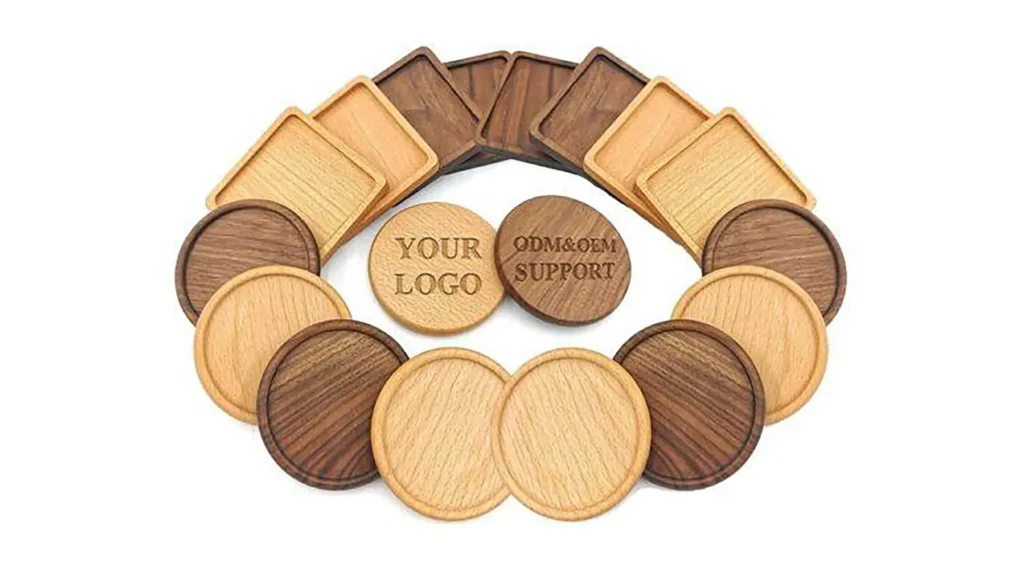
On capability, without ambiguity: a routed wooden frame, a wooden top, an engraved edge and a rebate sized to a specified insert are within what we produce in basswood, pinewood, rubber wood and birch, across three-dimensional sizes from 5 cm to 40 cm and flat work to 80 cm. The slab itself is not. Treat a composite as two supply lines with an assembly step and decide who holds that step before either component is ordered; where we do the assembly, the insert specification and tolerance must come from the slab supplier in writing.
Water Behaviour by Material and Finish
| Material and finish | Behaviour | Failure mode | Suitable where |
|---|---|---|---|
| Cork | Absorbs at the surface | Staining into the body; edge crumbling | General table use, not wine or coffee service |
| Unsealed or oiled wood | Absorbs and darkens while wet | Repeated swelling cycles lead to cupping | Dry settings, gift and decor use |
| Sealed solid wood | Sheds; water beads and evaporates | Finish wear, or an unsealed edge wicking inward | Hospitality, retail, corporate and gift |
| Stone, slate, ceramic | Non-absorbent; water pools | Chipping on impact; pooling defeats the purpose | Hot drinks, high-wipe environments |
| Sintered diatomaceous earth | Highly absorbent, dries by evaporation | Brittle; absorbency degrades as pores load | Replaceable-insert products, very wet use |
What We Check on a Wooden Coaster Order
This applies to sealed solid wood only; a buyer specifying cork, stone, ceramic or a sintered insert should ask that supplier the equivalent questions.
- Finish wrap confirmed — every face and edge sealed, end grain specified rather than left open, and the finish tested against a wet glass and a hot mug before the run.
- Moisture held at 8–12% before finishing, which stops a coaster cupping once one face is repeatedly wetted and the other stays dry.
- Construction chosen for movement — solid wood moves across the grain with humidity while a plywood core resists it and stays flatter, at the cost of an exposed edge that must be finished.
- Flatness and thickness tolerance held across the batch, so a set stacks without rocking and a rebate in a composite frame fits its insert in every season, not only the one it was cut in.
- Branding verified on the actual material — engraving depth, print adhesion after wetting, legibility at the smallest type in the artwork. Hospitality branding is in our guide to custom logo coasters, MOQ and cost factors.
- Documentation and packing confirmed — coating documentation where an article may contact food or drink, and export packing to our standard: white paper wrap, 6 to 12 per three-ply inner box at 21 × 11 × 14 cm, 240 to 480 per five-ply master carton at 58 × 44 × 31 cm, 8.0 to 15.0 kg gross, rated to ISTA 3A, with photographs and video before the 70% balance falls due.
End to End: Specifying for a Wet Environment
Convert the adjective into a mechanism. A hospitality group wants branded coasters for twelve taprooms serving mostly chilled beer, and asks for “absorbent” as its first specification. The question is not which material absorbs most but what the environment does to the piece: condensation rings all service, detergent wiping between tables, stacking damp overnight, high loss rate. Against that, an absorbent material that never fully dries is worse than a sealed one that is wiped.
Test both rather than argue. A trial of 100 pieces at a USD 500 minimum order value, air express DDP in 20–30 days, is split between a sealed solid wood coaster and the absorbent option to compare against it. Coasters are the cheapest hospitality item to test properly and the one most often specified from a photograph — which is how a finish that blushes under a wet glass gets ordered in volume.
Freeze the specification. Species, dimensions and thickness tolerance, finish system and its wrap, engraving method and depth, insert specification if composite, and the pack’s care instruction are written down against a retained sample. Programme context is in our guide to hotel and restaurant coaster programmes.
Scale. The reorder moves to 300 pieces at a USD 3,000 minimum order value, sea freight, 60–90 days to port, with custom boxes at the 500-piece minimum and payment T/T 30% deposit and 70% before shipment. Sustainability positioning is in our guide to wooden coasters for sustainable corporate branding, and the full category in our wholesale wooden coasters guide.
If you are specifying coasters for a wet environment and want the finish wrap, edge treatment and care instruction settled against your actual service conditions — with trial quantities and carton data — send us your use case and we will build the specification with you.
Frequently Asked Questions
Q: Are wooden coasters absorbent?
It depends on the finish. Unsealed or oiled wood absorbs — it darkens while wet and dries back, and repeated cycles eventually cup the piece. Sealed solid wood sheds: water beads on the film and evaporates without entering the substrate. Ours are sealed, so the question is not how absorbent they are but whether the seal wraps every face and edge.
Q: Is absorbent better than non-absorbent for a bar?
Not automatically. An absorbent material removes the ring but holds the water, and in a high-turnover bar may never fully dry between services, which is how staining, odour and edge breakdown start. A sealed surface wiped between uses keeps no water at all. Decide from the service pattern, not the word.
Q: Do you make coasters with a stone or ceramic absorbent insert?
No. We manufacture solid wood coasters in basswood, pinewood, rubber wood and birch, and can produce the wooden component of a composite — a frame, top, engraved edge, or rebate cut to a stated insert tolerance. The stone, ceramic or sintered slab is not a product we make and should be sourced separately.
Q: Why does the edge matter more than the face?
Because end grain wicks water far faster than face grain. A coaster sealed on top and open at the edge takes water in from the side, where the finish cannot be seen failing, and swells from within. Specifying the wrap — all six faces, end grain called out explicitly — is the most useful line in a wooden coaster specification.
Q: What should I ask a supplier instead of “is it absorbent”?
Ask for the mechanism and the evidence: which material, which finish system, how far the finish wraps, what happens to a coloured liquid left for an hour, behaviour after repeated detergent wiping, and whether batch test data exists. Those answers are comparable between suppliers; an absorption percentage from a marketing page is not, and we quote none.
Sources
Food contact substance requirements, which apply to a coaster touching a drink or food directly rather than only supporting a vessel, are published by the United States Food and Drug Administration, and forest provenance frameworks by the FAO forestry division. Our species list, moisture standard, hand-carved and hand-painted construction, carton specification and ISTA 3A rating, minimums, order values, lead times and payment terms are our own published first-party terms. No absorption rate, holding capacity, drying time, hardness figure or unit price is quoted for any material here, including our own: those vary by construction and must come from the supplier’s batch data. Cork, stone, ceramic and sintered diatomaceous earth are described from general behaviour and we make none of them — test samples from whoever does.