Skip to content

Key Takeaways
- Brewery tasting room coasters on every table generate thousands of impressions per weekend — each drink set down is a micro-exposure to the brewery’s logo.
- Two revenue streams from one product: bar-service coasters absorb moisture and protect tables during service, while retail-packaged sets sell as souvenirs at the register.
- Basswood and bamboo coasters accept laser-engraved logos with crisp detail, resist warping from condensation, and meet the durability demands of high-volume hospitality environments.
In This Guide
- Why Tasting Rooms Need Branded Coasters
- Wood Selection for Hospitality Coasters: Basswood vs. Bamboo
- Retail Coaster Sets: Turning Bar Customers Into Brand Ambassadors
- Custom Logo Engraving and Shape Options
- Best For / Not For: Coaster Format by Venue
- What We Check Before a Coaster Order Ships
- End to End: A 1,000-Coaster Tasting Room Program
- Wineries, Distilleries, and Coffee Roasters: Expanding Beyond Beer
- Frequently Asked Questions
Why Tasting Rooms Need Branded Coasters
A brewery or winery tasting room is a brand experience first and a drinking venue second. Every surface a customer touches — the glass, the flight paddle, the menu, the table — is an opportunity to reinforce brand identity. Yet the coaster, the item that sits directly under every drink, is often an unbranded afterthought. A custom wooden coaster transforms that overlooked surface into a brand asset that works for the duration of every customer visit.
Functional Merchandising That Earns Its Place
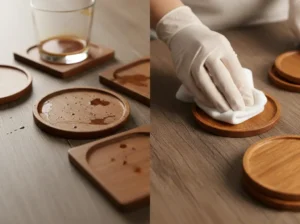
Unlike stickers or bottle openers — which get taken home and lost — a branded coaster stays on the table performing a real job: absorbing condensation, protecting furniture, and keeping the drinking surface dry. This functional role means the branding is never intrusive; it earns its place by solving a problem. Basswood coasters excel here because the wood’s natural porosity wicks moisture away from the glass, preventing the wet-ring problem that cardboard coasters fail to solve after the first drink.
The Dual Revenue Model
Smart tasting room operators stock two coaster SKUs: bar-service coasters (bulk, plain or lightly branded, used behind the bar) and retail coaster sets (gift-boxed packs of 4 or 6, sold at the register). The bar-service coasters pay for themselves through furniture protection and brand exposure. The retail sets generate direct margin — customers who just enjoyed a flight and admired the coaster under their glass are primed to buy a set to take home. This dual model turns a consumable supply expense into a profit center.
Wood Selection for Hospitality Coasters: Basswood vs. Bamboo
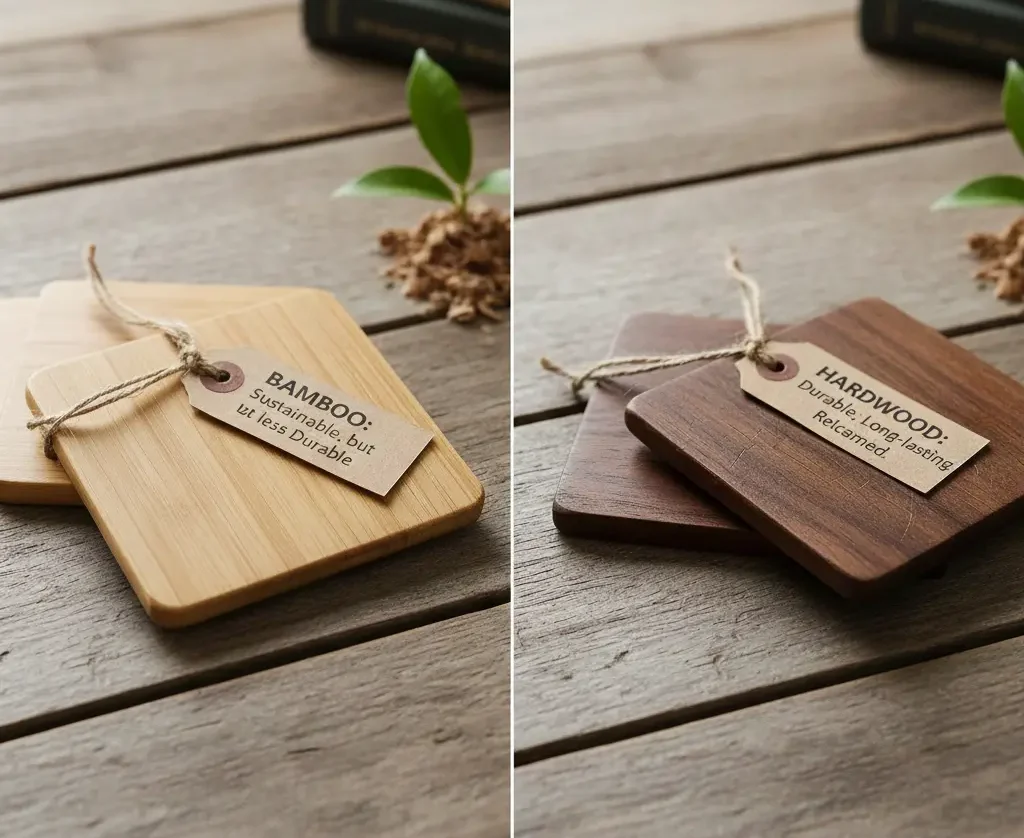
Basswood and bamboo are the two most practical wood choices for hospitality coasters, each with distinct advantages. Basswood offers superior laser-engraving contrast and natural moisture absorption. Bamboo provides higher hardness and a lighter color palette that suits modern taproom aesthetics.
| Property | Basswood | Bamboo |
|---|---|---|
| Engraving Contrast | High — dark burn on pale cream surface, logo pops clearly | Moderate — lighter base, engraved text visible but more subtle |
| Moisture Handling | Natural porosity absorbs condensation, reducing wet-ring pooling | Denser, less absorbent — better paired with a sealant coat for bar use |
| Durability (Bar Service) | Good — 410 Janka, withstands repeated use with occasional refinishing | Excellent — 1,380 Janka, highly scratch-resistant, longer service life |
| Aesthetic | Warm cream tone, fine grain, traditional wood feel | Light blonde, modern linear grain, suits contemporary taprooms |
Finish Options for Bar Environment Durability
For bar-service coasters that will see heavy use, we recommend a food-safe mineral oil finish that penetrates the wood grain and provides ongoing moisture resistance without creating a surface film that could peel. For retail sets, a matte polyurethane seal coat adds scratch protection and gives the coaster a polished, gift-ready appearance. Both finishes comply with food-contact safety standards — important for items that sit under drinking glasses.
Retail Coaster Sets: Turning Bar Customers Into Brand Ambassadors
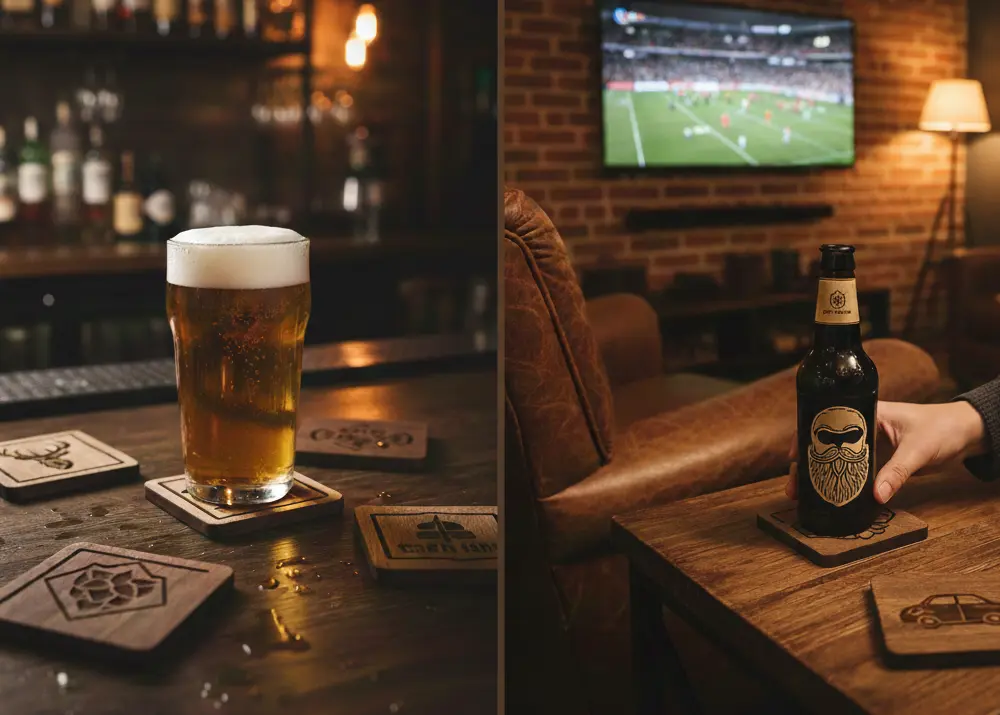
A guest who buys a branded coaster set at the register is not just generating $12–$18 in immediate revenue — they are taking the brewery’s logo into their home, where it will sit on their coffee table, home bar, or office desk for years. That’s brand exposure that no billboard or social media ad can match for cost per impression.
Packaging That Moves Product
Retail coaster sets sell best when packaged for impulse purchase at the register. A kraft gift box with a clear window showing one coaster, a belly band with the brewery’s logo, and a card explaining the wood’s origin creates an unboxing experience that justifies the retail price. Sets of 4 coasters in a box retail for $12–$18; sets of 6 with a matching holder tray retail for $22–$30. The wood, the engraving, and the packaging together create perceived value that supports these price points.
Display Placement in the Tasting Room
The most effective retail placement is not on a shelf — it is on the table where the customer is already using the product. Keeping a stack of boxed coaster sets at the register or on a display stand next to the exit captures the impulse buyer who just spent an hour looking at the coaster under their glass. One brewery reported that simply moving coaster sets from a back shelf to a countertop display next to the POS terminal tripled monthly retail sales of the item.
Custom Logo Engraving and Shape Options
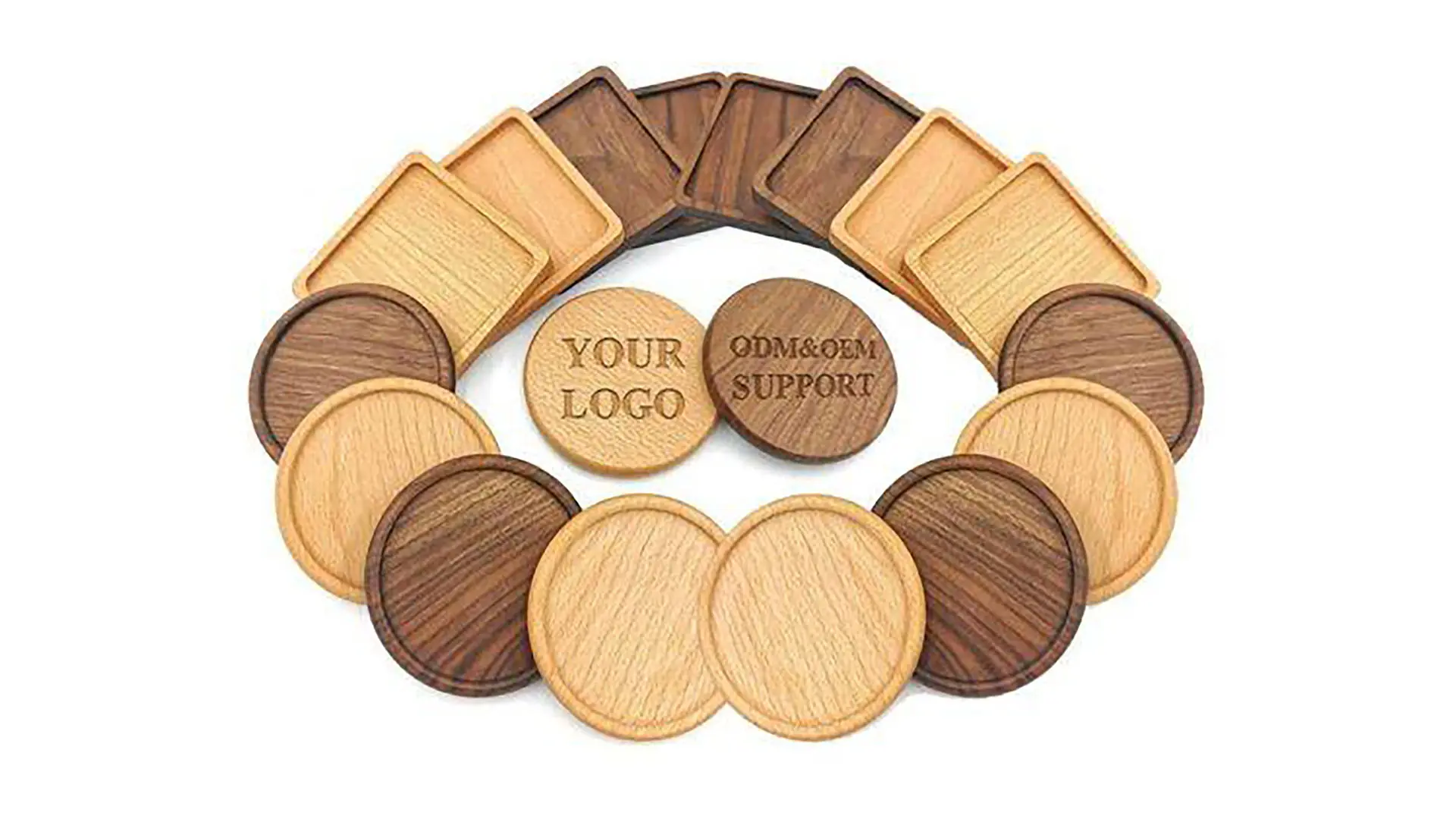
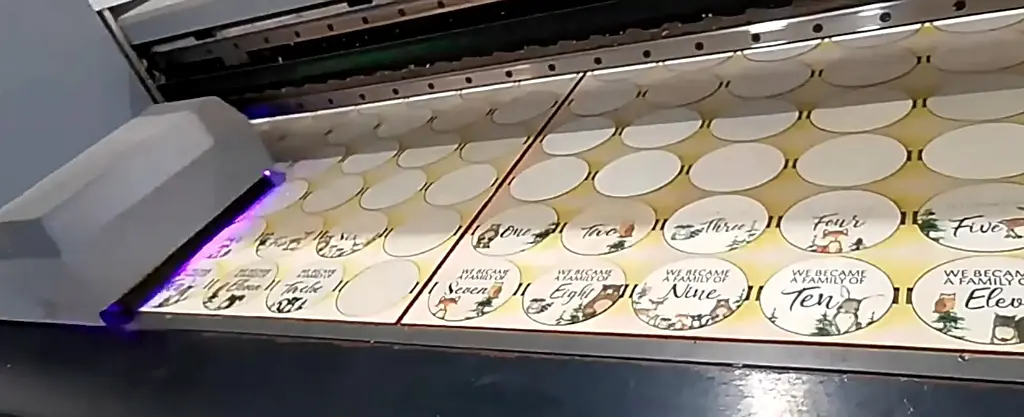
Laser engraving on wood produces a permanent, tactile brand mark that will not fade, rub off, or peel — critical for items that spend their life under wet glasses. Standard shapes include round (4″ diameter), square (4″x4″), and hexagonal, with custom die-cut shapes available for breweries wanting a distinctive silhouette that matches their brand identity.
Artwork Specifications
Laser engraving works from vector artwork — AI, EPS, SVG, or high-resolution PDF files. For best results on basswood coasters, logos should have clear contrast and avoid extremely fine lines below 0.5pt, which can lose definition in the wood grain. Our design team reviews every file and provides a digital proof within 48 hours. Multi-logo orders — different designs for different beer styles, seasonal releases, or anniversary editions — can be produced in a single batch run with no additional setup cost per design variation.
Best For / Not For: Coaster Format by Venue
Brewery tasting room coasters are a merchandising decision, not a supplies purchase, and the format that works depends entirely on where the coaster lives after it leaves your loading dock. The four formats below cover most hospitality orders; the “not for” column is the one that saves money.
| Format | Best For | Not For | Order Reality |
|---|---|---|---|
| Bar-service bulk round, lightly branded | High-turnover taprooms, festival pours, beer gardens where coasters are consumed as service stock | Register sales — no packaging, no perceived gift value | 200-piece minimum; reorders are the norm, so lock the artwork once |
| Boxed retail 4-pack kraft box, window, belly band | Tasting room registers, gift shops, take-home souvenirs at the $12–$18 retail point | Back-of-house service use — the packaging cost is wasted if the box is opened at the bar | 100 sets minimum (400 coasters); window alignment is a separate QC step |
| Custom die-cut shape hop cone, bottle outline, state map | Brand-led venues where the silhouette is recognisable across the room, and social photography | Tight budgets or first orders — tooling amortises only across volume | Die tooling is a one-time cost; shapes with thin points chip and should be redrawn |
| Large-format flight pad rectangular, fits tasting sheet | Winery and distillery flights of 4–6 glasses plus a printed tasting note | Crowded bar rails and standard glass racks — the footprint does not fit | Larger blank means more warp risk; thickness and finish must both be specified |
Retailers buying for resale rather than for a single venue should think in fixture terms, not SKU terms: how many facing does the register impulse zone actually have? Our planogram basics guide covers the arithmetic, and the channel-fit logic in museum store versus gift shop selection explains why a boxed coaster set sells in one room and dies in another.
What We Check Before a Coaster Order Ships
Coasters fail in wet environments, and a hospitality buyer finds out about a failure on the busiest Saturday of the season. These are the checks we run on every run, listed so you can ask any supplier the same questions.
- Condensation cycling. Samples go through repeated wet-and-dry cycles to confirm the blank does not cup, warp, or delaminate at the engraving.
- Moisture content at blank stage. Coasters are checked against our wood moisture content standard before finishing, because a blank that is too wet will move after it ships.
- Food-contact finish verification. Any finish on a bar-service coaster is confirmed against FDA food-contact substance requirements, and we keep the finish specification on file for the buyer’s own compliance records.
- Engraving contrast after finishing. Laser marks are inspected once the oil or lacquer is cured, not before; a finish can drop contrast below legible under bar lighting.
- Edge and surface safety. Edges are sanded round so a wet coaster never leaves a splinter on a bar top or in a guest’s hand.
- Dimensional tolerance across a boxed set. All four coasters in a retail set must sit flat and stack square, or the box window shows the mismatch.
- Packaging proof. Box, insert, and belly band are assembled with real product before the run, since window position and insert depth are the two most common packaging defects.
Buyers who want to audit a supplier rather than trust one should work from our wood carving factory audit checklisthttps://ewoodarts.com/wood-carving-factory-audit-checklist/, which turns these checks into questions you can ask on a factory visit.
End to End: A 1,000-Coaster Tasting Room Program
A regional craft brewery opens a second taproom and wants coasters doing two jobs: service stock behind the bar and a take-home item at the register. The order is 600 bar-service rounds and 100 boxed 4-packs (400 coasters), one logo, two finishes.
Week 1 — format split and artwork intake. The buyer confirms quantities per format and sends vector logo files. Artwork is checked for engraving viability: hairline strokes, reversed type, and small serif detail are redrawn before anything is cut, because those elements vanish in wood at production scale.
Week 2 — material and finish decision. Basswood for engraving crispness on the retail sets, with the food-safe mineral oil finish on the bar-service rounds. Species trade-offs are covered in our wood characteristics reference.
Week 3 — physical sample approval. One bar-service coaster and one boxed set ship to the buyer. The box is assembled, not mocked up, so the window alignment and insert fit are judged on the real thing. Production does not start until the sample is approved in writing.
Weeks 4–6 — production and inline QC. Blanks are cut, sanded, engraved, finished, and cured. The checks above run inline so a warping problem is caught early in the run rather than at final inspection. The procedural detail sits in our procurement guide for wooden crafts.
Week 7 — final inspection and packing. Bar-service rounds pack in bulk cartons; boxed sets pack flat with inserts and belly bands applied, so the taproom team can put them straight on the register shelf.
Weeks 9–11 — transit and delivery. Ocean transit plus destination handling, timed to land before the taproom’s opening weekend. Operators planning a second venue should treat the coaster reorder as a standing line item, and can compare it against the rest of the wholesale wooden crafts range they are already buying.
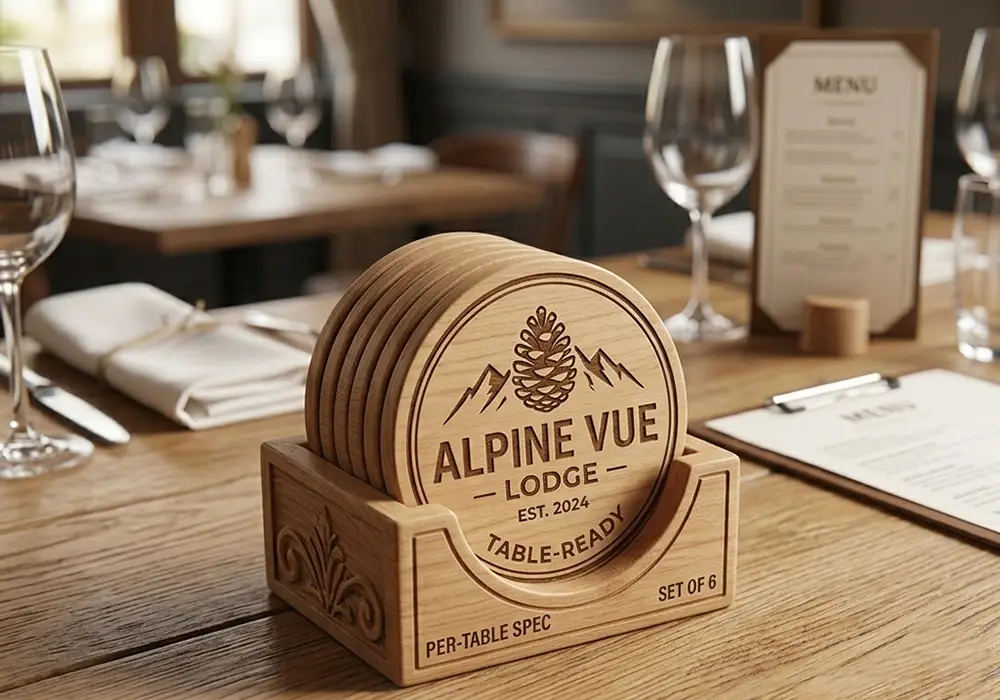
Wineries, Distilleries, and Coffee Roasters: Expanding Beyond Beer
While breweries pioneered the branded coaster model, wineries and distilleries represent a fast-growing second wave. Wine tasting rooms favor larger-format coasters (5″x5″ or 6″ round) that accommodate a glass and a tasting notes card side by side. Spirits distilleries and third-wave coffee roasters prefer darker wood tones and minimalist engraving that matches their premium brand positioning.
Winery Tasting Room Requirements
Wine tasting rooms present unique coaster requirements. The typical tasting flight involves 4–6 glasses per guest, often with a printed tasting sheet — meaning the coaster must be large enough to hold the glass plus the card without crowding. A 5″ or 6″ round basswood coaster provides this footprint while maintaining the elegant aesthetic that wine brands demand. Engraving tends toward subtle single-color logos rather than multi-design beer-style variations. Winery orders also trend toward higher retail-set ratios — wine tourists are more likely to purchase souvenir items than beer taproom visitors.
Spirits and Coffee: The Premium Niche
Craft distilleries and specialty coffee roasters operate smaller, more intimate tasting spaces where perceived quality matters more than volume. These buyers typically order 100–200 bar-service coasters and an equal number of retail sets, favoring darker woods or bamboo with minimalist, elegant engraving. The coaster becomes part of the brand’s premium positioning — an item that signals quality before the customer takes the first sip. For these venues, a coaster that feels substantial in the hand (thicker stock, beveled edges, smooth finish) is as important as the logo it carries.
Frequently Asked Questions
What is the minimum order for custom brewery coasters?
The minimum order is 200 pieces for bar-service coasters and 100 boxed sets (4 coasters per set) for retail. Mixed designs — different logos for different beer styles — can be combined within the same minimum quantity.
How do wooden coasters hold up to repeated wet glass contact?
Basswood coasters with a food-safe mineral oil finish absorb condensation and resist water damage for hundreds of uses. For extended bar service life, we recommend periodic re-oiling (every 3–4 months in high-volume venues). Bamboo coasters require less maintenance due to their higher density.
Can you produce coasters in custom shapes for our brewery?
Yes. Custom die-cut shapes — such as your brewery’s logo silhouette, a hop cone, a wine bottle outline, or a state-shaped coaster — are available with a one-time mold fee. Development takes 4–6 weeks, and the minimum order for custom shapes is 500 pieces.
What packaging options are available for retail coaster sets?
Standard retail packaging includes a kraft gift box with a clear PVC window, foam insert, and belly band. Custom-printed boxes with your brewery’s branding are available for orders of 300+ sets. Each box includes a care instruction card.
Are the finishes food-safe for bar service use?
Yes. All finishes used on bar-service coasters meet food-contact safety standards. We use food-grade mineral oil and beeswax for natural finishes, and water-based polyurethane for sealed retail coasters. Documentation is available for health department compliance.